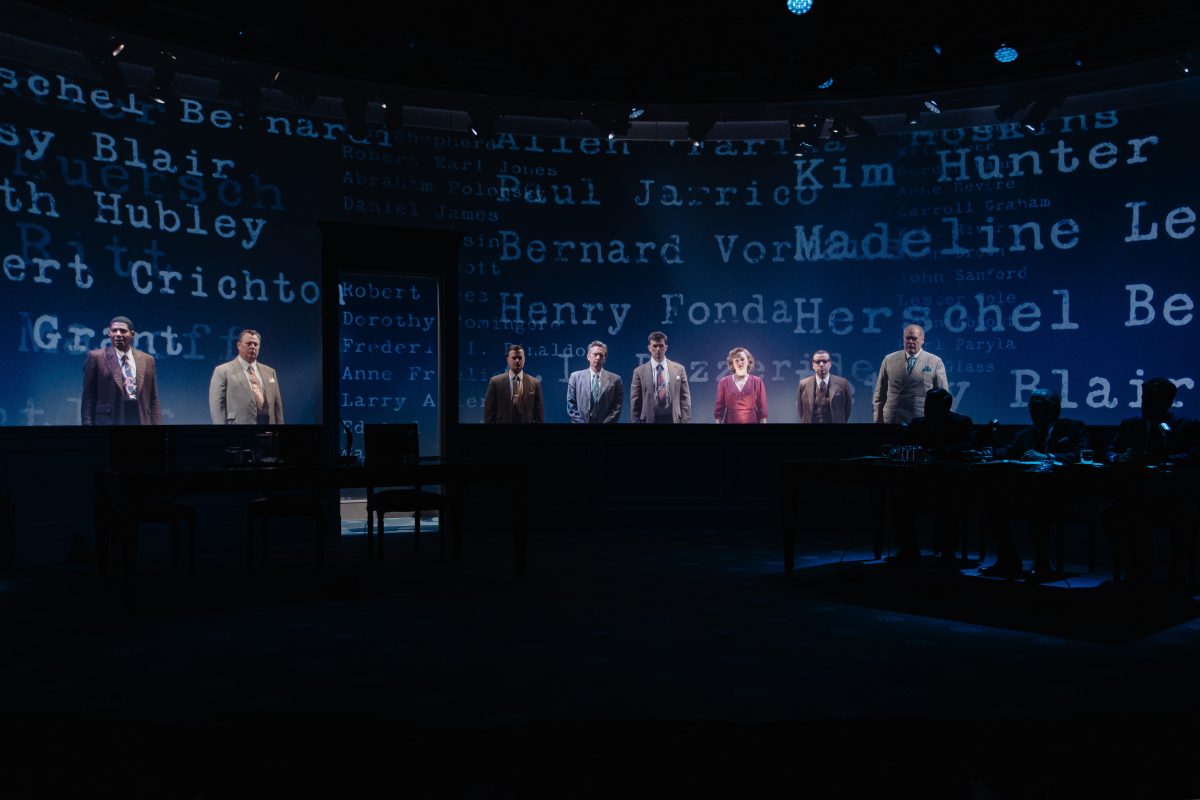
The revival of Eric Bentley’s gripping docudrama Are You Now or Have You Ever Been opened at New York City Center this month. As the first New York revival since the original 1979 Broadway run, this production is invigorated by Tony Award-winning director Anna D. Shapiro, who underscores the enduring relevance of a politically intolerant chapter in American history through masterfully raw and comedically nuanced performances by a rotating cast.
Jason Babinsky, Michael McKean, and Adam Kantor in Are You Now or Have You Ever Been. Photo by Marc J. Franklin
Based on original transcripts from the 1940s House Un-American Activities Committee hearings investigating alleged Communist influence in Hollywood, this production brings a decades-old period of paranoia and civil unrest to life through a blend of applause-worthy testimonies and laugh-out-loud quips. In the current cast, Ben Rappaport and Billy Eugene Jones deliver authentic and commanding performances as Larry Parks and Paul Robeson, capturing the hearings’ emotional toll through expressions of internal conflict, disillusionment, and resistance. Scott Adsit provides sharp comic relief as the hilariously eccentric Abe Burrows, using offbeat humor to lighten the production’s heavier political tone. Other notable performances include the committee members, played by Michael McKean as the Chairman alongside Jason Babinsky and Adam Kantor, who are chillingly apathetic and authoritarian, making the play’s themes feel unsettlingly contemporary. While communism is no longer perceived as an internal threat, the dangers of governmental overreach remain as relevant as ever.
Billy Eugene Jones in Are You Now or Have You Ever Been. Photo by Marc J. Franklin
The must-see theatrical event of the summer, Are You Now or Have You Ever Been—starring Brooks Ashmanskas, Jason Babinsky, Steven Boyer, Adam Kantor, Frederick Weller, Michael McKean, and guest stars Bob Odenkirk, Santino Fontana, Norbert Leo Butz, Steven Pasquale, Molly Ringwald, Billy Eugene Jones, David Krumholtz, Thomas Sadoski, and more—is in performances through September 11, 2026 at New York City Center Stage I.
Andrew McCarthy in Are You Now or Have You Ever Been. Photo by Marc J. Franklin
There is a distinct kind of magic that occurs when a century-old theatrical artifact is dusted off, popped and primed, then poured out for a contemporary audience, like a frosty bottle of expensive champagne. When Roundabout Theatre Company announced their major Broadway revival of Noël Coward’s initially-taboo 1925 comedy, Fallen Angels, at the beautifully renovated Todd Haimes Theatre, insiders and stage fans alike responded with immense curiosity. Could a drawing-room farce centered on upper-class British housewives pining over a shared pre-marital French lover still resonate, let alone provoke the raucous belly laughs required of a premium Broadway ticket today?
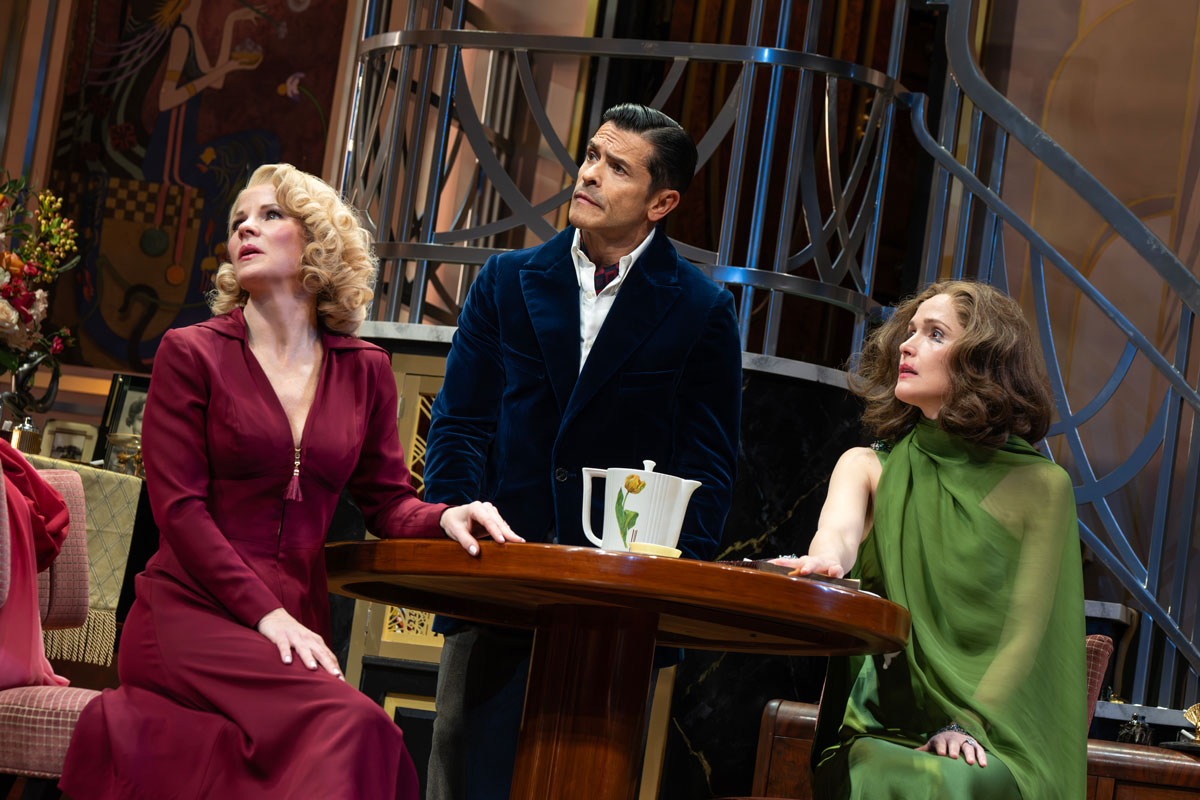
Rose Bryne and Kelli O’Hara in Fallen Angels on Broadway. Photo by Joan Marcus.
The overwhelming answer is yes. Under the witty direction of Tony Award nominee Scott Ellis, the intermission-free production is a flawless display of comedic timing, distinguished clowning, and shameless escapism. Museum-piece preciousness of the Art Deco era is replaced with a relentless, dizzying energy that channels the best of classic Hollywood screwball comedies, albeit while dripping in silk and feathers. Led by a dream-team of femme power, Tony winner Kelli O’Hara and Golden Globe winner Rose Byrne, Fallen Angels does more than simply entertain; it serves as a gorgeous and hilarious, hour-and-a-half reminder of how profoundly fresh pure theatrical fun can be.
Walking into the new Todd Haimes Theatre feels less like entering a cavernous Broadway house and more like being invited into an exclusive, upscale mid-1920s salon. The perfect location to tell this story. But this is also a venue designed for shared amusement, providing the ideal acoustic chamber for the fits of laughter that will undoubtedly plague the audience.
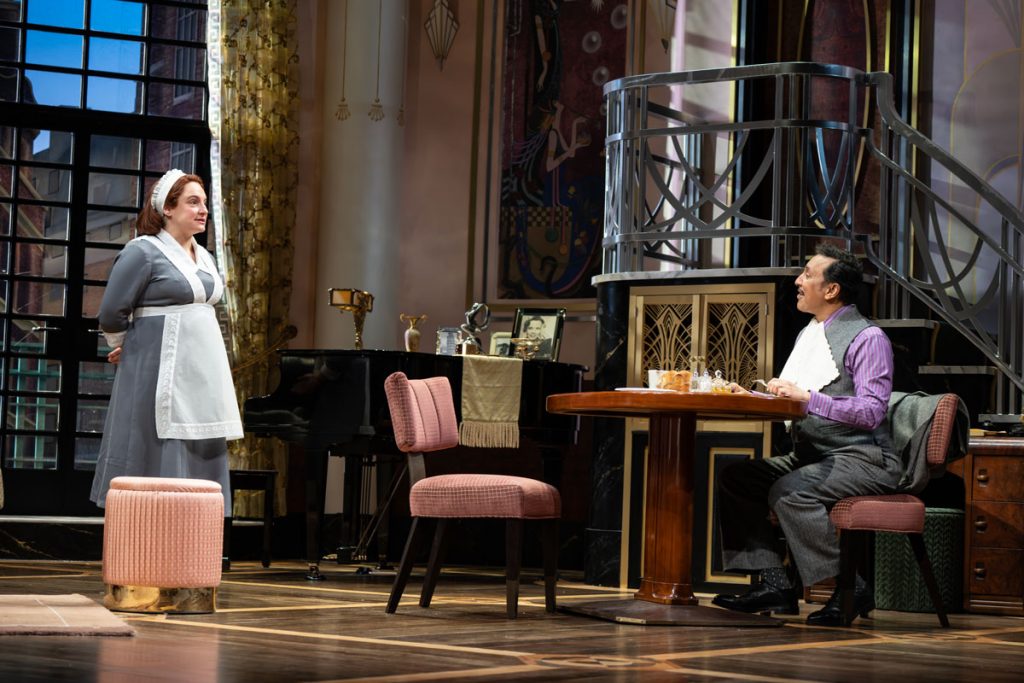
Tracee Chimo and Aasif Mandvi in Fallen Angels on Broadway. Photo by Joan Marcus.
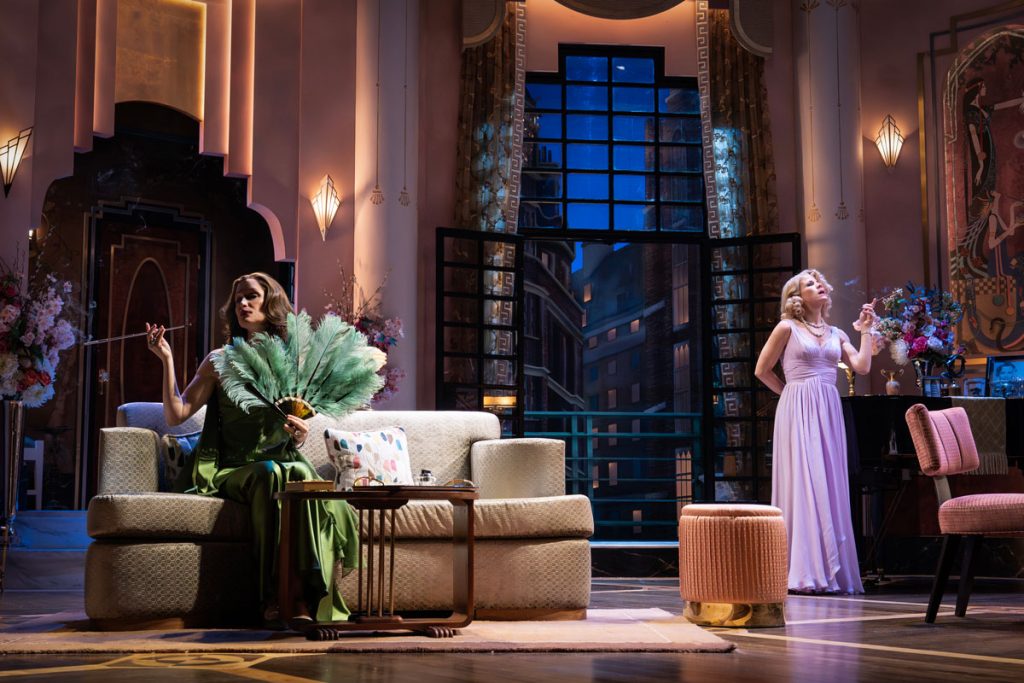
Set and vibe designer, David Rockwell, has outdone himself with this one, constructing a luxurious and stately London drawing room that is a colorful feast for the eyes. Expect rich textures, deluxe furnishings, architectural flourishes, and an expansive layout that gives the actors ample room to slide, stumble, and stomp during their most unhinged physical sequences. The set feels grounded in its period historical accuracy, yet vibrant and cinematic enough to look entirely alive. Matching Rockwell’s memorable space is the work of costume designer Jeff Mahshie. The garments worn by Byrne and O’Hara are nothing short of frothy. From the draped, fluid lines of silk pajamas to more structured, glamorous evening wear, Mahshie’s dressings capture the reckless indulgence of the Roaring Twenties with gilded precision. The wardrobes act as a brilliant comedic foil, as the characters’ internal composure completely unravels, their external wardrobe remains stubbornly glamorous, heightening the delicious absurdity of the affair.
While Fallen Angels is largely driven by its two delightful leading ladies, the revival’s supporting cast also promises that the momentum never falters when the spotlight shifts away from the central sofa. Tracee Chimo plays the newly hired, brilliant and outspoken maid, and is a scene-stealing delight. Saunders prides herself on a life of endless past experiences in which she feels inclined to serve the ladies, as often as a fresh glass of bubbles. Whenever Chimo enters the scene, you can expect a haughty punchline to follow.
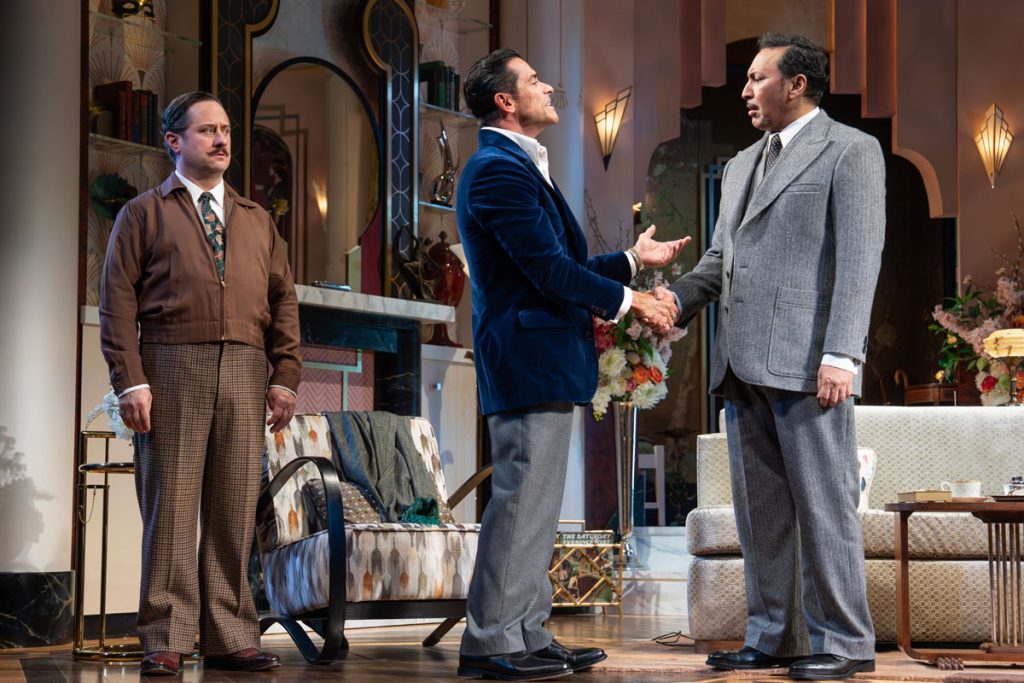
Christopher Fitzgerald, Mark Consuelos and Aasif Mandvi in Fallen Angels on Broadway. Photo by Joan Marcus.
In a Broadway landscape that often leans into moody dramas or massive, highly-engineered spectacles, Fallen Angels rises to the surface as a hilarious love letter to the art of the actor. It does not ask you to dig deep, nor does it seek to resemble the heavy anxieties of the modern world. Instead, Fallen Angels offers a glorious, unadulterated escape into a ninety-minute sanctuary of laughs, messy glitz and glamour, and memorable, standout performances. See it before it ends on June 7!
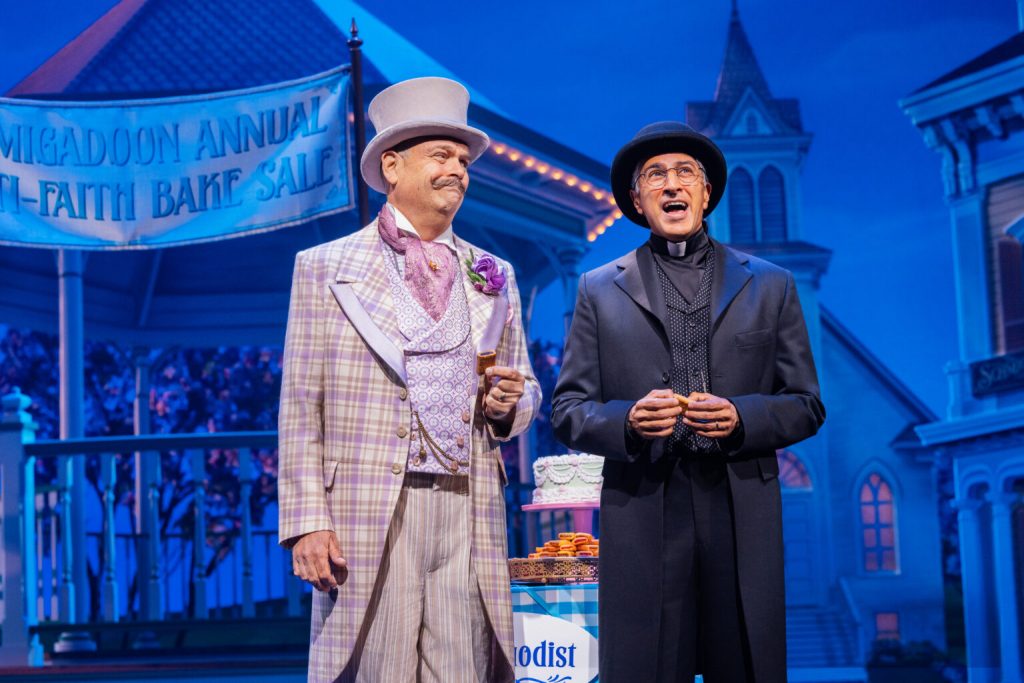
In deeply unsettling political times, art can provide essential commentary or essential escapism. Schmigadoon, the loving sendup of Golden Age Broadway musicals based on Cinco Paul’s Apple TV series, is wholly the latter. Like the Celine Dion jukebox musical parody Titanique, reviewed here, it’s silly, campy, and self-aware. Where Titanique is full of references catering to fans of Dion, LGBT culture, and Titanic, Schmigadoon is by and for lovers of traditional musical theatre and is somewhat less niche in its references — and it sticks the landing even better.
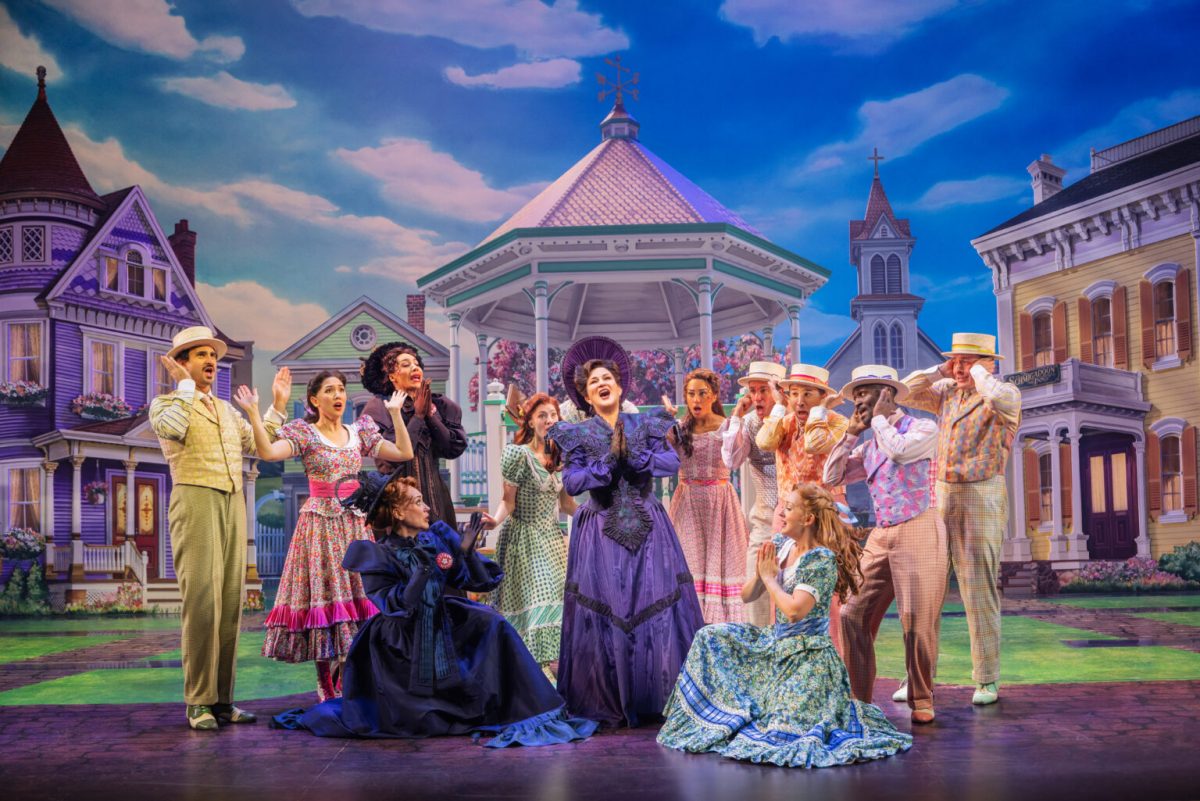
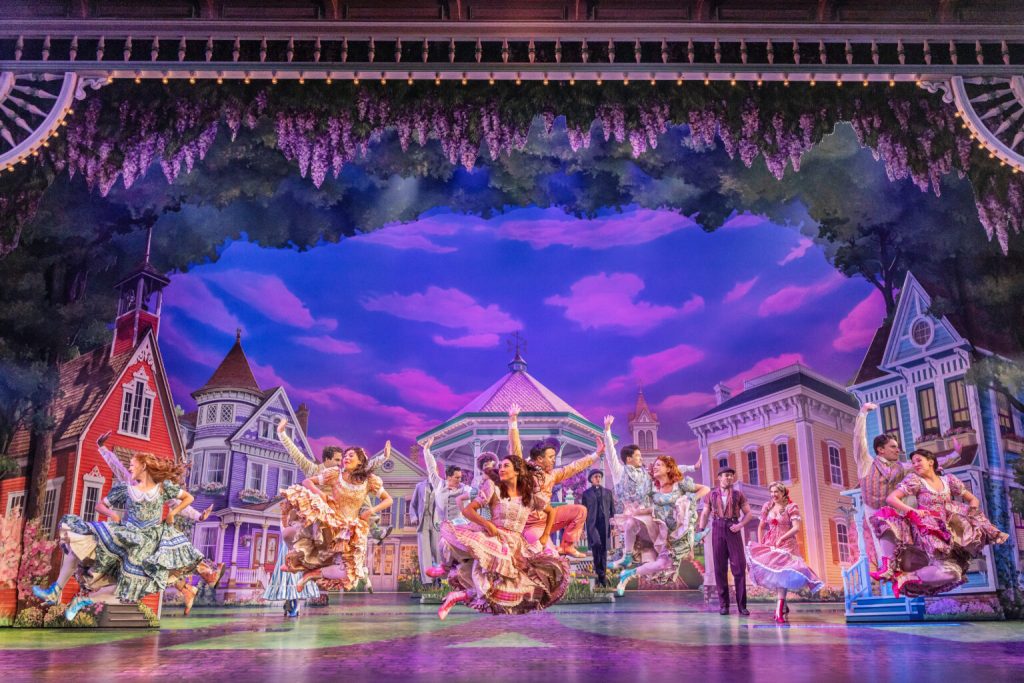
The cast of Schmigadoon!. Photo by Matthew Murphy and Evan Zimmerman.
Schmigadoon is pure escapism and a laugh riot directly adapted from but exceeding the impact of its television predecessor. The plot, much of the dialogue, and most of the songs (all by Cinco Paul) are largely unchanged from the series, but a loving parody of an art form in that art form — the traditional two-act structure with a live audience, rather than a six-episode TV show — hits different. In other words, the piece needs laughter to break the fourth wall and remove any seriousness from the narrative, and at the Nederlander Theatre, you are encouraged to laugh at absolutely everything. Parodies are meant to be enjoyed in a group setting!
At Schmigadoon, you don’t need to know Brigadoon or to have watched the Apple series to love it start to finish. What you will need is some prior exposure to traditional Broadway musicals like Oklahoma!, The Music Man, and The Sound of Music, which most do. I’d wager you’d enjoy Schmigadoon without it (it’s less inside joke-based than Titanique) but it’s best if you can catch the clear references to the classic showtunes the musical lovingly parodies and interpolates. You’ll laugh regardless, but if you’re a theatre buff, you’ll catch all the jokes, which come constantly. And unlike Titanique’s (deliberately!) low-budget set and costumes, Schmigadoon makes fun while providing classic Broadway musical production value — multiple sets, an ensemble of top-tier dancers, and all the bells and whistles.
But the show’s heart is in its satire of classic musical motifs. Each number references classic songs while parodying their cliche nature. Our leads are Josh and Melissa (Alex Brightman and Sara Chase), a couple looking to reignite the spark on a hiking retreat, who get lost and stumble upon a peculiar town called Schmigadoon, where townspeople burst into song spontaneously (something Melissa lives for and Josh abhors). Soon, they learn this isn’t like Colonial Williamsburg, but that they’re living inside an actual classic musical set in the 1940s (ish…the inconsistent era in which it takes place is a running joke). And they seemingly can’t leave.
Alex Brightman and Ayaan Diop in Schmigadoon!. Photo by Matthew Murphy and Evan Zimmerman.
The rest of the cast is composed of the Schmigadoonians they meet, all directly pulled from the Apple series that starred an ensemble of bigger names than this adaptation. I dare say the cast improves upon each performance — there are no weak links to be found. Perhaps it’s not so shocking that a cast of Broadway triple threats best parody Broadway musicals, but the onstage structure and live audience surely help. The one exception is Ann Harada, reprising her role from the TV series as the mayor’s ditzy wife. Her husband, who is harboring a secret, of course, was Alan Cumming onscreen and is now Brad Oscar.
Two deserving performers in the cast received Tony-nominations among the show’s 12. One is the hilarious Sara Chase, recognizable to some from Unbreakable Kimmy Schmidt, who adapts Cecily Strong’s onscreen role as Melissa and blows the roof off the Nederlander vocally. The other is Ana Gasteyer as Mildred Layton (Kristin Chenoweth onscreen), the reverend’s conservative wife, who deliver’s Act 2’s biggest showstopper, “Tribulation,” a brilliant satire of “Ya Got Trouble” from The Music Man. As we expect from the SNL legend, Gasteyer chews the scenery with every line delivery and delivers her signature belting riffs (though the people want even more!).
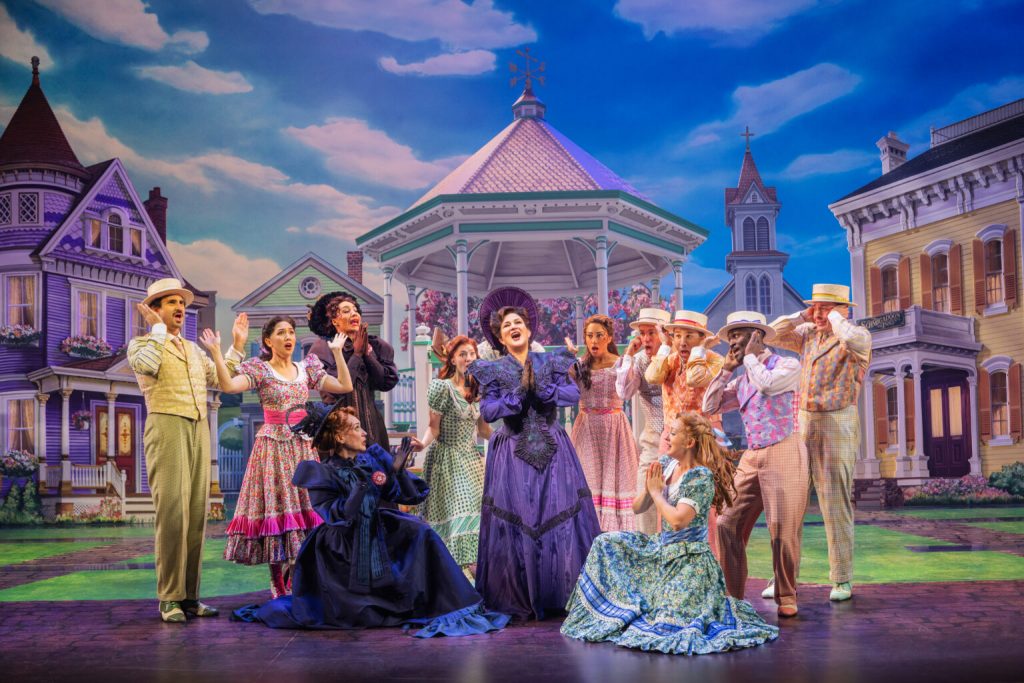
Ana Gasteyer and the cast of Schmigadoon!. Photo by Matthew Murphy and Evan Zimmerman.
While Gasteyer slays Act 2, when she’s most featured, I do want to shout out one cast member who was not recognized by the Tonys but delivers a genius comic performance in Act 1. McKenzie Kurtz, as promiscuous waitress and Josh’s love interest Betsy, hams up Dove Cameron’s performance in the role onscreen tenfold. Everything Betsy says and does is hilarious, and, as a former Glinda in Wicked, she has the vocals to match. Other standouts include Max Clayton as Melissa’s love interest, bad boy Danny Bailey (Aaron Tveit onscreen), as well as Isabelle McCalla, a terrific vocalist, as schoolmarm Emma Tate (Ariana DeBose onscreen).
The Apple TV series’ choreographer, Christopher Gatelli, handily takes the reins directing the stage adaptation, so it’s no surprise the plot and dancing directly mirror the source material. There are some welcome updates, including original songs written for the stage, which made Paul eligible for the Best Score Tony nomination — unlike last season’s Smash, which took its entire score from the NBC series.
The strongest songs here still come from the TV show, and of course, almost all of them are direct interpolations of existing classic showtunes, so he likely won’t win in that category. The Kiss Me, Kate-inspired song “I Always, Always, Never Get My Man,” performed onscreen by Jane Krakowski as a character based on The Sound of Music’s Baroness Elsa von Schraeder, is notably cut onstage and the role reduced. Thankfully, we still get Paul’s hysterical and raunchy sex-ed parody of Maria’s repeat-after-me “Do-Re-Mi.”
Brad Oscar and Maulik Pancholy in Schmigadoon!. Photo by Matthew Murphy and Evan Zimmerman.
There are several new one-liners in Paul’s updated book that are nearly perfect. And there’s one new key plot point — the traditional Act 2 tragic death trope a la Oklahoma! — which is folded in brilliantly and so ridiculously you won’t feel an iota of melancholy. Paul’s super smart addition of something dark in the lightest way possible really solidifies the show’s unapologetically campy and silly tone.
Many songs directly reference recognizable musical theatre cliches, like Clayton’s “You Can’t Tame Me,” Kurtz’s Ado Annie-coded “Not That Kinda Gal,” and Chase and Harada’s duet “What’s The Matter With Men?” — the last two of which are new to the stage adaptation. When Schmigadoon reaches its finale “How We Change,” aptly named for yet another end-of-a-musical motif, the audience has been taken on a joy ride that hilariously pokes fun of and pays tribute to the classic Broadway shows we know and love.
Visit Schmigadoon to escape the real world at the Nederlander Theatre. It’s one of the funniest and most joyful productions the season, and unlike Melissa and Josh, you’ll only be stuck there for a couple hours.
Broadway is no stranger to adaptations of films, though often they’re reimagined as musicals. Dog Day Afternoon, which opened March 30 at the August Wilson Theatre, is the somewhat rarer example of a nonmusical play adapted from a classic film. It tells the same story as the Oscar-winning 1975 movie, but with a new script and certain directorial choices that make it distinctly more comedic. While diehard fans of the film will struggle with these changes – as some critics did – those who can put their purism aside, or those going in blind, will greatly enjoy this fast-paced, funny, and deeply entertaining play as its own work of art.
Photo by Evan Zimmerman
Sidney Lumet’s Dog Day Afternoon starred Al Pacino and John Cazale and won Frank Pierson Best Original Screenplay at the Academy Awards. It was categorized as a crime drama based on a Life magazine article about a real 1972 bank robbery in Brooklyn. Here, Jon Bernthal and Ebon Moss-Bachrach (both known for The Bear, amongst other film and TV projects) star in Pacino and Cazale’s roles with a new, darkly comic script by Pulitzer Prize-winning playwright Stephen Adly Guirgis.
Bernthal gives his all as the play’s lead, Sonny, and commands the stage with ease in his Broadway debut. His friend and sidekick in the attempted robbery of a Chase branch in Gravesend is Sal, played as very intoxicated and sedated by Moss-Bachrach. While he’s billed second, his role is significantly smaller and less impactful. The robbery goes wrong, of course, and hilarious chaos ensues as the bank staff are held hostage by very incompetent captors.
If there is a cast member other than Bernthal who deserved recognition from the Tonys, it’s not Moss-Bachrach, but three-time nominee Jessica Hecht, who is hilarious as head teller Colleen. Like the script as a whole, she successfully goes for the laughs while still revealing inner turmoil as the play goes on and stakes are raised with the NYPD surrounding the bank. Colleen’s employees, Roxxana (Elizabeth Canavan), Lorna (Wilemina Olivia-Garcia), Alison (Andrea Syglowski), and Guadalupe (Paola Lazaro), and her boss, Butterman (Michael Kostroff), provide more comic relief.
While the play is over two hours long and its intermission is welcome, there’s a shift in content in the second act which comes abruptly. Fans of the film won’t be surprised by Sonny’s queer identity reveal, as it featured representation that was ahead of its time. Others may find it jarring, as without any references in the first act, it first seems like a joke. Luckily, Esteban Andres Cruz plays Sonny’s partner Leon, a trans woman, with a devastating humanity that is still funny, showing the audience that while Leon can tell jokes, she isn’t one herself.
There’s more than LGBTQ representation that feels politically progressive for a play set over 50 years ago. The humanization of and compassion between the robbers and bank workers is at the center of the narrative, where the villains, if there are any, are police officers. It’s simultaneously relatable — working class tellers and would-be thieves have more in common with each other than with the systems that oppress them — and it’s also very charming. There’s even an interactive anti-establishment chant with the audience.
Unlike The Bear, an intense drama series categorized as a comedy by the Emmys, Dog Day Afternoon reworks the dramatic cinematic masterpiece that inspired it to a crime comedy. Sometimes reimagined pieces of art are disastrous and deserve to be forgotten. But in the case of Dog Day Afternoon, comparison is the thief of joy. It’s interesting, suspenseful, and well-acted – and the comedy doesn’t take away from its impact. Those unfamiliar with this fascinating story will be hooked by the plot and will stay for the laughs. Those planning to see a remake of the film onstage should keep an open mind – and you might enjoy it just as much.
Dog Day Afternoon runs through July 12 at the August Wilson Theatre.
With yesterday’s Tony nominations announcement, the 2025-2026 Broadway season has come to a close. Full of ups and downs, hits and flops, and some big surprises, the season’s offerings spanned genre, budget, and tone, including some of the more intense productions in recent memory (Oedipus, Bug, and Ragtime, to name a few). Titanique, the newly opened Titanic parody/Celine Dion jukebox musical, which received four Tony nominations, is firmly in another camp – the campy camp, to be specific! And unlike the infamous doomed voyage that inspired it, this show delivers exactly what it sets out to.
A transfer from its hit Off-Broadway run at the Daryl Roth Theatre, Titanique has set sail at the St. James, a large, three-level, traditional Broadway theater that generally houses big-budget or classic musicals. There are a few added bits and a larger set, but the satirical, referential script and the dinky costumes/props to match the tone are unchanged. Those expecting flawless vocals, perfectly tight choreography, and expensive costuming that most Broadway musicals provide may be briefly taken aback by the kitsch factor in a huge venue that hosted Sunset Boulevard last season – but most will get used to the vibe as the lower-budget, lower-brow, high-camp parody it’s meant to be. Lovers of the Off-Broadway run would only be disappointed if they expected the transfer to reinvent the wheel and rework itself into a bigger show more traditionally suited for The Great White Way. Titanique is a parody a la Forbidden Broadway, so it does not and does not intend to do so.
For those who missed it and are wondering if it’s now worth the trip… ‘shall we go for it?’ First, ask yourself if you’re a fan of any of the following: 1) Titanic, the 1997 film; 2) Celine Dion’s personality and discography; 3) theatre-related inside jokes; and 4) near-constant references to gay/LGBTQ culture. If you feel nothing for these four topics, I’d look elsewhere. But if you enjoy multiple or all of them, like this reviewer, you’ll feel it’s a tailor-made extravaganza conceived from the corners of your own mind.
In fact, Titanique is conceived by original stars Marla Mindelle and Constantine Rousouli with director Tye Blue, whose laugh-a-minute book was just Tony-nominated, alongside the production for Best Musical. Mindelle stars as emcee/narrator Celine Dion, retelling her version of the Titanic story with her own catalogue of music, save for “It’s All Coming Back to Me Now” (rights issue). Rousouli plays Leonardo DiCaprio’s Jack Dawson appropriately and hilariously as an dancing, “aging twink” in tight pants earnestly wooing Rose. Mindelle is a genius impressionist and deservedly received one of the show’s two acting nominations, even if her and Rousouli’s vocals may not match the level of certain costars, or, of course, Celine herself.
Layton Williams, photo by Evan Zimmerman
The other Tony-nominated actor is vocal standout Layton Williams, who won an Olivier Award for originating this track on London’s West End – I won’t spoil which legendary songstress the Iceberg transforms into for a showstopping drag number. Vocally, the other standouts were John Riddle as Cal, Rose’s fiancé, also reprising his role from off-Broadway, and cast newcomer (but longtime music veteran) Deborah Cox as the “unsinkable” Molly Brown, whose “All By Myself” blows the roof off the St. James.
Along with Cox, the new additions to the Broadway transfer are Melissa Barrera as Rose, Frankie Grande as Victor Garber as the ship’s captain, and Jim Parsons as Rose’s bitter mother Ruth. While Williams, Riddle, and Cox’s vocals often outshine other cast members, the strongest comedy comes courtesy of Mindelle as Dion and, perhaps more unexpectedly, Jim Parsons (Our Town, The Big Bang Theory) as an iconically scene-stealing Ruth. His voice is the least strong, but it simply doesn’t matter due to the character’s deadpan one-liners and slapstick comedy, complete with slaps. In sum, what certain performers like Jim Parsons or Marla Mindelle may lack in vocal prowess they more than make up for in their comedy, while Deborah Cox and Layton Williams are there to provide the classic top-tier Broadway belting needed to balance it. It feels apt that one of the comic standouts (Mindelle) and one of the vocal showstoppers (Williams) were those singled out by the Tonys, along with Mindelle, Blue, and Rousouli’s hilarious script.
Photo by Evan Zimmerman
At times, Titanique is silly, campy, stupid, ridiculous, amateur, and farcical. It’s also laugh-out-loud funny and a delight from start to finish. No, it will not be everyone’s cup of tea or sense of humor, and many without prior connections to Dion, Titanic, Broadway shows, or queer culture may find a lot is lost in translation, leaving them underwhelmed by a low-budget parody on a Broadway stage, with prices to match. But those who get it will get it. If you’ve ever enjoyed a karaoke singalong to “My Heart Will Go On,” a RuPaul’s Drag Race “lipsync for your life” reenactment, a fully improvised fourth-wall-breaking section, or an SNL parody, book yourself a voyage on Titanique – it’s a gay old time.
The current Broadway season of plays is full of high-stakes drama, intensity, topicality, and stellar performances. Oedipus, for example, is gripping and haunting. Marjorie Prime is powerful and deeply relevant. Neither is light viewing — you’ll leave shellshocked — but both are effectively thought-provoking, top-tier dramatic theatre. If you liked either of those, add Bug to your list now.
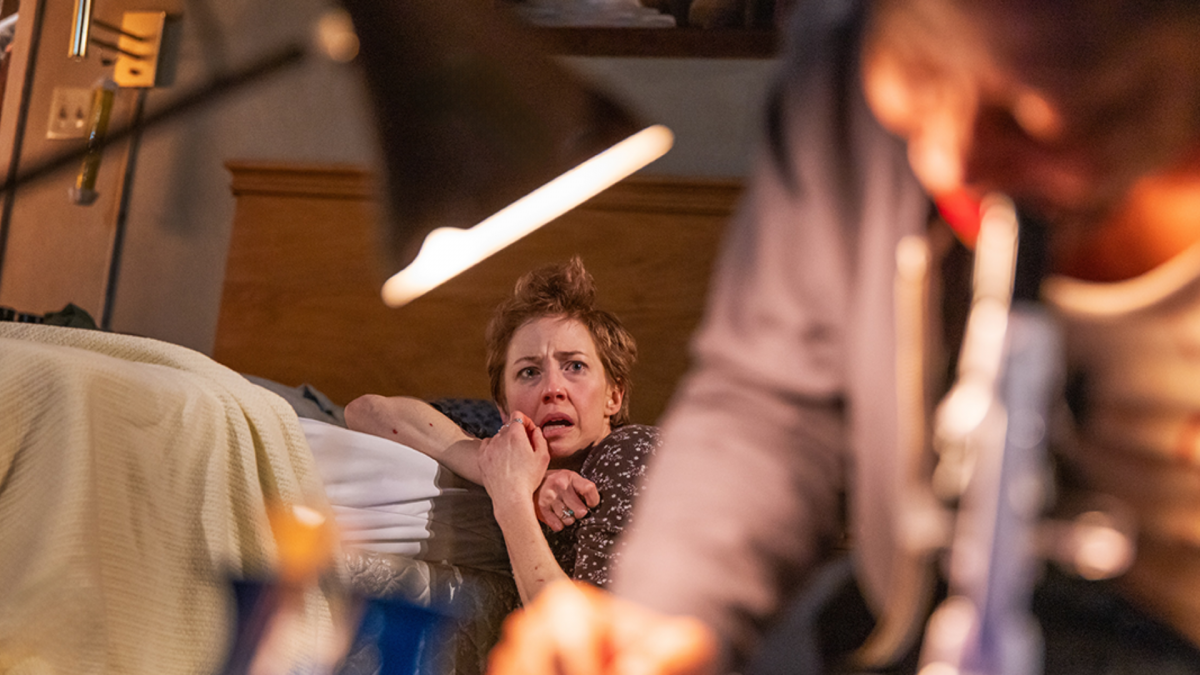
Carrie Coon stars in a revival of her husband Tracy Letts’ 1996 thriller, which was also adapted into a horror film starring Ashley Judd and Michael Shannon. It takes place exclusively in the motel room of Agnes (Coon), who strikes up a friendship with Peter, an ex-soldier with a mysterious backstory (Namir Smallwood). The supporting cast is Agnes’ abusive ex-husband (Steve Key), her friend and drug dealer R.C. (the scene-stealing Jennifer Engstrom), and a doctor from Peter’s past (Randall Arney).
In this new Broadway production at Manhattan Theatre Club’s Samuel J. Friedman Theatre, the events remain horrifying — but it’s not necessarily a straight-up horror play. The new direction by David Cromer, and especially the devastating lead performances by Coon and Smallwood, present a story that surely gets gory (be forewarned) but is more sad than prior iterations. In other words, the villain and his victim are both suffering from mental illness and/or trauma, and the ways in which they descend into madness evoke sympathy alongside shock.
If you think Act One is a slow burn, just you wait. Act Two builds to a crescendo of shocking proportions, mirroring the slippery slope of conspiracies and how quickly things can devolve from reality to insanity. I found the full nearly two-hour performance gripping, but it’s worth knowing this one builds exponentially, so each scene is more “off” than the last — at first subtly, and eventually very, very climactically.
The notion this play is just about conspiracy theorists, at least in a “faked moon landing” sense, is reductive — one character is sick, while the other is susceptible. It begs the question: if conspiracy theorists are “delusional,” are all people experiencing delusions conspiracy theorists? Or are they all just unwell? The play doesn’t answer this, so you’ll be left theorizing. As the lead characters leave reality, it’s sometimes unclear if what we see onstage is real. Are we a fly on the wall (no pun intended), or are we seeing it through the eyes of the drug-abusing lead characters?
What is certain is that Carrie Coon delivers a tour de force. Fans who love her from The Gilded Age or The White Lotus will forget those characters quickly, as Coon transforms into Agnes, who couldn’t be more different. With a season full of intense, thought-provoking dramas anchored by spectacular lead female performances, this year’s race for the Leading Actress in a Play Tony Award will be heated. Coon enters the competition as a major threat alongside Jean Smart in Call Me Izzy, June Squibb and/or Cynthia Nixon in Marjorie Prime, and my personal pick, the brilliant Lesley Manville in Oedipus. Many more plays are set to open this spring, so plenty could change. For now, don’t miss Carrie Coon in Bug, through March 8 only. Tickets at https://www.manhattantheatreclub.com/shows/2025-26-season/bug/
Plays exist to entertain. Some amuse. Some devastate. Some evoke complex thought. Some, like Data, do all three. To say that Matthew Libby’s new Off-Broadway work is timely would be a massive understatement.
A deeply relevant and suspenseful drama, Data is by no means an upper, though its satirical elements of Silicon Valley tech bro culture bring some laughs. But it doesn’t take long for existential dread and moral dilemmas to overwhelm the lead character, a new employee at tech company Athena named Maneesh (the terrific Karan Brar). His concerns and fears mirror the audience’s, as the hyperrealism of Libby’s narrative sets in. It’s a work of fiction — Athena doesn’t exist, but it’s palpable that the tech companies that do are just as ethically dangerous as they appear in the play.
The 100-minute, intermission-free drama follows Maneesh as he is recruited out of his basic job in user experience (UX) under mentor/himbo Jonah (Brandon Flynn) to the prestigious data analytics team under CEO Alex Chen (Justin H. Min). Maneesh is hesitant, but his college friend Riley (Sophia Lillis), who is already central to the data team, gets him a meeting with her boss. Each of the four characters’ motivations are not what they initially seem, as secrets are revealed and the gravity of Maneesh’s dilemma simultaneously hits him and the audience.
Sharply directed by Tyne Rafaeli, Data brings Libby’s script to life with sleek, effective set and lighting design, respectively by Marsha Ginsberg and Amith Chandrashaker. As Maneesh, Karan Brar, best known for Diary of a Wimpy Kid and Disney Channel’s Jessie and Bunk’d, more than proves his dramatic prowess for a very different audience (not for kids!). Sophia Lillis (of the It horror films) is the other standout as Riley, who we first meet as a nervous, socially awkward workaholic, but soon discover is in a far more complex situation. Similarly, Brandon Flynn (Netflix’s 13 Reasons Why) first presents Jonah as a basic tech bro with little nuance, but reveals a darkness and desperation that instigates a major plot point — the handsome himbo is more than meets the eye, for better or for worse!
The political and ethical implications of rapidly growing AI technology — who it really serves, and at what cost — seem ripped from our very current headlines. Fascinatingly, Libby first developed Data as an NYU grad student in 2018, well before the AI boom changed the tech landscape. He edited and updated the script as AI grew and the tech industry’s entire culture changed at rapid pace. There’s a second incredibly timely political element to Data that I won’t spoil — you’ll know it when you hear it.
Data isn’t an easy watch. It’s alarming because it’s so real and of our time, even as a work of fiction that’s been in development for over seven years. It reminded me in some ways of the current Broadway production of Marjorie Prime, which confronts the ethics of AI from a different, equally pertinent angle. That play premiered in 2014 and feels even more relevant today, as if it saw the future. The future — or likely, the present — portrayed in Data is not a hopeful one. But not all plays should be. It is certainly well-acted, engaging, and smart, but it most effectively confronts important ethical issues that are sadly not theoretical. They’re here, and just as the play ends ambiguously, we can only hope the whistle is blown before it’s too late.
The James Earl Jones Theatre in New York currently hosts Liberation, a compelling two-timeline story penned by the talented playwright, Bess Wohl, and brought vividly to life under the meticulous direction of Whitney White. This fresh production offers a thoughtful exploration of complex, intergenerational themes, enriched by captivating performances from lead actors Betsy Aidem, Audrey Corsa, Kayla Davion, Susannah Flood, and more fierce femmes with a few gents. With its blend of emotional depth and sharp dialogue, Liberation on Broadway invites us to reconsider notions of freedom, legacy, and connection in a modern world.
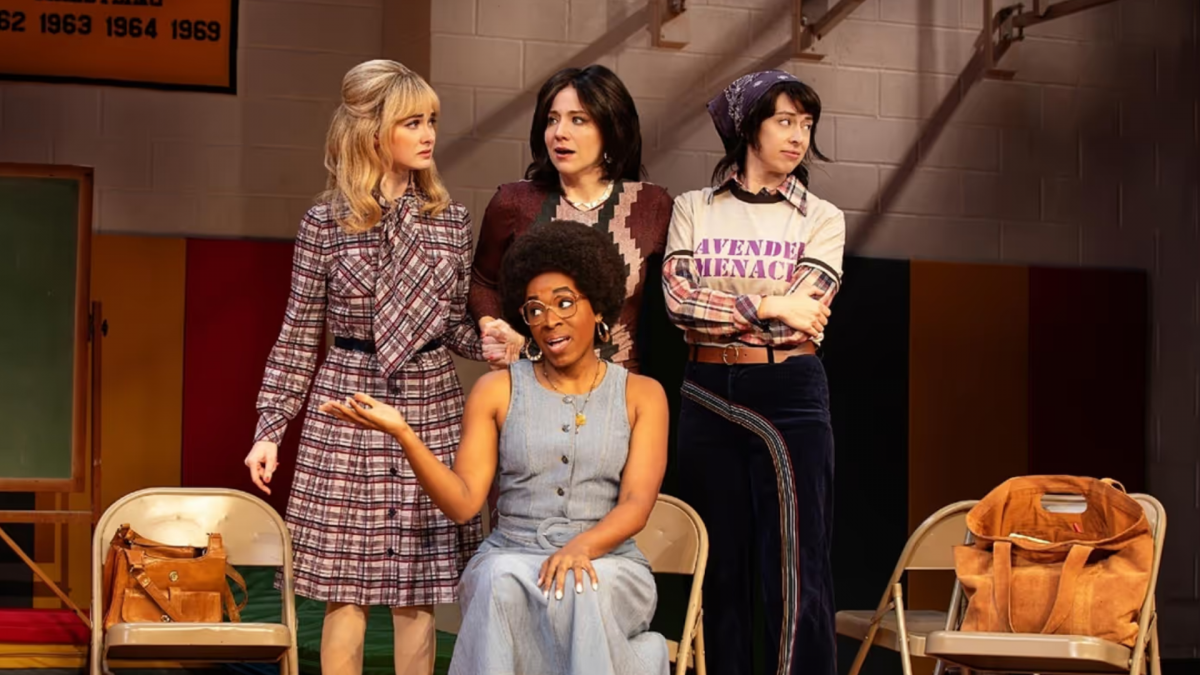
At its heart, Liberation unfolds as an intimate dialogue between women whose lives intersect in unexpected ways, beginning in 1970s Ohio. The story centers on a young, ambitious journalist named Lizzie, who starts a small “consciousness-raising” group, bringing local women together to discuss evolving their lives and the world for the better, by exploring themes of sisterhood, ambition, and societal constraints. Betsy Aidem is Margie, a woman grappling with the shadows of her past and the memories of societal upheaval she once witnessed. Enter Kayla Davion’s character, a younger woman searching for her own identity and a sense of liberation amid contemporary struggles. Their encounter sparks difficult conversations about history, trauma, and the fleeting nature of freedom. In the present day timeline, Lizzie’s daughter revisits her mother’s past, piecing together the history of the group and the choices her mother made, questioning the legacy and the true meaning of liberation.
Wohl’s writing deftly balances the personal and political, weaving moments of tenderness with biting honesty. The narrative does not rely on grand spectacle but thrives on the nuanced exchange of ideas and emotions between the characters, making the theatre space a crucible for reflection and empathy.
Director Whitney White’s vision shines throughout the production, creating a staging that feels both minimalistic and deeply resonant. The intimate setting of the James Earl Jones Theatre complements this approach, fostering a sense of immediacy and engagement that draws the audience directly into the emotional landscape of the story unfolding before you.
Betsy Aidem’s portrayal of Margie is a masterclass in subtlety, her performance conveying the weight of lived experience with a quiet strength that commands attention without overwhelming insistence. Kayla Davion as Joanne complements her character beautifully, infusing youthful urgency and vulnerability into the dynamic between the characters. The cast’s chemistry anchors the play’s themes and invites viewers to linger on the complexities of liberation itself—not just as a concept but as a lived reality.
For a contemporary audience, Liberation resonates on multiple levels. It challenges us to consider how personal histories are intertwined with broader social narratives and how the quest for freedom can take many forms, from political activism to the intimate act of personal truth-telling. Bess Wohl’s script, supported by excellent direction and acting, does not provide easy answers but opens a space for meaningful dialogue, which oftentimes lends more to the cause than a firm resolution ever could.
Moreover, the inclusion of powerful female leads emphasizes the voices that are even still, too often marginalized in mainstream theatre, adding crucial perspectives to ongoing cultural conversations.
Liberation is a testament to the power of theater to confront difficult themes with grace and emotional honesty, leaving audiences both moved and contemplative as they exit onto the ever colorful and always righteous New York City streets. Don’t miss Liberation on Broadway before it ends on February 1st. For tickets: https://liberationbway.com/
What happens to our memories, the wonderful and the terrible, after they fade? Will others we shared them with remember the glorious or painful details well enough for us, or must our memories simply die with us, never to be recalled or told again? Marjorie Prime on Broadway wastes no time, ahem, asking these very questions not only of the Oscar-worthy cast, but of the audience, too.
Written by Jordan Harrison and directed by Anne Kauffman, Marjorie Prime is a ninety-minute drama with the kind of slow-burn grief that only comes with that of dementia. The phenomenal June Squibb is Marjorie, the lead character at the center of the story. Sharp as a tack herself at a ripe young age of 96, Squibb’s “Marjorie” portrayal is a mighty one, as a grandmother with Alzheimer’s who playfully but purposefully pokes fun at the seriousness of losing one’s mind. Marjorie’s daughter, Tess, played by the righteous Cynthia Nixon with the kind of sincere conviction you can expect from her today, unsurprisingly finds nothing funny about her mother’s memory loss, which can only mean she’s in for a larger loss to follow.
Tess’s husband, Jon, played by stage and television star, Danny Burstein, is the loving and loyal glue that helps bind the sticky bonds of his wife and mother-in-law as they collectively brace for the next life chapter to come. And then there’s the gracious and most charming Christopher Lowell, who plays Walter, Marjorie’s sci-fi companion who is a hologram of her late husband. This is where the “Prime” comes in. We meet Walter as a young adult man sweetly rehashing fond memories of yore with a woman old enough to be his grandmother. But it’s not long before you realize that Walter is perhaps an AI companion whose only use is to keep the living entertained with past tales that are either tall or taut, depending entirely on who you ask. In Walter’s case, all his memories have been trained by Tess and therefore told with edited outcomes for her mother.
The story of Marjorie Prime on Broadway will be a familiar tale for so many who have slowly lost a loved one twice. Once when their memory of you fades but they are still physically here, and then a final time when they physically fade away entirely. But this isn’t solely another story of slow grief followed by inevitable loss. Marjorie Prime dares us all to ask ourselves how we remember our own stories and how we choose to tell them. Do we sterilize the bad stories with better outcomes? Because hey, if we don’t remember how it went anyway, why not simply retell it with a better narrative? And is it better for those who can’t recall their own memories to go ahead and bend their truth for them, to make a recollection worth reliving?
See Marjorie Prime at New York’s lovely Hayes Theater before it closes on February 15. And don’t forget to ask yourself how you’d prefer your best, and worst, memories told when you’re no longer around to tell them. Tickets at 2st.com/shows/marjorie-prime
The Broadway production of Queen of Versailles, recently starring Sherie Rene Scott in the lead role, offers a captivating theatrical adaptation drawn from the buzz-worthy documentary directed by Lauren Greenfield. The transition from film to stage unveils the legendary story of American wealth and aspiration through a fresh and vibrant lens. You can expect to experience both glamour and vulnerability on New York’s premiere Broadway platform at the gorgeous St. James Theatre.
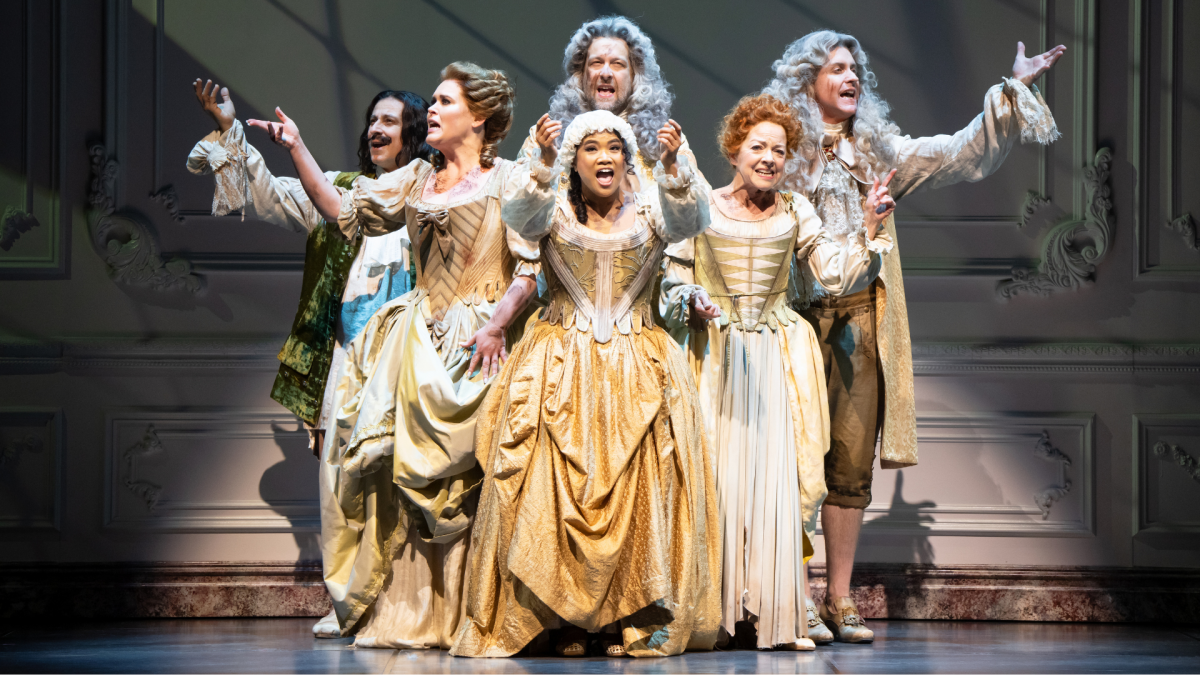
Inspired by Greenfield’s 2012 documentary that chronicles the lives of Jackie and David Siegel, a billionaire couple building the largest house in America. The Broadway show reimagines their story with sharp wit and poignant drama fit for a stage, easily marrying 18th Century French royalty with modern day glitz. Originating from the book by Lindsey Ferrentino, Stephen Schwartz of Wicked fame is behind the music and lyrics. Queen of Versailles captures the delicate balance between excessive opulence and the human cost that lies beneath. Led by director Michael Arden, the production seamlessly combines humor, tension, and insight, offering a rich portrayal of the family’s ambition and challenges during the 2008 economic downturn.
The cast dazzles in bringing this story to life, with Sherie Rene Scott stepping gracefully into the leading role of Jackie Siegel, made famous by Broadway darling, Kristin Chenoweth. Scott’s standby performance is both nuanced and engaging, emphasizing the emotional depth and resilience of her character amidst the chaotic circumstances of over-indulging. The recognizable and esteemed actor F. Murray Abraham plays her billionaire husband, David Siegel with passion and conviction. Abraham lends a wealth (pun intended) of convincing love and affection for his wife, as he also grapples with family and fortune and the addiction to having “more.”
Supporting roles feature a talented ensemble whose chemistry and energy only enrich the show’s narrative, creating a dynamic atmosphere that easily keeps you thoroughly engaged. Time moves fast here because you are indeed having fun.
For theatergoers keen on shows that blend social insight with entertainment, Queen of Versailles offers a unique experience. It prompts reflection on themes like consumerism, resilience, and the elasticity of the American Dream, all within the dazzling world of a Broadway musical.
Moreover, the show incorporates moments of humor and irony, gently poking fun at the idea that more money can solve everything. The production balances spectacle with intimate character moments, ensuring the story remains thought-provoking, rather than simply lavish and superficial.
Queen of Versailles on Broadway is more than just a story about wealth. It’s is an exploration of dreams, setbacks, and the human condition beneath the glittering surface. The show begs the question of every audience member, what truly matters when the palace walls come crashing down? And that alone, is a beautiful takeaway.
Don’t miss your chance to witness this fun musical feat before it closes on January 4th, 2026. Tickets at queenofversaillesmusical.com