Categories
Creative

Broadway’s Married Couples

We all know that theater is a labor of love. But some of Broadway’s brightest stars have taken that to heart more than others, looking within our own theater community for romantic partnerships. In preparation for Valentine’s Day, here’s Broadway’s Best Shows’ list of our favorite Broadway duos.

Audra McDonald & Will Swenson

Photo by Marc J. Franklin

Audra McDonald is the Tony-winningest performer in history. And if she represents Broadway royalty, then her husband of over 10 years, Will Swenson, undoubtedly stands as a king in his own right. While McDonald graced the stage most recently in Ohio State Murders, Swenson commanded the stage just across Times Square, leading the cast of A Beautiful Noise as Neil Diamond. The couple starred opposite each other in a 2015 Williamstown Theatre Festival production of A Moon for the Misbegotten by Eugene O’Neill.

Phillipa Soo & Steven Pasquale

Photo by Jeremy Daniel

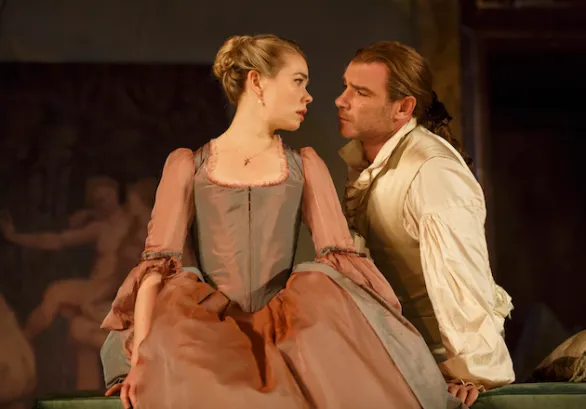
Another pair of performers, Philippa Soo and Steven Pasquale recently mirrored their real-life relationship, playing lovers at the Kennedy Center in their 2022 production of Guys & Dolls. Individually, Soo has appeared in Hamilton, Amélie, and Camelot, while Pasquale’s credits include The Bridges of Madison County and American Son. The couple were married in 2017, following her star-making run in Hamilton and ahead of his engagement in Lincoln Center Theater’s Junk

Andy Karl & Orfeh

Photo by Amy Arbus

Likely the first Broadway couple that comes to mind for many, Andy Karl & Orfeh have been married since 2001, mere months after meeting when Karl joined the cast of Saturday Night Fever. The stalwarts have appeared together on the Broadway stage twice more since then, in 2007’s Legally Blond: The Musical and 2018’s Pretty Woman: The Musical

Christopher Fitzgerald & Jessica Stone

Photo: City Center

It might be a surprise to learn that the Tony-nominated director of Kimberly Akimbo and the upcoming Water for Elephants is married to the legendary character actor, of Wicked, Waitress, and now Spamalot fame. In true showbiz fashion, Fitzgerald and Stone met in 1999, performing opposite each other in the 1999 Encores! Concert of Babes in Arms at City Center, and married in 2001. As Stone transitioned from a performer to a director, they continued to work together – most notably, Stone directed the legendary 2009 production of A Funny Thing Happened on the Way to the Forum at Williamstown Theatre Festival, starring Fitzgerald as Pseudolus alongside an all-male cast.

Photo: Williamstown Theatre Festival

Lisa Peterson & Rachel Hauck

Photo by Jennifer Broski

A power couple off- and on Broadway, Rachel Hauck is the Tony-winning set designer of Hadestown, and Lisa Peterson is the two-time OBIE-winning director of new plays premiered around the country. They met while working at the Mark Taper Forum in 1996. Audiences might best know their project An Iliad, which Peterson wrote with performer Denis O’Hare, and which toured the country after its 2012 premiere. They most recently collaborated on the 2023 play Good Night, Oscar, which also marked Peterson’s Broadway debut. 

Charlotte d’Amboise & Terrence Mann

Photo by Joan Marcus

Triple threat Charlotte d’Amboise has been married to fellow performer Terrence Mann since 1996, after meeting over a decade prior when they were both in Cats on Broadway. D’Amboise has had a long career on the Broadway stage, including two Tony-nominated performances, but is maybe best known for her perennial stints as Roxie Hart in Chicago, to which she has returned more than 25 times for brief runs in the starring role. Mann, a three-time Tony nominee, has appeared in 14 Broadway productions since 1981. The couple most recently appeared together in the 2013 revival of Pippin, and have also co-founded Triple Arts, a training program for aspiring musical theater performers, which they operate and teach together.

Maryann Plunkett & Jay O. Sanders

Photo by Joseph Marzullo

Two veterans of the New York stage, Maryann Plunkett and Jay O. Sanders have been married since 1991. Each with decades-long careers on and off Broadway, the pair has appeared onstage together in Richard Nelson’s Apple Family and The Gabriels play cycles, as husband & wife in the former three plays and then as brother- & sister-in-law in the latter. Recently, their work on Broadway overlapped as Sanders finished up the final weeks of his run in Purlie Victorious: A Non-Confederate Romp Through the Cotton Patch at Music Box Theatre, while Plunkett worked directly across 45th Street in tech rehearsals for The Notebook at the Gerald Schoenfeld Theatre.

Leslie Odom, Jr. & Nicolette Robinson

Photo by Marcus Middleton

Tony Award winner Leslie Odom, Jr. married Nicolette Robinson back in 2012, years before he would go on to become a household name as the original Aaron Burr in Hamilton, and she would make her own Broadway debut in Waitress. The couple are frequent creative collaborators, releasing music together, co-writing a children’s book, and most recently, teaming up as producers for the 2023 Broadway revival of Purlie Victorious, in which Odom also starred in the title role. 

Allan & Beth Williams

Broadway.com | Photo 30 of 43 | Great Balls of Fire! Million Dollar Quartet  Burns Up Broadway on Opening Night

Behind-the-scenes duo Allan Williams & Beth Williams have each been a part of over 65 Broadway productions in their careers to date. Allan is a veteran General Manager and Producer, recently serving as GM on Purlie Victorious, Good Night Oscar, and Diana the Musical and as Executive Producer on American Utopia, The Band’s Visit, and American Psycho. Beth is a Producer, who also served as CEO of Broadway Across America between 2008 and 2013. She has 12 Tony Awards to date, and her next show is the new musical Water for Elephants.

Categories
Creative

“My Most Challenging Work” with Director Pam MacKinnon

Pam MacKinnon is a prolific New York theater artist, with years of directorial experience on Broadway and off, as well as across the country. With a certain proclivity for the works of Edward Albee, she has directed A Delicate Balance and Who’s Afraid of Virginia Woolf? on Broadway (winning a Tony Award for the latter), as well as world premiere productions of Peter and Jerry and Occupant (the latter of which is further discussed below). Other Broadway credits include Clybourne Park, The Heidi Chronicles, China Doll, Amélie, and The Parisian Woman.

MacKinnon gave a unique answer when Broadway’s Best Shows asked which, of all her many productions to date, she considers to have been the most challenging. Rather than discussing the dark themes of a particular piece, she is shining a light on the sometimes hectic nature of being a top working director in New York City, when an unfortunate turn of events had her multitasking beyond her wildest dreams… Here is Pam MacKinnon on her most challenging project(s) yet:

Putting up a great show is always full of joy and hard work. Always.

As a lucky, in-demand freelance artist, I sometimes found myself with as many as seven productions in a season. It’s a hustle that both feeds and interferes with the art. Schedules are beyond our control.

There was one week in the spring of 2008 with my production of Itamar Moses’ THE FOUR OF US up and running at Manhattan Theatre Club, as I was already starting tech of Edward Albee’s OCCUPANT at Signature Theatre. Two amazing projects; beautiful plays with glorious acting companies. After many years working out of town I was about to have two shows off-Broadway.

Blue skies. What could go wrong?

Well.

We got word with a couple of weeks to go in the MTC run that Sony Music had finally gotten around to answering our rights query about some transition music that had been central to our many transitions. Lightning out of a blue sky. Their answer was no. We were facing an immediate cease and desist. I was suddenly teching lights and sound for two shows! One from 8 am-11 am. The other from 12 noon to midnight. Designers were already onto their next gigs. Associates who had not been involved with THE FOUR OF US were my new collaborators, brought in to make it all seem seamless. We had one understudy covering both roles in the two-hander, he came in those three mornings to help with the crucial timing.

And I peddled my bike to and fro City Center and the old Signature space—could it have been any further west?!!—avoiding Times Square at all costs, feeling very fortunate to be living the dream, angry with Sony, and very very sleepy by my next Monday day off.

Categories
Creative

“My Most Challenging Work” with Director Leigh Silverman

For 20 years, Leigh Silverman has built an impressive directing career in New York and across the country. Since her Off-Broadway debut with 2004’s Well at the Public Theater (which she would restage for Broadway two years later), Silverman has helmed five Broadway and over 30 Off-Broadway productions. 

Her Broadway credits include Chinglish, The Lifespan of a Fact, and Grand Horizons, among others, and her sixth Broadway show is this season’s new musical Suffs, which Silverman brings to the Music Box Theatre following its Public Theater premiere in 2022.

Her awards nods include a Tony nomination for her work on the 2014 revival of Violet and two Drama Desk nominations, one for directing the play From Up Here in 2008 and the other for the musical Soft Power. The latter happens to be the show that came to mind for Silverman when Broadway’s Best Shows asked about her most challenging work to date. See what she had to say about the difficult project, and her eye towards its future… 👀

Conrad Ricamora & Kendyl Ito in Soft Power at the Public Theater. Photo by Joan Marcus

This interview has been edited for clarity and concision.

Broadway’s Best Shows: What has been your most challenging work to date?

Leigh Silverman: This is such an interesting question because every project is rife with its own unique, amazing challenges. I love challenge when it is artistic in nature and forces my collaborators and me to imaginatively and rigorously grapple.

The most challenging work, using this framework, would be Soft Power, a musical I directed at the Ahmanson Theater in 2018 followed by a run at the Curran in San Francisco and was then produced at the Public Theater in 2019.

BBS: What was so difficult about this project? 

LS: This musical had been a dream of David Henry Hwang’s, with music by Jeanine Tesori, and was a true exploration/investigation of what is “possible” in musical theater.  David wanted to write a play that would shatter when the character of DHH is stabbed (a hate crime that did happen to the real David), and then the play would replay/transform into a musical complete with a full orchestra. He loved the structure of Anne Washburn’s iconic play, Mr. Burns, and in his own spin wanted to create an inverse to Rodgers and Hammerstein’s The King and I. So in his musical Soft Power, America’s struggles are musicalized through a futuristic Chinese musical lens. 

We faced challenges in tone and style as we tried to bend and twist and subvert and articulate why we love musicals, and why, even when they are so very problematic and racist, they still have the power to move us so deeply. All this while commenting on China’s possible future point of view about America as told through musical theater and thereby exerting their “soft power.”

BBS: How did you address and/or resolve the challenges?

LS: We worked tirelessly.  We love musical theater and wanted to make an exciting piece of musical theater that honored the form while interrogating it. We wanted to explicitly address the brutal and constant racism Asian Americans face. We worked and worked and worked and at one point Jeanine said to David, “David! Put your pancreas on the table!” That’s how hard we were all working.

BBS: Are you proud of the result?

LS: Extremely. But also it is unfinished. 

BBS: Is there anything you would do differently with the benefit of hindsight?

LS: The world has changed significantly since 2019 and I believe, when we get back to it, there will be fresh ideas and energy for reinvestigating David’s incredible vision.

Categories
Creative

“My Most Challenging Work” with Set Designer Beowulf Boritt

Beowulf Boritt is one of the busiest set designers on Broadway. Since making his debut with 2005’s The 25th Annual Putnam County Spelling Bee, Boritt has designed the set of over 30 Broadway productions, earning two Tony Awards (from six nominations), and two Drama Desk Awards (from eight nominations) in the best scenic design category. His latest Broadway set was for Harmony, and next up is the upcoming revival of Thornton Wilder’s Our Town.

His 2023 Tony Award and Drama Desk Award wins were both for his design of the new musical New York, New York. These must have been particularly rewarding accolades, considering that show is the one Boritt named when we asked him about his toughest project to date. Here is Beowulf Boritt on his most challenging work to date:

An early sketch for ‘Wine & Peaches’ in New York, New York, courtesy of Beowulf Boritt.

This interview has been edited for clarity and conciseness.

Broadway’s Best Shows: What has been your most challenging work to date?

Beowulf Boritt: New York, New York (by John Kander, Fred Ebb, David Thompson, Sharon Washington, and Lin-Manuel Miranda at the St. James Theatre, Directed and Choreographed by Susan Stroman, 2023) was by far the largest, most complicated set I’ve designed. 

BBS: What was so difficult about this project? 

BB: The show required many, many locations in quick succession and it all had to squeeze into a Broadway theatre without a very big backstage. The rapid pace of the scene changes was hard because there were several 15-20 minute sequences in the show that were basically constant scene changes keeping the crew working at a fevered pace. For the first 10 days of tech, I think the crew and stage management just thought it was impossible, but they kept at it valiantly, and eventually, we got it all working efficiently, safely, and beautifully.

BBS: How did you address and/or resolve the challenges?

BB: We planned very carefully, making sure everything was exactly the size we had laid out in our technical drawings so it could all fit together like a giant three-dimensional Tetris game. We had to balance all these technical needs with the look of the design so it would all feel beautiful and effortless.

BBS: Are you proud of the result?

BB: I won a Tony Award for it, so that’s a nice cherry on top!

BBS: Is there anything you would do differently with the benefit of hindsight?

BB: The show was enormous. Perhaps too enormous to survive in the current Broadway climate. It was what the artistic and producing team wanted, I think, but I suppose in retrospect had we done a much simpler production it might have had a longer life.

Categories
Creative

The Legacy of Martin Luther King Jr. on Broadway

Broadway is often a platform for important stories that reflect the diverse tapestry of our collective history. Martin Luther King Jr., an iconic figure in the civil rights movement, has not been exempt from this trend. Over the years, various productions have paid homage to his legacy through impersonation, invocation, and references. In celebration of Martin Luther King Jr. Day, let’s take a journey through some notable instances of Martin Luther King Jr. on the Broadway stage.

Samuel L. Jackson as Martin Luther King Jr. in The Mountaintop. Photo by Joan Marcus

The Mountaintop
Katori Hall’s The Mountaintop provides a unique perspective on the last night of Dr. King’s life. Premiering on Broadway in 2011, the play featured Samuel L. Jackson as Martin Luther King, Jr., and Angela Bassett as a mysterious hotel maid. The production delved into King’s inner thoughts and struggles, offering a poignant portrayal of the man behind the movement. The Mountaintop humanizes the legendary leader, giving audiences a glimpse into the vulnerability beneath the public persona.

Brandon J. Dirden as Martin Luther King Jr. in All The Way. Photo by Evgenia Eliseeva

All The Way
Bryan Cranston took on the challenging role of President Lyndon B. Johnson in All The Way, which premiered on Broadway in 2014. While the play primarily focuses on LBJ’s presidency, it touches upon the Civil Rights Act and King’s interactions with the administration during a crucial period in American history. Brandon J. Dirden took on the role of the iconic activist as “All The Way” served as a reminder of the intricate dance between political leaders and activists during a pivotal era.

Jay O. Sanders as Ol’ Cap’n Cotchipee in Purlie Victorious. Photo by Marc J. Franklin

Purlie Victorious: A Non-Confederate Romp Through the Cotton Patch
Although not a play centered on Martin Luther King Jr., Ossie Davis invokes his name in Purlie Victorious as a timeless symbol of progress and racial equality when Ol’ Cap’n Cotchipee asserts that segregation ought to remain the way of things and “to hell with Abraham Lincoln and Martin Luther King.” It also deserves mention due to King’s actual attendance at its original Broadway production. Dr. King was in the audience when the play reached its 100th performance, becoming a historical moment connecting theater and the civil rights movement.

Billy Dee Williams as Dr. Martin Luther King, Jr. with Judyann Elder in a  scene from the Broadway production of the musical play "I Have A Dream". -  NYPL Digital Collections
Billy Dee Williams as Martin Luther King Jr. in I Have A Dream. Photo by Martha Swope

I Have A Dream
I Have A Dream was a musical revue that pays tribute to the powerful words of Dr. King. Premiering on Broadway in 1976, the production wove together King’s speeches and sermons, providing audiences with a musical journey through the key moments of the civil rights movement. Billy Dee Williams played the central figure. Through soul-stirring musical performances and poignant storytelling, “I Have A Dream” celebrated the enduring impact of King’s words and the resonance they continue to have in the fight for justice and equality.

One Night in Miami…, Directed by Regina King and Starring Leslie Odom Jr.,  Sets Release | Playbill
The cast of the film One Night in Miami, directed by Regina King.

One Night in Miami
Kemp Powers’ play One Night in Miami explores a fictional meeting between Malcolm X, Muhammad Ali, Sam Cooke, and Jim Brown. While not directly focused on King, the play acknowledges his influence on the era, placing his ideals at the center of the cultural and political discourse. One Night in Miami invites audiences to reflect on the interconnectedness of historical figures and the collective pursuit of social change. The play underscores the enduring relevance of King’s principles in shaping conversations around activism and equality. The play was adapted by Regina King for a 2020 film.

These Broadway productions serve as a testament to the enduring impact of Martin Luther King Jr. on American society. Whether through direct impersonation or indirect references, the stage has become a canvas for artists to explore and celebrate the legacy of a man who played a pivotal role in the fight for civil rights.

Categories
Creative

Where’s That Cast Now? Mamma Mia! Edition

The jukebox musical featuring the songs of ABBA, premiered on the West End in 1999. Two years later, the show was an international sensation and opened on Broadway at the Winter Garden Theatre. In the years since, the musical continues to entertain with productions and tours all over the world, two movie adaptations, and a rumored third on the way!

Come along, dancing queens, as Broadway’s Best Shows dives into the careers of the original Broadway cast over 22 years later.

Louise Pitre (Donna Sheridan)

As Donna, Pitre earned herself a Tony Award nomination in 2002. After leaving the show in 2003, Pitre has continued in musical theatre, with iconic performances as Fantine in Les Misérables, Mama Rose in Gypsy, and Joanna in Company. In 2009, Pitre performed at Carnegie Hall in the musical Kristina, written by ABBA’s Benny Andersson and Bjorn Ulvaeus. 

Judy Kaye (Rosie)

Kaye received a Tony Award nomination for Mamma Mia!, and has continued to appear on Broadway and regional stages across the country. In 2006, Kaye appeared as Mrs. Lovett for 1 week in the revival of Sweeney Todd while Patti LuPone was on vacation. Later that year, she took over for Patti again in the revival of Gypsy. Kaye starred in the 2012 musical Nice Work If You Can Get It, winning a Tony Award, Drama Desk Award, and Outer Critics Circle Award for her portrayal of Duchess Estonia Dulworth. After a brief run as the Dowager Empress in the Broadway musical Anastasia, she originated the role of Queen Elizabeth II in Diana, The Musical

Karen Mason (Tanya)

Seven years after originating the role of Tanya on Broadway, Mason appeared on Broadway in Hairspray as Velma Von Tussle. In 2011, Mason appeared as the Queen of Hearts in the Broadway musical Wonderland and went on to recreate the role in the Tampa & Houston productions. She also appeared as Madame Giry in the national tour of Andrew Lloyd Webber’s Lover Never Dies.

//assets.playbill.com/editorial/148ade5a540076c638380c2330eba485-ne_107608.gif
Karen Mason, Louise Pitre & Judy Kaye in Mamma Mia! Photo by Joan Marcus

Ken Marks (Bill Austin)

Marks has appeared in several Broadway productions since originating the role of Bill, including Hairspray as Wilbur Turnblad, Spring Awakening, Spider-Man Turn off the Dark, Airline Highway, and most recently, the 2022 Tony-winning revival of Take Me Out

Dean Nolan (Harry Bright)

Following his run as Harry Bright, Nolan continued to appear in Off-Broadway and regional theaters. He co-produced a documentary titled “None Less than Heroes,” about the Honor Flight program which brings World Warr II veterans to Washington D.C. Currently, Nolan is on the faculty Texas Tech University’s School of Theatre and Dance. 

Tina Maddigan and Joe Machota starred in the original cast production of \"Mamma Mia!\"
Tina Maddigan & Joe Machota in Mamma Mia! Photo by Joan Marcus

Tina Maddigan (Sophie)

In 2006, Maddigan returned to Broadway as a standby in the original Broadway cast of The Wedding Singer. After a spinal injury left her with vocal paralysis, Maddigan spent years in vocal therapy and is currently an avid TikToker with over 500k followers. 

Joe Machota (Sky)

After leaving the production in 2005, Machota moved to the business side of the industry, becoming the head of theater at CAA, where he currently represents some of the largest names in entertainment. 

Notable Broadway Replacements

Carolee Carmello (Donna)

Following her departure from the show, Carmello originated the role of Alice Beineke in the musical The Addams Family. In 2011, she replaced Victoria Clark as Mother Superior in the musical Sister Act. Other notable Broadway credits include Scandalous, Finding Neverland, and Tuck Everlasting. Carmello starred as Dolly Levi in the national tour of Hello, Dolly! Until its closing in 2020, and most recently appeared in the Broadway musical Bad Cinderella.

Beth Leavel (Donna)

Beth Leavel succeeded Carolee Carmello as Donna in 2009. Since, she’s appeared on Broadway in Elf the Musical and Baby It’s You!, earning a Tony nomination for the latter. In 2018, she starred in The Prom, earning another Tony nomination. Most recently, Leavel starred as Miranda Priestly in the Chicago premiere of the musical adaptation of “The Devil Wears Prada.”

Christy Altomare

Altomare made her Broadway debut in Mamma Mia! Since, she originated the role of Anya in the Broadway musical adaptation Anastasia

Judy McLane (Donna & Tanya)

McLane starred as both Donna and Tanya, and is the longest-running lead in the musical’s history with over 4,000 performances. Currently, McLane is starring as Joanne on the national tour of Company.

Categories
Creative

When Push Comes to Shove: Spotlighting the Work of Fight Director Thomas Schall

by Ben Togut

In our new series, Unsung Roles of the Theater, Broadway’s Best Shows takes a peek behind the curtain to showcase the work of underappreciated Broadway professionals and their contributions to the theatrical ecosystem. 

This week, we will be highlighting the work of Thomas Schall, a veteran fight director with over 100 Broadway credits to his name, including Waitress, Angels in America, and the 2023 revival of Purlie Victorious: A Non-Confederate Romp Through the Cotton Patch. He has won two Drama Desk Awards: one as an actor for Outstanding Ensemble Performance (Stuff Happens, 2005), and another for Outstanding Fight Choreography (A Soldier’s Play, 2020).

Thomas Schall in rehearsal for the Public Theater’s Othello, 2018.

As a fight director, Schall is intimately concerned with violence as a device of narrative storytelling. When building a scene, Schall considers three main narrative elements: the emotional arc of the characters in the show, the physical story of the violence, and the communication between actors during a fight scene. With these elements in mind, Schall must choreograph fight scenes that serve the narrative of the show at large, ensuring that the violence is readable to the audience and safe for the actors to perform every night. 

Schall’s passion for fight directing emerged while training to be an actor in college. After enjoying stage combat classes in school, Schall followed his passion, working as both an actor and an in-house fight captain for productions at the Folger Shakespeare Theater in Washington D.C. There, he studied with several choreographers who whetted his interest in the art form and trained with the Society of American Fight Directors. Schall soon began choreographing fights of his own while continuing to work as an actor.

Thomas Schall (right) in Roundabout Theatre Company’s Hamlet, 1992, in which he played Marcellus and served as Fight Captain. Photo by Martha Swope

When Schall moved to New York City in the mid-1980s, he feared his work as a fight director would limit his acting opportunities. 

“I was a little bit afraid of being pigeonholed as an actor who was a ‘fight guy,’” Schall said. “And [hearing] ‘there is no role for a fight guy in this show’ and having my resume set aside. So I stopped doing it completely, and was just an actor and did pretty well in New York over the years.”

After putting aside fight work for a few years, Schall put acting on the back burner and began pursuing fight work full-time as gigs became more regular in the late ‘90s.

In the current revival of Purlie Victorious, Schall choreographed a scene where Ol’ Cap’n Cotchipee is about to whip protagonist Purlie, considering each character’s emotional arc throughout the show and the history of their relationship to make the scene work onstage. For Schall, bringing this scene to life onstage was challenging as it required finding the comedy in a moment of real violence.

“It’s the game that the entire play plays,” Schall said. “It’s talking about very serious themes, and very serious pieces of history in the country, but at the same time, it’s also a comedy, it’s a farce, and it’s a romp. And playing those two notes against each other is a very tricky, subtle game.”

Schall worked closely with director Kenny Leon and star/producer Leslie Odom Jr. in order to strike the right balance between seriousness and humor. By examining the overstory, or emotional arc of the scene, the trio found that the crack of Ol’ Cap’n’s bullwhip, a charged piece of imagery for the audience and the cast alike, was the perfect catalyst for the scene’s tonal transformation.

The bullwhip is both a prop and symbol in Purlie Victorious, representing the physical and psychological violence inflicted on African Americans during a time of segregation and oppression. Photo by Marc J. Franklin

“That whip crack became like a button, a sort of a switch for when things went from serious to comedic,” Schall said. “And so we shifted a line so that everything happens, sort of all the threatening things happened up to the whip crack. And then we were free to have fun.”

For Schall, it is these moments of collaboration that he values most. In his work as a fight director, Schall seeks to build a room of trust, asking his collaborators to trust him with their safety and have faith that they won’t feel embarrassed or stupid performing fight sequences onstage. While building trust is often challenging, it is also the most rewarding part of Schall’s job, as it allows him to form close relationships with his collaborators. After decades of working as a Broadway fight director, Schall has had several repeat collaborators, many of whom he calls friends.

“Every show and rehearsal on some level is a celebration of community,” Schall said. “And I love being part of a community of people. There comes a point in your career, hopefully, where you come into one of these rehearsal rooms, and you see people you’ve worked with before and they’re friends, and that, for me, is the most gratifying part.”

Purlie Victorious: A Non-Confederate Romp Through the Cotton Patch runs at the Music Box Theatre through February 4, 2024.

Categories
Creative

Where’s That Cast Now? The Producers Edition

Mel Brooks’s musical comedy, which held the record for the most Tony Awards ever received by a single production for 15 years (in 2016, Hamilton tied with 12 Tony Awards), opened on Broadway in 2001. The musical, based on Brooks’s 1967 Oscar-winning film, which constantly broke box-office records at the St. James Theatre, ran for 6 years and was adapted into the 2005 hit film of the same name. Come with Broadway’s Best Shows as we look into the careers of the original Broadway cast since their departures from the show.  

Nathan Lane (Max Bialystock)

After his Tony Award-winning performance in The Producers, Nathan Lane has continued to be a prominent figure in entertainment. On Broadway, Lane has appeared in The Odd Couple (Alongside Matthew Broderick), Butley, November, Waiting for Godot, The Addams Family, The Nance, It’s Only a Play, The Front Page, Angels in America (Tony Award Win), Gary: A Sequel to Titus Andronicus, and Pictures From Home. He has appeared in TV shows like “Only Murders in the Building”, “Modern Family”, “The Good Wife”, “Penny Dreadful: City of Angels”, and “Gilded Age.” On Film, Lane has been in the A24’s “Beau is Afraid” and “Dicks: The Musical.” 

In 2006, Lane received a star on the Hollywood Walk of Fame, and was inducted into the American Theater Hall of Fame in 2008. 

The Producers" at Arizona Broadway Theatre
Photo by Paul Kolnik

Matthew Broderick (Leo Bloom)

Broderick has remained an active entertainer since his acclaimed run as Leo Bloom. He starred in the 2005 movie adaptation of the musical alongside Nathan Lane. On Broadway, Broderick has starred in The Odd Couple (with Nathan Lane), It’s Only a Play (also with Nathan Lane), The Philanthropist, Nice Work If You Can Get It with Kelli O’Hara, Sylvia with Annaliegh Ashford, and most recently, Plaza Suite alongside his wife, Sarah Jessica Parker. He appeared in TV series like “Better Things”, “30 Rock”, “Bojack Horseman”, “Rick and Morty”, and “Modern Family”, and did voice work in the films “The Lion King 1½”, “Good Boy!”, “Bee Movie”, and “The Tale of Despereaux.” In 2006, Broderick also received a star on the Hollywood Walk of Fame, and has also been inducted into the American Theater Hall of Fame. 

Gary Beach (Roger De Bris)

After his Tony-winning performance as Roger De Bris, Beach starred as Albin in the 2004 Broadway revival of La Cage Aux Folles, as well as the 2006 Broadway revival of Les Misérables. Beach also starred alongside Lane and Broderick in the 2005 film adaptation of the musical.

Unfortunately, Gary Beach passed away in 2018.

Gary Beach, Tony Winner for 'The Producers,' Dies at 70 - The New York Times
Photo by Paul Kolnik

Cady Huffman (Ulla)

Since The Producers, Cady Huffman continued her career in theater and appeared in various productions, including alongside Nathan Lane in the Broadway play The Nance. She has also had appearances in the TV series “The Good Wife”, “Frasier”, and “One Life To Live.” Huffman was a regular judge on Food Network’s competition show, “Iron Chef America.”

Roger Bart (Carmen Ghia)

Following his departure from the show, Bart returned in 2004 as a replacement for Leo Bloom. Bart’s other Broadway appearances since The Producers include Stephen Sondheim’s The Frogs, as Dr. Frankenstein in Young Frankenstein, Disaster!, and currently Back to the Future: The Musical at the Winter Garden Theatre. Bart has had TV appearances in “The Blacklist”, “The Good Fight”, “Grace and Frankie”, “Modern Family”, “How I Met Your Mother”, “It’s Always Sunny in Philadelphia”, “30 Rock”, and many more. Bart has a cameo in the 2021 film adaptation of Tick, Tick… Boom!

Brad Oscar (Franz Liebkind)

After his successful run as Franz Liebkind, Oscar replaced Lane as Bialystock.  In 2008, Oscar returned to Broadway as Sir Bedevere in Spamalot, and has since appeared in The Addams Family, Nice Work If You Can Get It, Big Fish, Something Rotten!, and Mrs. Doubtfire. Recently, Oscar was a replacement in the Off-Broadway revival of Little Shop of Horrors. Oscar has had appearances in TV series including “Law & Order”, “The Good Wife”, and “Smash.”

Categories
Creative

“I don’t think I’ll ever think of it the old way again”: A Q&A with Emergence’s Patrick Olson

Sponsored post

Q&A with Patrick Olson of Emergence

By Broadway’s Best Shows Staff

The new show Emergence, now running at the Pershing Square Signature Center, knows it’s hard to describe – is it a musical? A concert? A scientific exploration? An acid trip? It’s a little bit of everything. In this interview with lead performer and composer Patrick Olson, we explore the creative process behind this idiosyncratic event, that’s a little bit David Byrne, a little bit Carl Sagan, and even a little bit Woodstock. 

This interview has been edited and condensed for clarity. 

Broadway’s Best Shows

Why write songs about huge philosophical questions?

Patrick Olson

You know, it may be less of a choice than just a simple response to how my mind is evolving, as I get older. I’ve tended to find that over time, whatever songs I’m writing at a given point in my life are reflective of the thought space that I carry around in that time. And maybe that’s not so surprising! I really think about these big questions, I really think about the implications of scientific insight. I really think about what it means to be human in a rapidly changing environment that we’re all in. And since I think about those things all the time, I think it’s natural that the music would reflect that.

BBS

Tell us about the songwriting process. I mean, it’s the cliche question, which comes first, the music or the lyrics, but…

PO

I normally start with just a baseline, and try to find some bass groove that feels right to me, and evokes some kind of specific emotion. The rhythm section of drums and bass constitute the spine of any song, so I like to start with the spine. And once that feels like it’s in a certain kind of pocket, then I just start noodling around the edges of that. Typically, the next thing [is] a basic portal structure that I would do on an acoustic piano, and figure out what kind of chord progressions feel right in relation to that baseline and those drums, and what sort of harmonic harmonic dimensions will come out of that. Lastly, I start to experiment with vocal ideas, which constitute the melody of any given song. 

Once all of that is in place, then I really like to give the music a week or two, to breathe on its own and develop its own sense of character. And so when writing lyrics and the song, the structure of the song, the tone of the song, the qualities that the instrumentals offer, they really shape what the emotional context of the lyrics is going to be in. Then it’s just a matter of linking that to whatever ideas seem to fit the best. And usually, there are scientific insights of one kind or another, and the song kind of comes together at that point.

BBS

How and why did your album Music for Scientists become a work of theater that’s now running at the Pershing Square Signature Center? That’s a really unusual journey. 

PO

Yeah! Writing and recording and producing that album was immense, fun, and really interesting. We really didn’t cut any corners. You know, we had a full orchestra that we recorded in Nashville. And this was during COVID, too, so that represented all of its own challenges, but we had I think a 50, 60, 70 piece orchestra with it. All of the songs on that album constitute the fertile soil that the next stage would grow out of. We really only used one song from that album, in the show Emergence, and that was “Moons of Jupiter.” I wrote nine new songs to constitute the show. But that album laid out the DNA for what the following songs would be and how they might constitute a different kind of experience, not just an isolated sonic experience, but a visual experience and a community experience of that theatrical experience.

BBS

That leads really nicely into my next question– what is the sort of emotional experience you’re  hoping to create for your audience?

PO

I would really love for people to just be plainly entertained, in the most superficial way. [And] I would hope people would experience some emotional movement. For them to be touched, or for them to have the music and the stage-theatrical experience, evoke an emotion from them. 

I’m really, really happy to report that, we go out into the lobby after every show and greet everyone as they’re leaving, and every single night, I get to hear people say [those] things: they feel it was so entertaining, and the show was really tight, and the choreo was great. And everything just kept moving, and they didn’t know what to expect next. And that there were periods of time in the show where people tell me they were really moved to tears. And it was just really beautiful. 

People tell me pretty regularly, “I never thought of this in that way. And I don’t think I’ll ever think of it the old way again. Now I see the world in this way.” So it’s not just my intention, but I really have the privilege of being able to have face to face contact with people as they’re leaving the theater. And they tell me [that] happens. And it’s wonderful! 

BBS

And you give them a tulip, which is also lovely. (Audience members are handed a tulip as they leave the theater.)

PO

They get a tulip as well! Which is sort of an emblem of the show in many ways. It’s referenced in the show and has scientific meaning as well as, you know, just kind of a nice little practical thing to give people to memorialize the experience.

BBS

So what do you see as the importance of an artist, such as yourself, communicating science? Why is that important to you? Why does that matter?

PO

It’s really fascinating because the word ‘science’ is loaded. It can mean so many different things to so many other people, you can say the word ‘science’ to someone on the street and who knows how they might react to that – it might be they have a sense of dread about physics exams that they had during college, or they feel like it’s really ‘mathy’ and something far away from them. Or it’s inscrutable, [like] “science is all about test tubes, and formulas and things I don’t understand.” 

I don’t think of science as any of that stuff. I think of science as the insight, the understanding into the nature of the universe. That’s what I care about. The scientific method and good research methodology lead to solid insights, but it’s the insights that I care about. And so when I think about science, what I think about is reality. That is our best human understanding of the nature of things. And science happens to be the most reliable tool for getting at that thing, but it’s that thing that I care about.

BBS

An element of the show that was really unique was Jordan Noltner’s lighting design. It had a sort of rock concert feel that I so rarely see onstage. And so I’d love to know how that unique visual was created. 

PO

There’s no question Jordan Noltner is a gifted lighting designer. It has to do with the DNA of the show… a big part of what we are is a musical concert, and any rock concert that you would go to for any popular musician, they have extensive and dramatic lighting, and we felt that that would be fitting for what we’re doing here as well.

BBS

So you come from the music world. How is the theater schedule treating you? What’s your routine to do this show? Because this is a big sing.

PO

Yeah, you know what I didn’t realize? Last night we finished our 62nd or 63rd show. And since a run of this length is very new to me, I did not understand just how taxing it is physically. I find I live a pretty quiet life outside of the show. And that’s necessary for me to summon all of the energy and explosive stuff that happens in the show. And then I go back home and recover and continue with my quiet life. So it does take a lot of sustained energy–I was surprised by how physically taxing a theatrical run like this is! But it is at the same time the most inspiring and most fun thing I think I’ve ever done in my life. So I will take the exertion, I’ll take all the beatings that come down the pipe, and I’ll keep doing this as long as we’re able to, because it is so exciting. And mostly it’s just about having contact with the audience after the show, when they can speak to me about their experience and that, more than anything else, just recharges my batteries for the next show.

Categories
Creative

Persisting Pauses: The Status of Intermissions on Broadway

By Ben Togut

For many Broadway lovers, the intermission is a welcome interlude in the theater-going experience, providing audience members with the opportunity to get out of their seats, use the restroom, or head to the concession stand. However, it appears the well-worn tradition of the intermission is at a critical juncture. According to an article in the Philadelphia Inquirer, of the 80 new plays that opened in the U.S. 2019-2020 theater season, 62% had no intermission. This development begs a vital question: are intermissions a thing of the past?

The intermission has a storied history. Before electricity, they allowed theater staff the opportunity to trim and relight the wicks of candles illuminating the stage. Intermissions served a similar purpose in movies, giving projectionists the time to change film reels. Over time, the intermission gained commercial as well as practical value. In the 1950s and 60s, advertisers enticed moviegoers to make trips to the concession stand with commercials like Let’s All Go to the Lobby, featuring dancing candy, popcorn, and soft drinks. Likewise, Broadway theaters encourage audience members to open their wallets during intermission with flashy merch tables and cocktails with names relevant to the show, allowing the audience to continue engaging with the production between acts. 

In recent years, more and more Broadway shows have been presented without an intermission, including musicals such as Come From Away and the most recent revival of West Side Story (which was pared down to a single act), and plays like Leopoldstadt, The Minutes, The Shark is Broken, Ohio State Murders, Jaja’s African Hair Braiding, and The Sound Inside alike. Why has there been a trend away from intermission in recent years? Given shorter attention spans and an increased focus on accessibility in the theater, it seems that the absence of an intermission would be counterintuitive.

Come From Away
The 2017 musical Come From Away had a runtime of approximately 90 minutes with no intermission at the Schoenfeld Theatre. Photo by Matthew Murphy

However, having an intermission doesn’t always make sense for a production. In an interview with the L.A. Times, playwright and director Robert O’Hara argues that a “seismic shift” must occur between acts for an intermission to be justified. From this angle, productions shouldn’t have intermissions just because they are expected. Instead, an intermission should only occur if it serves the narrative of the show and how the audience experiences the story. 

More and more, having an intermission in theater seems arbitrary, especially when audiences are willing to sit through long movies without a break. Recently, Oppenheimer, Killers of the Flower Moon, and Avatar: The Way of Water have been hits at the box office while all running three hours or longer. If audience members can watch the latest Scorsese saga straight through, a two-hour Broadway show should be a walk in the park.

The 2023 Broadway revival of Purlie Victorious is performed without an intermission at the Music Box Theatre. Photo by Marc J. Franklin

What’s more, not having an intermission often has strategic value to theatermakers, allowing them to heighten the emotional and narrative arc of their plays. The current revival of Purlie Victorious is a timely example. While the original 1961 production had an intermission, standard for straight plays of the era, the 2023 revival runs without one. Without an interruption, Purlie Victorious builds tension and maintains its comedic momentum, taking audience members on an uproarious journey as they root for Purlie to win back his family’s inheritance. Foregoing an intermission, Purlie Victorious sustains its dramatic thrust, providing no shortage of laughs and surprises over its two hours.

While plenty of shows continue to have intermissions, playwrights and directors are reconsidering the efficacy of this tradition, not having a break in their shows’ runtime unless it makes sense as a narrative tool. Although not having an intermission can have strategic value, it raises concerns about accessibility, especially for the elderly and people with disabilities, for whom sitting for extended periods of time can be physically challenging. Going forward, Broadway may consider taking further measures to ensure that everyone has a more comfortable and enjoyable time at the theater.