“Mamet’s gripping play argues, everything in America – and this play throws sex, rape, the law, employment and relationships into its 90 minutes of stage wrangling – is still about race.”
Chicago Tribune
“Scalpel-edged intelligence!”
The New York Times
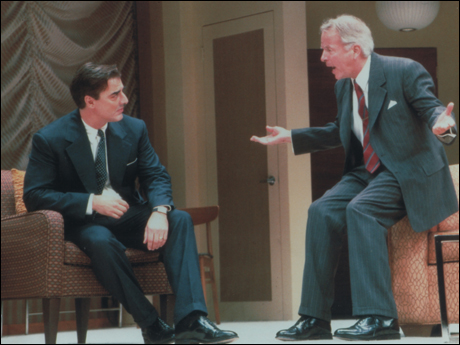
RACE, by Pulitzer Prize winner David Mamet, tackles America’s most controversial topic in this provocative play. A potent dramatic cocktail of sex, guilt and legal maneuvering, Race concerns three lawyers (Ed O’Neill, David Alan Grier and Alicia Stith) defending a wealthy white executive (Richard Thomas) charged with raping a black woman. David Alan Grier and Richard Thomas return to the roles they created during the play’s hit run on Broadway. Tony Award winner Phylicia Rashad directs.
You needn’t ever ask anyone who has served as an artistic director of a regional company if there is anything left they wished they’d directed. If the service happens to extend to about 25 years, as mine did at the Old Globe in San Diego from 1982 to 2007, I probably ticked off most my secret favorites, including as much Shakespeare as anyone of my generation. But along the way, I also managed a modern, “regional” adaptation of KISS ME, KATE, as well as THE TORCHBEARERS, with the full intent to prove that George Kelly predated the Brits’ NOISES OFF by a couple of generations, as well as a production of the rarely done THE WAY OF THE WORLD in Balenciaga gowns and including an original rhymed prologue and epilogue of “ghosts” of the period, explaining the connotation and getting a few welcome laughs.
Don’t kid yourself — the fare of a seasonal roster of plays by any regional theatre is not actually dictated, as one might suppose, by the whims of its artistic staff. It is completely at the discretion of a publishing deadline for the dreaded and deeply feared subscription brochure, something as fixed as the Sword of Damocles, and just about as welcome. If one depends upon a subscription, as almost all the major regional companies have done over decades, that slender folder of printed promise needs to go out in time for the cash to come back in before you’re able to spend a single penny; and management really doesn’t much care if you are on a first name basis with your Muse or not: they need the next six plays, let’s say. Cough it up!
I’ve always equated choosing a season with sport fishing, or maybe even better, cooking. People are coming over to eat. They assume you cook well, and if you expect to see them again, you don’t want to disappoint them; so off you go to the Farmer’s market with your basket, and you choose the best possible ingredients, trying to excite yourself as well as tempt the tastes of your friends. So initially perhaps, “one from column A, and another from column B” is a good place to begin. In the case of the Globe, the faithful expected no fewer than three Shakespeares during every summer. And, oh yes! A musical will certainly bring them in… find us a good musical! See what I mean? By the time you’ve chosen your classic, and hit upon an appropriate musical project, and thought of something for “him,” your best actor, or “them,” that attractive new married couple with the hit t.v. show on both a hiatus and with a lust for legitimacy, you are more than half way there.
So possibly something just for you might spur your enthusiasm and renew your excitement. We were usually fairly fortunate during the years I was in residence in San Diego, but I must confess, the moment Sondheim and Lapine’s INTO THE WOODS became a possibility for us to premiere, the entire regional field burst into bloom, and the future was written all over our walls. No longer the “boonies…” we swiftly became America’s theatrical proving ground, and the gloves were pretty much off. There were those sassy premieres you could grab, and others that were in serious contention, but always, inevitably, that private stash of your own, tucked away for special occasions. KISS ME, KATE and THE WAY OF THE WORLD certainly qualified for me, but honestly, too, always did Meredith Willson’s THE MUSIC MAN.
It so happened that my father, who died in the ’50’s when I was 18, was very involved in SPEBSQSA, The Society for the Preservation and Encouragement of Barbershop Quartet Singing in America, to the extent that he wrote a column for their national publication, and since THE MUSIC MAN gave glorious precedence to it’s own barbershop quartet singing immaculate material — LIDA ROSE?… oh God!!… I have longed all my life to have a whack at it. As a matter of fact, when I was finally able to witness the original production following my dad’s demise, I presented myself at the stage door, not to get an autograph or gaze at either Robert Preston or Barbara Cook, but rather to climb interminable stairs up to the very last dressing room in the Majestic Theatre to pay my compliments to the Buffalo Bills, the celebrated featured quartet, who had been pals of my dad’s and who consequently presented me with my first taste of Scotch whiskey. Their harmony, I recall, was also equally neat and marvelously peaty.
The fallacy, of course, is that those “at the top” pretty much have the field to themselves, and get to do whatever they wish. Nonsense! Timing, availabilities, even politics carry the day, and here I am, hat in hand, finally reconciled to the fact that my good friend, the inestimable Jerry Zaks has beaten me to the punch, and will be guiding brilliant Hugh Jackman and Sutton Foster to their announced and assuredly glorious revival. As a crusty veteran of these celestial lotteries, I am thoroughly contented to order my ticket early and wish them nothing but health, happiness, and extravagant raves in this coming, (please, dear God!) recovering season of ours. I guess it’s time for me to reset my sights on something a bit more attainable: anyone up for GAMMER GURTON’S NEEDLE?
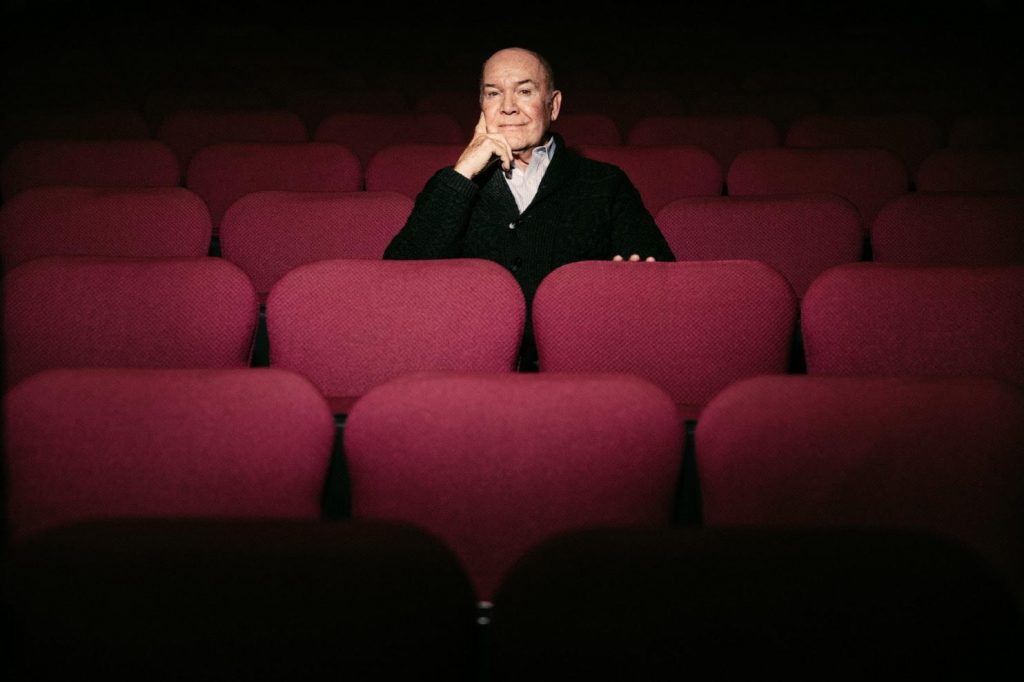
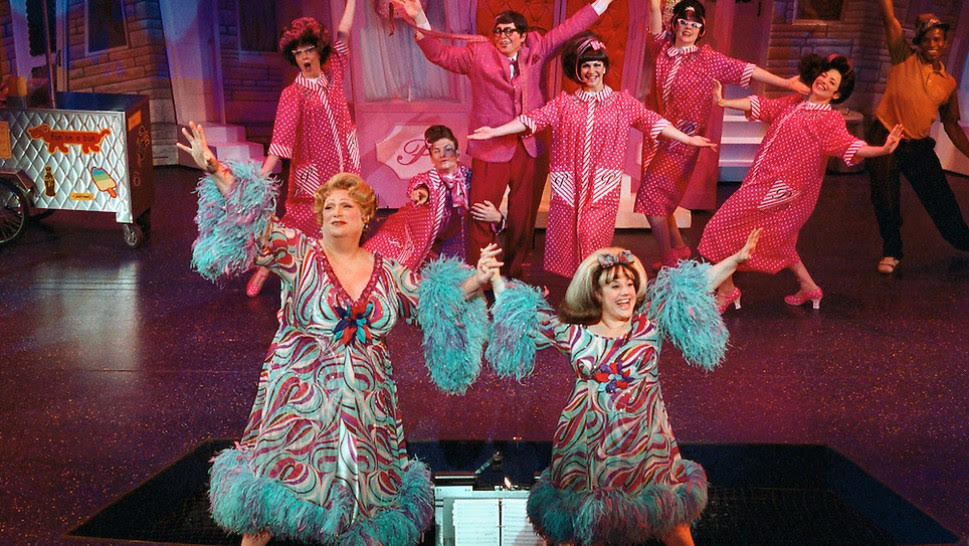
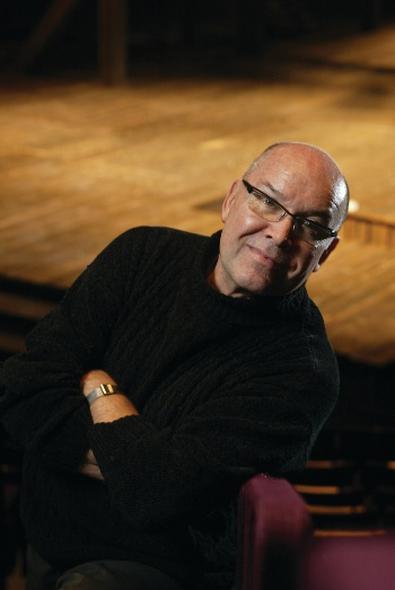
Jack O’Brien, one of the American theatre’s most honored directors, is a ten-time Tony Award nominee and has been awarded the Tony three times, for his direction of “Hairspray,” “Henry IV” and “The Coast of Utopia”. He is also the recipient of four Drama Desk Awards, for his staging of the aforementioned plays and “The Invention of Love”. Among his major New York theatre directorial credits are: “Porgy and Bess” (1977 revival), “The Most Happy Happy Fella (1979 revival), The Cocktail Hour, Two Shakespearean Actors”, “The Full Monty”, and “Dirty Rotten Scoundrels”. He served as the Artistic Director of the Old Globe Theatre in San Diego, California from 1981 to 2007.
Once upon a time my life changed forever when a horrible onstage accident led to a happily ever after. This was before my Broadway break, way back in Minneapolis, MN, where I grew up performing at the Tony Award-winning Children’s Theater Company, where we set our scene.
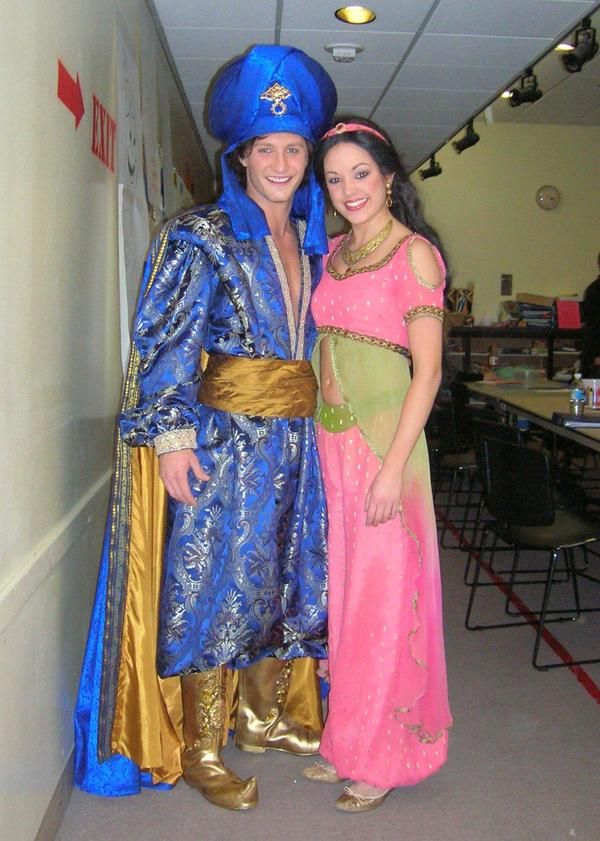
I took a year off after my freshman year of college to intern as a Performing Apprentice at CTC in 2006, performing and understudying in all the shows that season, including the splashy holiday musical, Disney’s Aladdin. It was led by one of the most influential directors of my life, Matthew Howe… who also proved to be a bit of a match-maker. I was 19 years old, cast in the ensemble, and charged with understudying the role of Princess Jasmine (forgive us, this was 15 years ago in a very scandinavian Minnesota). Also in the ensemble, a charismatic and very handsome young Nathan Johnson, understudied Aladdin. We often found ourselves gravitating towards each other, wanting to hang out on rehearsal breaks or between shows, and everyone (even my own mother) was placing bets on when we’d start dating. I had just gotten out of a long relationship and was hesitant to recognize any new romantic spark.
However, this budding “showmance” blossomed when one afternoon, the real Aladdin and Jasmine actually collided on stage in the middle of the opening song, “One Jump Ahead.” He spun around at just the right moment, with just the right velocity, to knock his teeth right into her forehead, chipping his front tooth in half. Like gladiators, they charged on, using Aladdin’s stolen loaf of bread to soak up the blood dripping from the bite into her eyebrow. The audience applauded as we buttoned the number, no one really realizing the severity of what had happened, until the voice of God came over the speakers to hold the show.
It was determined the real Aladdin and Jasmine would both need to be rushed to the hospital, Nathan would be the new Streetrat, and I would be stepping into the Princess’ beautiful, albeit blood-stained, golden gown (remember, this is regional theater where understudies get one rehearsal, rarely go on, and definitely don’t get their own understudy costumes or wigs).
Everything from here on out was basically a blur. Except that somehow, I knew I was going to be safe out there with Nathan — even though we were both understudies, taking on these iconic roles as blue-eyed babies, we had at least gotten one understudy rehearsal together and our off stage friendship made the onstage chemistry effortless. In Act II, as he reached his hand out to me earnestly, “Do you trust me?”, I knew there was truly no one I could trust more in that moment to have my back and look out for me as we navigated our way through telling the story from this new, fantastic point of view. I still can’t believe we actually rode that magic carpet together. As I said, my memory of it, from way up here, is far from crystal clear.
Unlike in the famous animated movie, Aladdin and Jasmine actually get married at the end of the musical. And this is the one moment I do recall. It was staged so that Nathan and I walked down opposite side aisles of the house, arriving and meeting center stage… Nathan in his pillowy, white turban, and me in Jasmine’s pristine, belly-button-bearing wedding dress. My eyes met his and we couldn’t help but smirk in disbelief and beam over the fact that we had made it. And that this was really happening!? With paper rose petals raining from the rafters and the entire teary-eyed cast staring at us and harmonizing a glorious reprise of “A Whole New World”, Nathan took my face in his hands and kissed the bride!
I know you want me to say that time stopped and fireworks exploded everywhere, but I’m a professional, and a stage kiss is exactly that… a stage kiss. Even when it’s with the boy I have a covert crush on. A few days later, I hosted a christmas carol party with the cast at my house, and as we said goodnight that evening, Nathan and I shared our first off-stage kiss… now THAT was indeed shining, shimmering, splendid! What was so inevitably meant-to-be, finally became clear in my heart. We started officially dating in that moment, he proposed exactly one year later, and we celebrated our 13-year wedding anniversary this past May. I guess you could say that onstage, fairytale wedding foreshadowed all that was to come, and it’s been a whole new world ever since!
LAURA OSNES was last seen on Broadway in Bandstand and the title role in Rodgers + Hammerstein’s Cinderella (Drama Desk Award; Tony, Outer Critics Circle, Drama League, Astair noms.). Other Broadway: Bonnie Parker inBonnie & Clyde (Tony nom.); Hope Harcourt in Anything Goes (DD, OCC, Astaire noms.); Nellie Forbush in South Pacific and Sandy in Grease. Encores! Productions of The Band Wagon, Faust and Pipe Dream; The Sound of Music in concert (Carnegie Hall); MCP’s Crazy for You (Lincoln Center); Carousel (Chicago Lyric Opera).
Kenneth Lonergan’s acclaimed THIS IS OUR YOUTH, which follows forty-eight hours in the lives of three very young New Yorkers at the dawn of the Reagan Era, has attracted a trio of the most exciting new actors. Lucas Hedges, an Academy Award nominee from Lonergan’s Manchester By the Sea, this year’s Emmy Award nominee for Best Actor, Paul Mescal (Normal People) and Grace Van Patten (The Meyerowitz Stories, Good Posture). This play, which involves theft, drug-dealing and youthful desires is a riveting snapshot of the moment between adolescence and adulthood. Lila Neugebauer (The Waverly Gallery) directs.
Bloody Bloody Andrew Jackson at the Jacobs Theatre
You might not think you can draw a line from Andrew Jackson to the sensual allure of the musical Moulin Rouge!, or that Herbert Hoover has anything to do with the anarchic fun of Broadway’s Beetlejuice. Alex Timbers, however, has proven the connection. Long before he directed those productions, he injected a similar, raucous spirit into three different musicals about American presidents.
In Bloody, Bloody Andrew Jackson, the 2010 Broadway show he created with Michael Friedman, he turned the Commander-in-Chief into a swaggering emo rock star. In 2015’s Here’s Hoover!, he let Hoover take the stage and argue, via rock songs, that he deserved a better reputation. And back in 2003, he directed Kyle Jarrow’s insouciant show President Harding is a Rock Star, which put a wild new slant on Teapot Dome and other scandals.
Alex Timbers and Michael Friedman
These projects not only helped Timbers develop the aesthetic style he’s carried over to his current Broadway hits, but also let him explore his particular fascination with the American presidency. The office has enticed countless theatre artists, since it offers so many angles for investigating America’s identity, history, and possible future.
Timbers is especially interested in subverting our common notion of the role. “There is something fun about taking presidents, whom one thinks of as very staid and buttoned-up, and ripping open that shirt collar,” he says. “Without being wildly rigorous with the depiction of these people, you can still capture their spirits and the way they catalyzed moments in history.”
Take the antihero of Bloody, Bloody Andrew Jackson: “We depict him as a frustrated teenager in the suburbs who feels overlooked by his parents, and even if that’s not literally true, it does get at something real about who Jackson was,” Timbers says. “He felt disenfranchised, and he felt that the frontiersman wasn’t being represented by the government.”
Benjamin Walker and the cast of Bloody Bloody Andrew Jackson
Timbers is also intrigued by the brevity of the president’s power, which only lasts a maximum of two terms. “I’ve always been interested in legacy,” Timbers says. “With kings, you die without knowing your legacy, but with presidents, you can live half your life after you’re out of office. You can see your legacy taking shape in front of you.”
It makes sense that he would compare a president and a king. According to cultural critic Isaac Butler, “If you’re doing a drama about the president, it allows you to engage in the same things that are so pleasurable about Greek tragedies or about Shakespeare’s history plays. You can tell the story of big social transformations and the nature of politics itself through the actions of one complicated individual.”
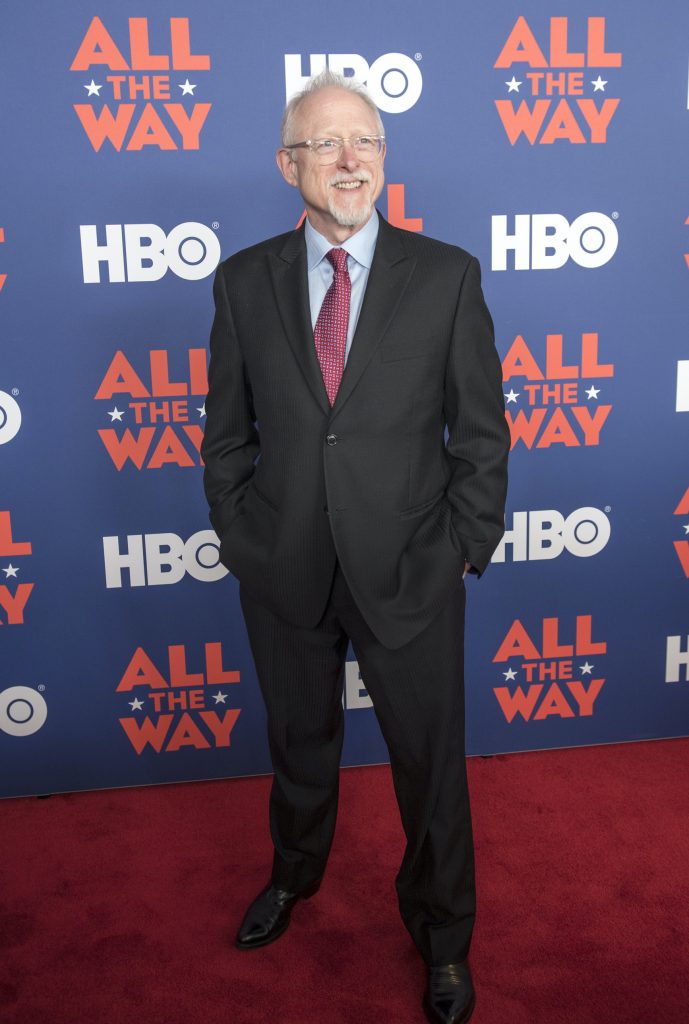
Robert Schenkkan
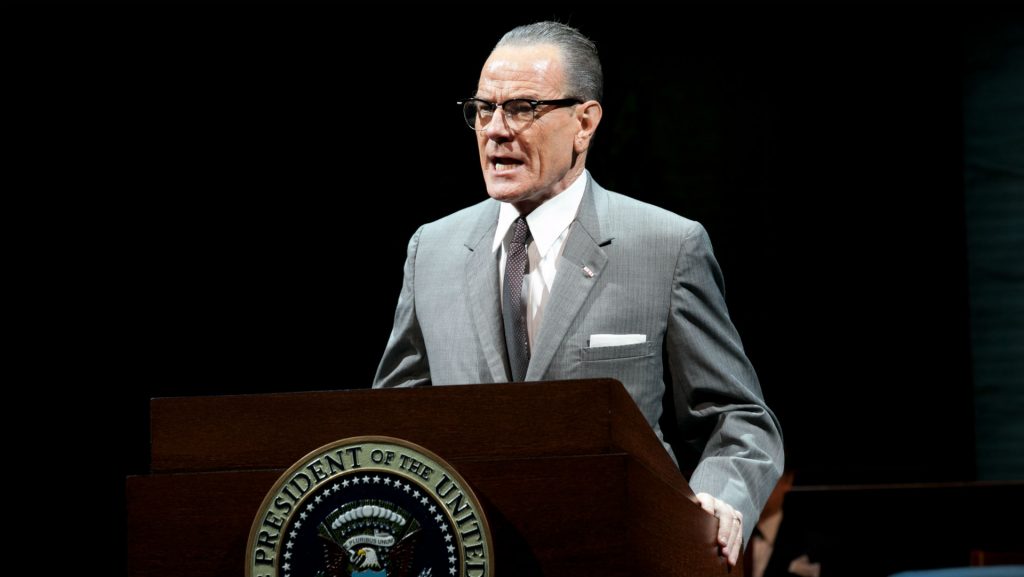
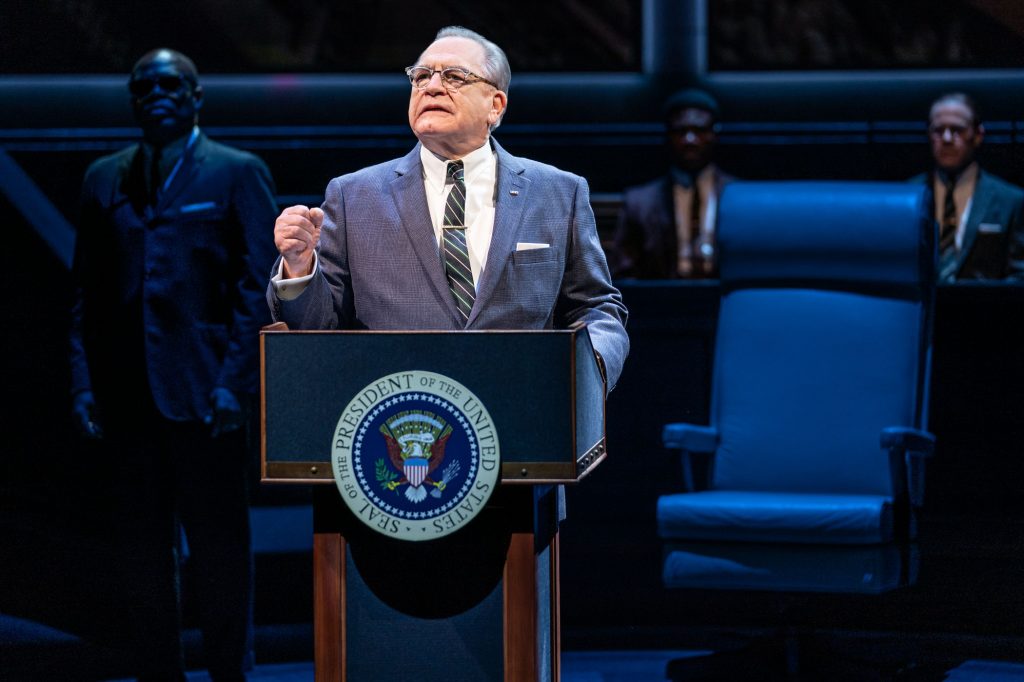
That epic sense of narrative certainly informed Robert Schenkkan, who wrote a two-play history cycle about Lyndon B. Johnson: In All the Way, which won the 2014 Tony Award for Best Play, we see Johnson on the ascendant, pushing to pass the Civil Rights Act and learning how to wield his office on behalf of his ideals. In The Great Society, which premiered on Broadway last fall, we see his plan for the titular social reform get swallowed by the quagmire of the Vietnam War.
“I was very much thinking about Shakespeare when I wrote, and the sense of the wheel of fortune rising and falling,” Schenkkan says. “There’s a rise and fall of kings, and LBJ was the king. All plays are, to varying degrees, about the acquisition, distribution, and use of power, and nothing is more clear in that regard than the narrative of how one becomes president and then how one governs as president.”
Americans deeply understand that story. No matter how long one has lived in the country, the president’s power — and that power’s ability to impact our lives — is impossible to overlook.
Left: Bryan Cranston as LBJ in All the Way. Right: Brian Cox as LBJ in The Great Society.
In fact, long before he wrote about him, Robert Schenkkan had a first-hand encounter with LBJ’s influence. The future writer was only three or four years old at the time, visiting the then-senator’s Texas ranch after his father (a major player in public broadcasting) got an invitation. And while Schenkkan doesn’t remember much about the trip, he has asked his older brother for details.
“My brother told me, ‘I don’t remember LBJ specifically, but what I remember is how incredibly respectful our father became around this strange man,'” Schenkkan says. “And what’s interesting about that to me is the child’s perception of his father’s response to the presence of power. That’s what stuck with him. I think that’s a really illuminating anecdote.”
That’s the kind of story, in fact, that could become the basis of a play.
Mark Blankenship is the founder and editor of The Flashpaper and the host of The Showtune Countdown on iHeartRadio Broadway.
Thank you for all who have donated to the Actors Fund!
GORE VIDAL’S THE BEST MAN weaves humor and suspense in equal measure as a Secretary of State and a U.S. Senator contend for the Presidential nomination and, most importantly, for the endorsement of a colorful and canny ex-President. Academy Award winner Morgan Freeman plays the ex-President and the company of actors includes John Malkovich, Zachary Quinto, Vanessa Williams, Stacy Keach, Tony Award winners Phylicia Rashad, Reed Birney, Katie Finneran, and Elizabeth Ashley, directed by Michael Wilson.
To have my Broadway debut be the 2000 revival of Gore Vidal’s The Best Man was a stroke of good fortune that almost passed me by. I had been filming Sex and the City at the time and convinced myself that I shouldn’t try to juggle the two (which actually was not a problem since my character came and went throughout the series and wasn’t in every episode). The truth is I was a bit intimated by the character of Joe Cantwell – he seemed like an archetype to me – with the distinct possibility of descending into a caricature and I wasn’t sure that could pull it off – so I turned it down.
On set of SATC that week I casually mentioned this to Sarah Jessica. “Have you lost your mind?!!” she exclaimed (with some exasperation), “It’s GORE VIDAL on BROADWAY!! Wake up!!!” I’m so glad I did. With a cast of 17 and a voiceover by Walter Cronkite – this examination of a presidential election during a presidential election proved to be the most exciting and unforgettable experience I’ve ever had on stage. The actual election was a nail biter and when the results of Florida came out – many of us were on stage.
I remember being in a scene with Christine Ebersole (who played my wife) – and hearing Elizabeth Ashley’s distinctly loud voice off stage, “Al Gore just won Florida!…Hooray!!!!” But by intermission they took it away from him. With ballots being recounted over the next weeks – suddenly the audience who came to see us were listening much, much more intensely to what Gore Vidal had to say about politics. Dialogue which never got much response before – like “Bill this convention is really hung up and the way things are going we may never nominate anybody” suddenly got a roar of laughter – people were invested in what they were hearing on stage – every moment seemed to have meaning and Gore’s play seemed to be giving them insight to what was happening to the country in real time.
And oh what a band of players I got to be with-all of them! I can never forget Spalding Gray who managed to convey an electric wire of nerves with an unflappable serenity at the same time. Michael Learned who played the enduring wife to Spalding’s – Bill Russell – brought such a delicate ballast to Spalding’s intellectual storms – she always amazed me with her pitch perfect timing. The charming, sly, with a dash of the devil – Charlie Durning who many nights before curtain regaled me with the stories of World War Two and his hand to hand combat during the Battle of the Bulge. Who could have guessed that Charlie Durning was phenomenal ballroom dancer? So deft on his feet he seemed to float; which to our shock and awe he displayed at different parties during the run. And my partner in crime Christine Ebersole who’s merry, lilting laugh and participation in some high jinx pranks with me made every night a joy…
My dressing room next door neighbor Elizabeth Ashley, whose booming voice and laugh filled the theater on and off stage, was and is a treasure. and this is where my friendship with Mark Blum, recently lost to COVID-19, began 20 long years ago – Mark the consummate actor – never one to blow his own horn – Mensch doesn’t begin to describe what he brought to the mix. Once you worked with Mark – you wanted him in every project you ever got hired for. We both went right from the play to a soapy mini series in Toronto – thank God he was with me – we were to be in a production of Uncle Vanya this summer at The Berkshire Theater Group. It’s hard to even consider him gone. And of course the master – Gore Vidal whose stories of history, literature and gossip (a lot of historical gossip) – wicked impressions of Tennessee Williams and Truman Capote – made for glamorous nights of drinking.
How can so many of this group have passed? I miss them all… the living and the dead; and the experience of together bringing life to Gore’s grand play for the ages.
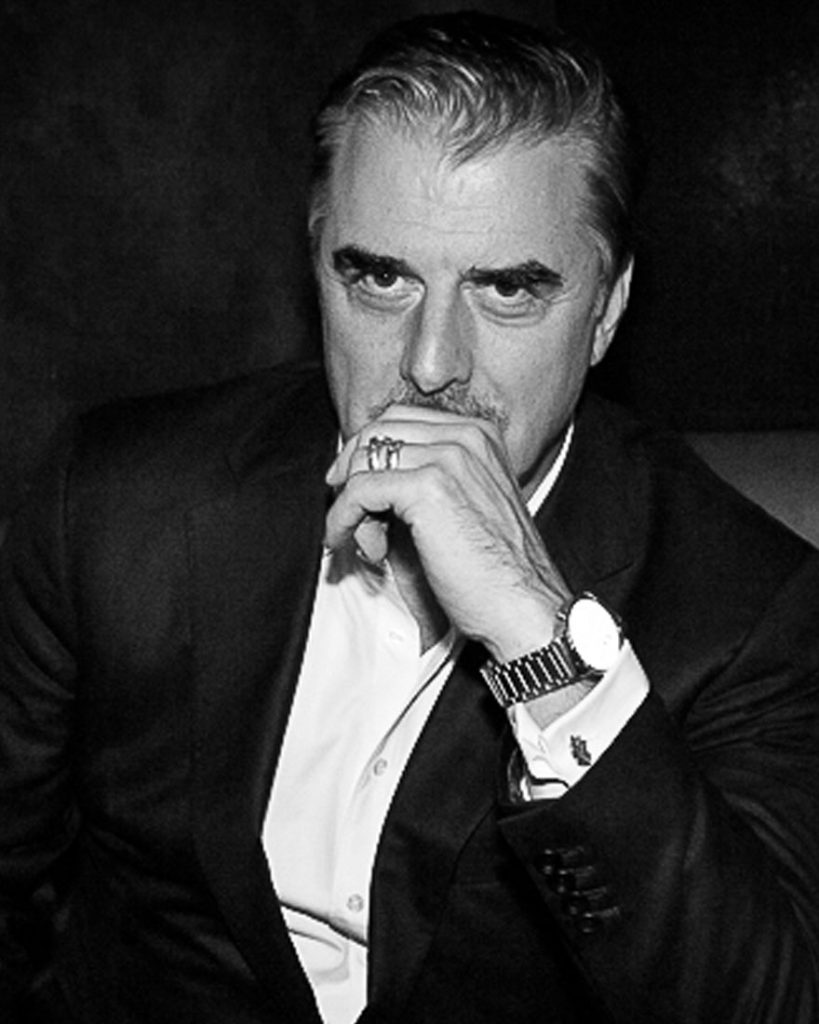
Chris Noth
Christopher David Noth is an American actor. He is perhaps best known for his television roles as NYPD Detective Mike Logan on Law & Order, Big on Sex and the City, and Peter Florrick on The Good Wife.
Broadway’s Best Shows is proud to present Spotlight on Plays, a starry series of livestream readings of Broadway’s best plays to benefit The Actors Fund.
Spotlight on Plays presents
7 Great Plays by 7 Great Playwrights
ANGRY, RAUCOUS AND SHAMELESSLY GORGEOUS
by Pearl Cleage
THE THANKSGIVING PLAY
by Larissa FastHorse
WATCH ON THE RHINE
by Lillian Hellman
THE OHIO STATE MURDERS
by Adrienne Kennedy
DEAR ELIZABETH
by Sarah Ruhl
THE BALTIMORE WALTZ
by Paula Vogel
THE SISTERS ROSENSWEIG
by Wendy Wasserstein
COMING SPRING 2021
The Actors Fund envisions a world in which individuals contributing to our country’s cultural vibrancy are supported, valued and economically secure.
Mission: The Actors Fund fosters stability and resiliency, and provides a safety net for performing arts and entertainment professionals over their lifespan.
With Stars Of Hamilton, The Band’s Visit, and Fiddler On The Roof
Based in Jewish tradition, Shabbat — and its teaching that spending meaningful time connecting with friends and family — is for everyone. Much like yoga or meditation can be, Shabbat is an act of peaceful rebellion against a constantly moving world. When this isolating global pandemic took hold, OneTable was looking for a way to keep the magic of Friday night Shabbat going, and for a way for people to mark time when every day feels the same.
They landed on PAUSE, a new video series collaboration between OneTable and Broadway’s Adam Kantor. Initially conceptualized as a one night special, OneTable and the production team behind Saturday Night Seder were stuck on the fact that the beauty of Shabbat comes from its unfaltering arrival every single week. The series is designed to build on the ritual of Shabbat, to take a moment — a pause — and ask big questions. Each video melds tradition with innovation, asking and answering the question how might we imagine the world not as it is, but as it could be?
“Since Broadway has shut down, I’ve been missing the joys of collaborating with artists who inspire me on the daily,” Kantor said. For the series debut, OneTable and Kantor collaborated with dancer/choreographer Jesse Kovarsky (The Band’s Visit, Fiddler On The Roof, Sleep No More). “Jesse is one of my favorite artists and collaborators on Broadway,” Kantor said. “We first met during Fiddler On The Roof, in which he played the titular role, and then we had the good fortune of working together again on The Band’s Visit, in which he was the associate choreographer.” Filmed in his own NYC apartment, Kavarsky explores his interpretation of receiving traditional Shabbat candles in the mail from his parents, and figuring out how to make them his own — delving into the question, “What do we do with the things we inherit?”
The second installment (Friday, November 6) features Daniel Watts (Hamilton, Marvelous Mrs. Maisel, In the Heights, Tina) and Kelly Hall-Tompkins (the fiddler violin soloist in the recent Broadway revival of Fiddler On The Roof), wrestling with the concept of making the ancient new, through music and spoken word poetry. The remaining ten episodes of the series (co-produced by Eric Kuhn and production agency Gesundheit Media) will debut on each of the first Fridays of the month, culminating on Friday, September 3, 2021.
You can watch the first video above, and stay tuned at @onetableshabbat or onetable.org/pause on the first Friday of each month at 5pm Eastern as featured artists offer their personal interpretation of the traditions, intentions, and contemporary applications of Shabbat ritual through digital performance art, spoken word, dance, song, humor, meditation and more.