Whether it’s long-standing shows or a limited-run production, Broadway offers the best theater New York – and the world – has to offer. With over 40 theaters and a never-ending list of shows coming and going, it’s often hard to choose what to see. So, we’re going to give you our best Broadway shows for 2023.
Hadestown by Anaïs Mitchell
Greek myth is all the rage at the moment and Hadestown has added fuel to that hellfire. The musical based on the myth of Orpheus and Eurydice had a long road to Broadway but now it’s here, we don’t know what we would have done without it.
After workshops that started back in 2006, Hadestown finally landed a run on Broadway in 2019. It was an instant hit and garnered 14 Tony Award nominations of which it won eight.
The modern retelling of the ancient myth shows a young woman who chooses to sell her soul to Hades in a bid to ease her suffering. However, she is soon forced to work in his factory and her lover, a wannabe musician, attempts to save her from her miserable fate all set to an incredible soundtrack.
Currently playing at Walter Kerr Theater.
Kimberly Akimbo by David Lindsay-Abaire and Jeanine Tesori
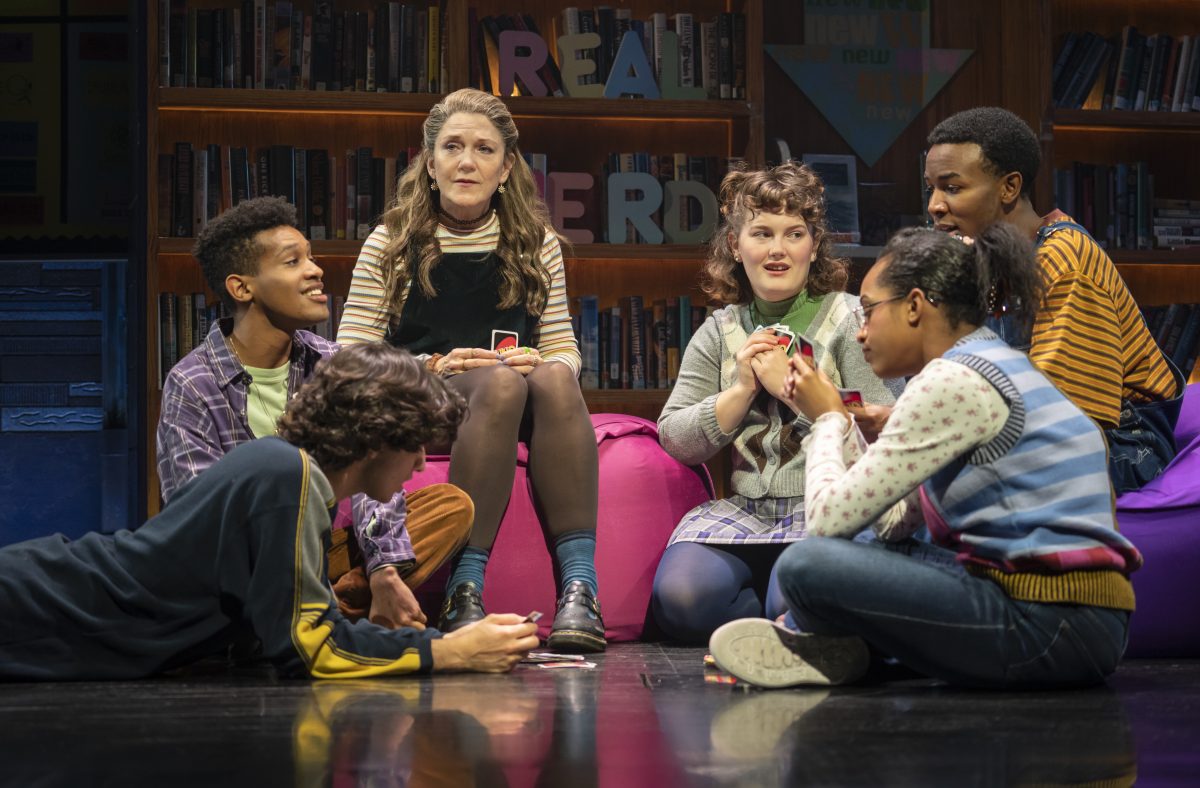
This year’s Best Musical winner at the Tony Awards, Kimberly Akimbo, is a touching and joyful show centring Kimberly Levaco – a 16-year-old high schooler who suffers from an incredibly rare condition that makes her age rapidly – played by 63-year-old Victoria Clark.
The show, based on David Lindsay-Abaire’s 2001 play of the same name, is a clever and darkly absurd comedy about a teenager dying of old age. It’s set to a playful and uplifting score from Caroline, Or Change’s Jeanine Tesori and it’ll leave you with a newfound verve for life.
Currently playing at Booth Theater.
Moulin Rouge! The Musical by John Logan
This red-hot stage adaptation of Baz Luhrmann’s film of the same name enchanted audiences when it opened in June 2019. Even COVID-19 couldn’t slow down its momentum. After nine months of packed audiences and rave reviews, Moulin Rouge! The Musical was forced to close due to multiple cast members contracting the virus. They hoped to reopen a few weeks later but a few weeks turned into over a year when the whole of Broadway went dark. When doors reopened, audiences flocked to the windmill for the extravagant show and they weren’t disappointed.
Winning 10 Tony Awards – including Best Musical, Best Actor in a Musical (for Aaron Tveit) and Best Choreography – this tragic, brash, raunchy love story is filled with glitter and heart.
Currently playing at Al Hirschfeld Theater.
The Book of Mormon by Trey Parker and Matt Stone
You won’t know whether to laugh, cringe, or sing along with this dark satire that’s been winning over audiences since 2011. The Book of Mormon follows two young Mormon missionaries who are sent to Uganda to recruit local people to join the Church of Jesus Christ of Latter-day Saints. Once there, they’re made to face the realities of the world and the inconceivable hardships people have to undertake resulting in their faith being rocked.
From the creators of South Park, this tongue-in-cheek, outrageous, incredibly dark comedy musical makes social commentary no one thought possible (or appropriate) to make. But with nine Tony Awards under its belt and a run that looks infinite, it’s definitely a crowd-pleaser.
Currently playing at Eugene O’Neill Theater.
Sweeney Todd: The Demon Barber of Fleet Street by Stephen Sondheim and Hugh Wheeler
If A-listers are the name of your game, you’ll lose your head if you miss this killer revival.
Sweeney Todd: The Demon Barber of Fleet Street is arguably one of the greatest Broadway musicals of all time. Written by the late-great Stephen Sondheim, it features his signature and irreplaceable sound along with a true crime story you won’t be able to resist.
The current revival has won praise from all, with much of that admiration going to the show’s stars Josh Groban, Annaleigh Ashford, Jordan Fisher, and Gaten Matarazzo.
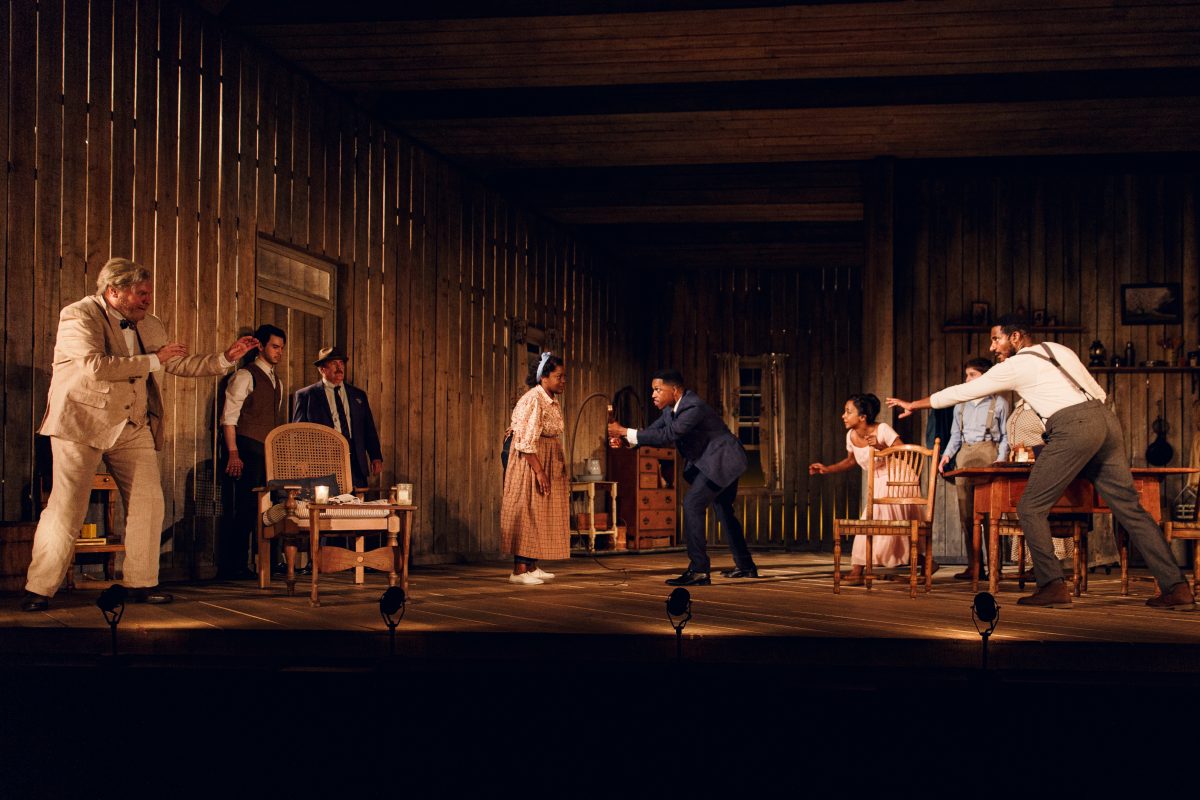
“Purlie Victorious: A Non-Confederate Romp Through the Cotton Patch” has withstood the test of time and stands as evidence of the genius of the late great Ossie Davis, but it is also so much more than that. When I heard that this play was returning to Broadway after 62 years I was absolutely thrilled! It began performances on Thursday, September 7, 2023, and officially opened on Wednesday, September 27, 2023, at the Music Box Theatre. The production was later extended through February 4, 2024! Talk about a legacy and a play with a timeless message.
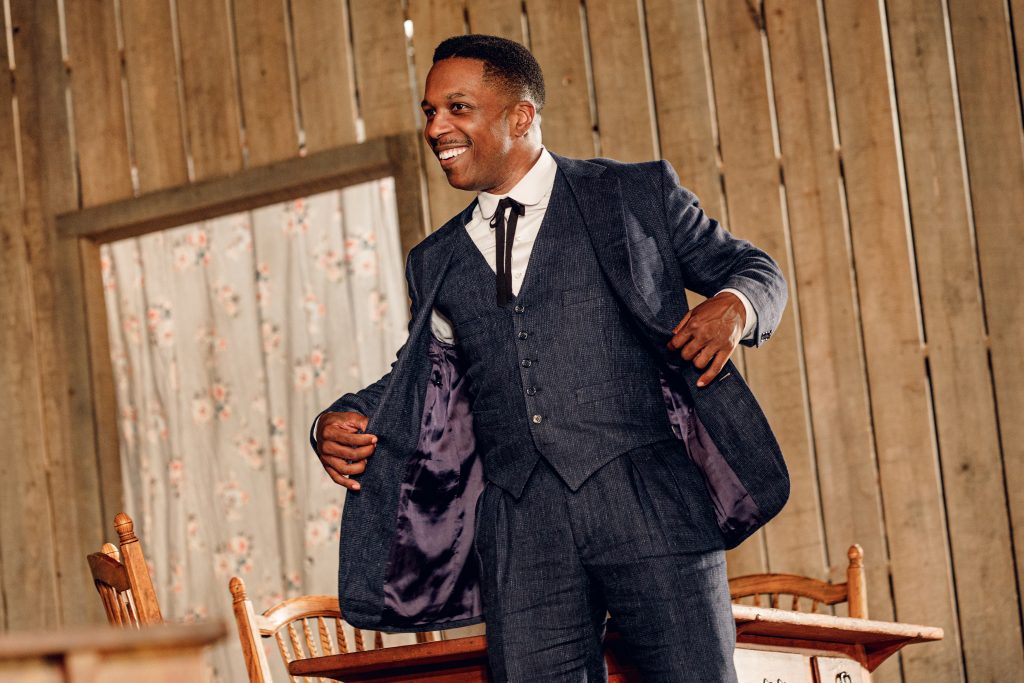
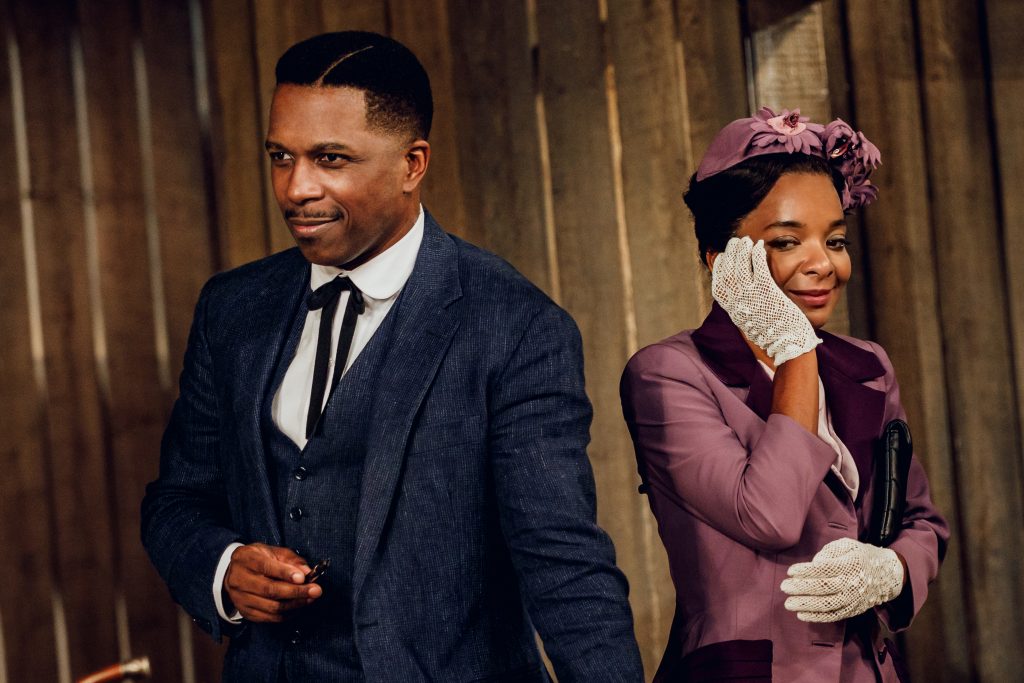
Leslie Odom, Jr. stars as Purlie Victorious Judson. Photo by Marc J. Franklin.
Ossie Davis is regarded as an incredible person who left a great legacy as an actor, playwright, and activist. His play contains a timeless message about Black love, pride, identity and the Black person’s indomitable spirit that allows them to fight for their rights. “Purlie Victorious: A Non-Confederate Romp Through the Cotton Patch” shares the story of Purlie Victorious Judson, a Black Preacher fighting segregation and trying to save his church. When Davis first debuted this play at the Cort Theatre—now the James Earl Jones Theatre—on September 28, 1961, the Civil Rights Movement was in full swing. Blacks had few opportunities to be on stage, let alone Broadway stages and Black roles on stage were not something that promoted Black pride. With this play Davis offered an incredible solution to so many issues of the time. He used this play to not only tell an African American story that fought against segregation, but to encourage Black people to love themselves—take pride in their physical appearance—and he created this play to give Black actors much needed jobs and establish their names in the industry.
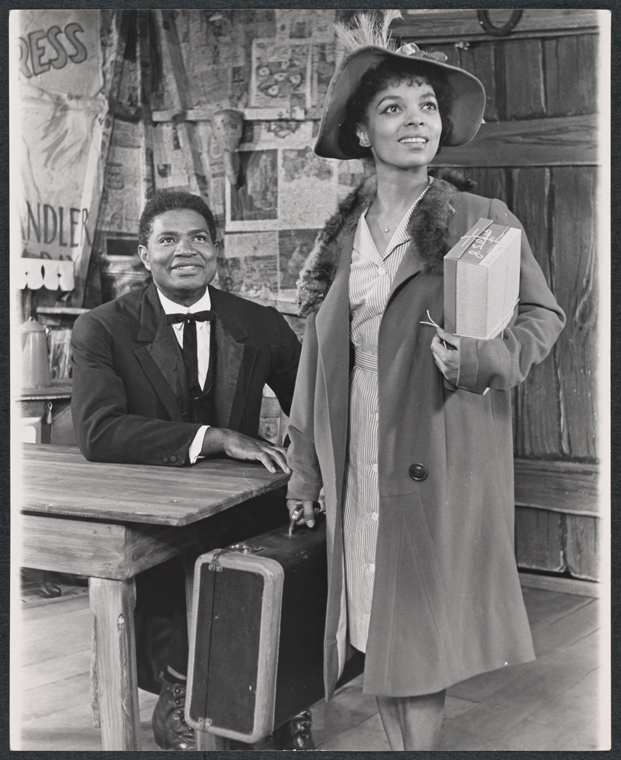
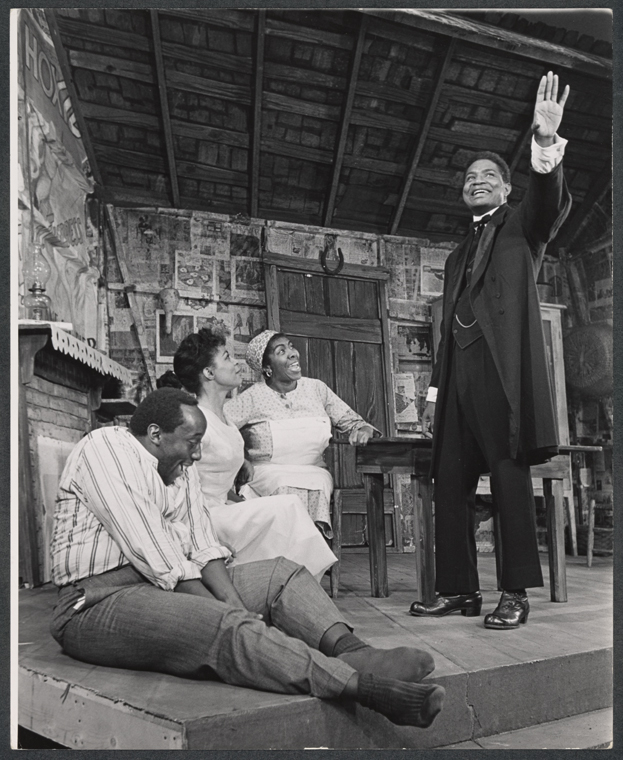
Ossie Davis and Ruby Dee in “Purlie Victorious.” Photo by Friedman-Abeles.
He starred in the play as Purlie Victorious Judson and he created the role of Lutiebelle Gussie Mae Jenkins for his wife Ruby Dee. Other prominent actors were Godfrey Cambridge–who received a nomination for the 1962 Tony Award for best performance by an actor in a featured role in a play for the role of Gitlow Judson, and a young Alan Alda appeared as Charley Cotchipee before becoming known for his role in the long-running television series M*A*S*H. The company also included Sorrell Booke who played Ol’ Cap’n Cotchipee, Helen Martin who played Missy Judson, Beah Richards who played Idella Landy, Ci Herzog as The Sheriff and Roger C. Carmel as The Deputy. The original work was directed by Howard Da Silva. Sadly, the racism that existed when this play first ran continues to be a part of our society’s fabric. Black people are still fighting racist hatred, being treated poorly and having a hard time feeling proud of who they are. And consequently, this play is as relevant today as it was 62 years ago.
Leslie Odom, Jr. and Kara Young as Purlie Victorious Judson and Lutiebelle Gussie Mae Jenkins, respectively. Photo by Marc J. Franklin
When “Purlie Victorious…” debuted in 1961 it played 261 performances and critics happily acknowledged Davis’ writing talent, his acting talent and that of his wife, Ruby Dee. The Daily News wrote, “As a playwright, Davis is well equipped with crackling jokes and jabs…As a comic actor he is very skillful, with a remarkable voice, a most amiable presence…Miss Dee reveals herself as a deft and charming comedienne…”Variety raved, “Purlie Victorious reveals a new playwright of promise, particularly in the race field of broad comedy…Davis and his wife, Ruby Dee, are costarred in this conglomerate mixture of comedy, melodrama, farce, fantasy and tolerance sermon, with a basically serious, if not intense, theme…A novel aspect of the play is its uninhibited use of racial stereotypes (both Negro and white) for comedy. Beneath all the laughs, of course, the author is purposeful, and his points are effectively made.” The New York Times remarked, “Ossie Davis, actor and author, has passed this miracle of uninhibited and jovial speaking out in his new play, Purlie Victorious …While Purlie Victorious keeps you chuckling and guffawing, it unrelentingly forces you to feel how it is to inhabit a dark skin in a hostile or, at best, grudgingly benevolent world.”
Original Broadway production of “Purlie Victorious.” Photo by Friedman-Abeles
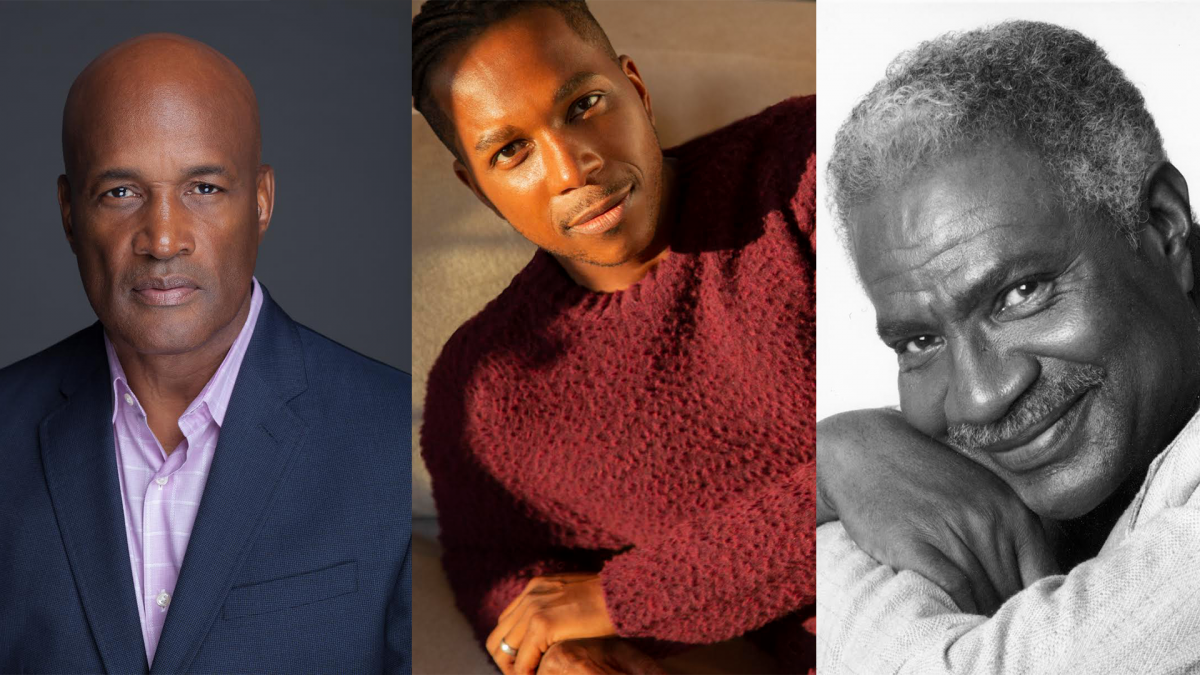
While the original production in 1961 launched careers, the 2023 production is being embraced by established, award-winning stage artists. Tony Award winner and Oscar nominee Leslie Odom, Jr. (Hamilton, One Night in Miami) plays the lead role of Purlie Victorious Judson, twice Tony-nominated actress Kara Young (Clyde’s, Cost of Living) plays Lutiebelle Gussie Mae Jenkins; they are be joined by Billy Eugene Jones (Fat Ham), Vanessa Bell Calloway; Heather Alicia Simms, veteran theater actor Jay O. Sanders,; Noah Robbins, Noah Pyzik and Bill Timoney. The play is directed by Tony Award winner Kenny Leon (A Raisin in the Sun, Fences).
Recently, the three children of Ossie Davis and Ruby Dee, Nora Davis Day, Guy Davis, and Hasna Muhammad, talked about what Purlie Victorious meant to their family, and what this play meant back then and means today. Nora recalled that her father worked on this play for 5 years. “He told me what he was doing from beginning to end,” she said, sharing why this work has a special place in her heart. “I remember being a little girl and knowing when it got late at night Dad would be downstairs with a legal pad–that’s how he wrote and he wrote in pencil and he would tape his pinky finger because when he was writing if he wasn’t careful he would get a callus or a blister on his pinky. He used scotch tape which was always interesting. So, when we had the opportunity to bring the play back there was no question that we would respond to Jeffrey [Richards-one of the producers] and others for this opportunity to get Dad’s poetic play back on Broadway.”
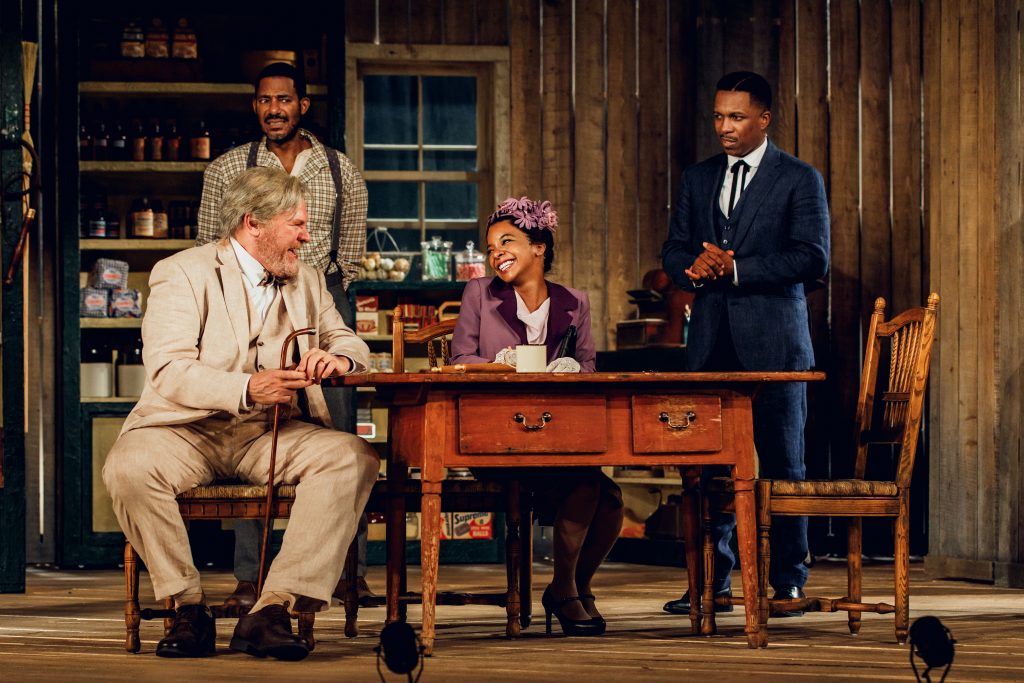
Jay O. Sanders, Billy Eugene Jones, Kara Young & Leslie Odom, Jr. Photo by Marc J. Franklin.
Considering the importance of the character of Lutiebelle Gussie Mae Jenkins, Guy realized that his father was an innovator for women. “It was something that was ahead of its time in terms of women getting important roles. But, I think that Dad’s motive was more love than politics…It was a chance for the family to work together.”
Ossie Davis and Ruby Dee taught their children the value of having Black stories and putting Black actors to work. Hasna shared, “Mom and Dad always talked with us about the significance of having African American writers, producers and directors and people behind the scenes, people owning the studios. And the fact that they were in a play where they were working actors was always something to be celebrated and they were glad for it and we felt happy for them, but they never lost sight that there were so many other Black actors who weren’t working. Some of them weren’t working just because they were Black and because there were no roles for Black folk. I think that the fact that Dad was able to write something that both he and Mom were able to perform in, but not only perform in, but perform on Broadway, this was incredible.”
Speaking on the legacy of this beloved play Hasna reflected, “It’s legacy, an African American playwright has had a play on Broadway and a play that is considered a classic… For the character of Purlie Victorious the legacy speaks about manhood, about finding oneself acceptable and beautiful without needing the white gaze and being able to use wit and the constitution to fight segregation, to use humor to fight segregation. It’s another tool in our toolbox for the liberation of our people. There’s all types of art that bring different perspectives on what resistance looks and feels like and what Dad does is he adds to those tools the value of laughter and humor and our ability to resist.”
The foremost First Lady of her time, or perhaps ever, Eleanor Roosevelt said it best: “If you have not seen ‘Purlie Victorious’ I think it is well for you as an American citizen to see it and to ponder our racial problem, not as a question affecting our lives here in the United States but as a question affecting our standing and our real sincerity among the peoples of the world.”
Ossie Davis and Ruby Dee left a great legacy for their children and the world. They raised their children in theater, but also in civil rights and made them a part of any protest they participated in, instilling in them the importance of supporting the Black community. Today they are artists, teachers, photographers and they continue, through their work, the legacy that Davis and Dee started. See a piece of their and our history at the Music Box Theatre.
New shows come to town all the time. But there are those long-standing favorites that feel like they just belong in New York City. In our list, we’ll be including the longest-running Broadway shows of a single production – past and present. And you know what they say: only the best Broadway shows have runs like these.
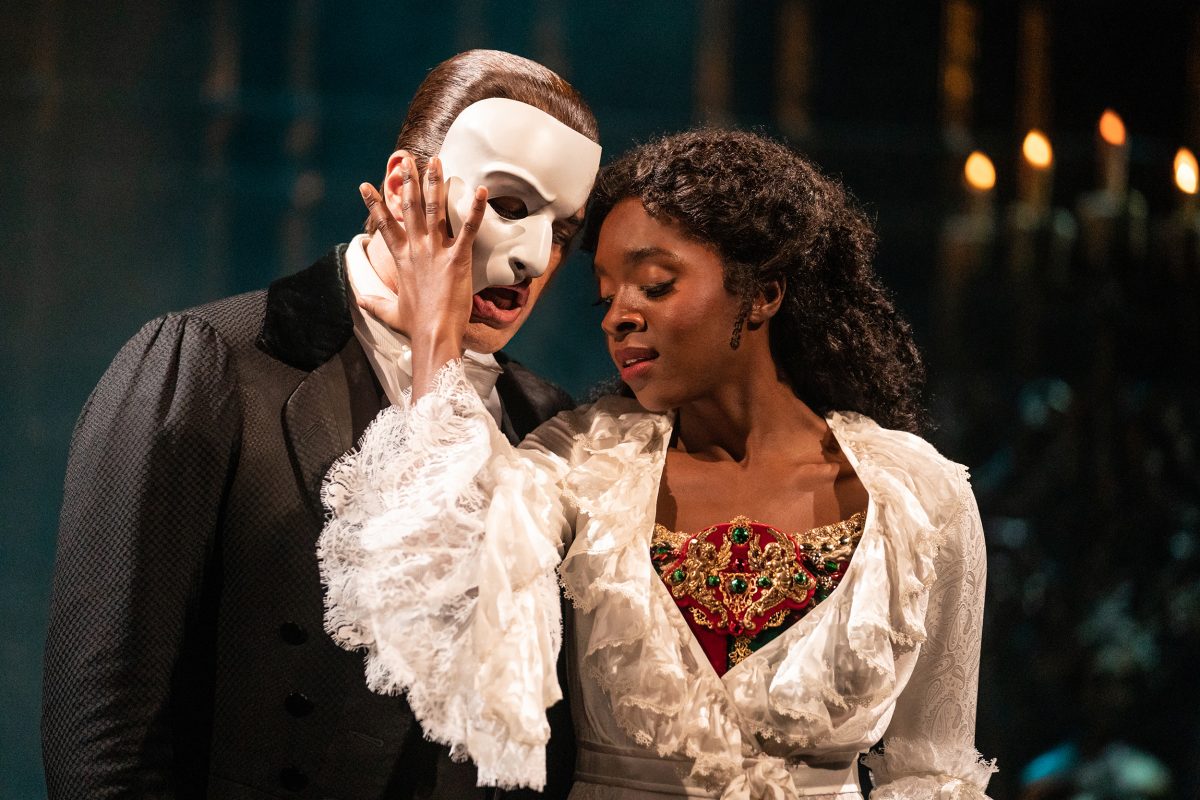
Photo by Matthew Murphy.
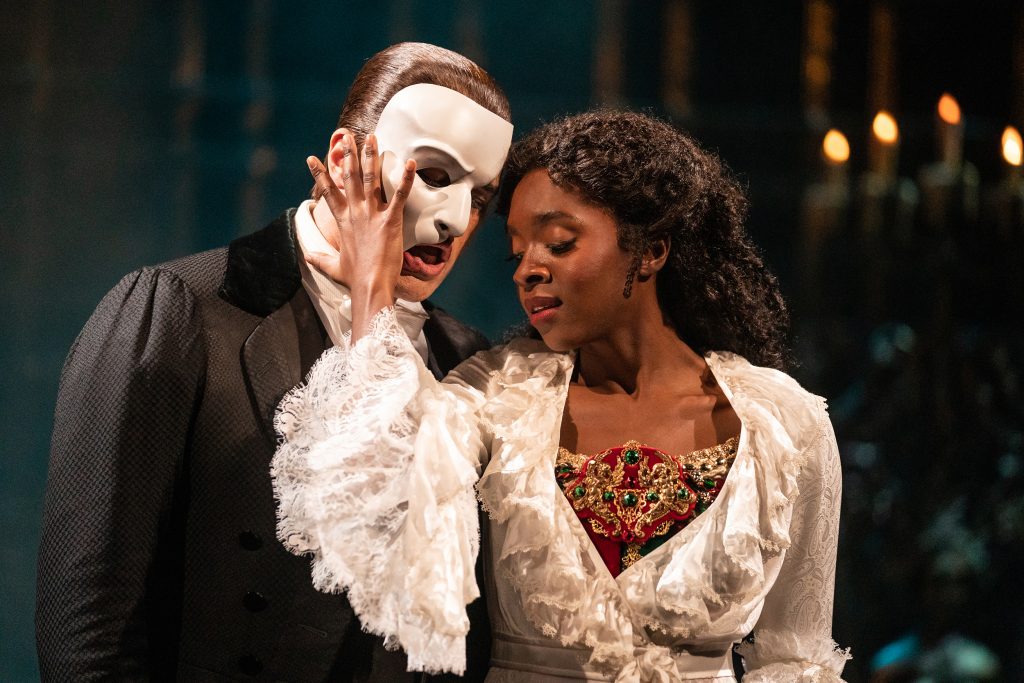
The Phantom of the Opera by Andrew Lloyd Webber and Charles Hart
With an unbelievable 13,981 performances, The Phantom of the Opera easily tops the list. For 36 years it took residence in the Majestic Theater where it ran from January 26 1988 to April 16 2023.
When it first opened, it won seven Tony Awards and seven Drama Desk Awards. It was the first Broadway musical in history to surpass 10,000 performances and has had over 3,500 more performances than the second longest-running Broadway show in history – that’s over eight years of performances! With a record like that, it really is one of the best Broadway shows.
Photo courtesy of Boneau/Bryan-Brown.
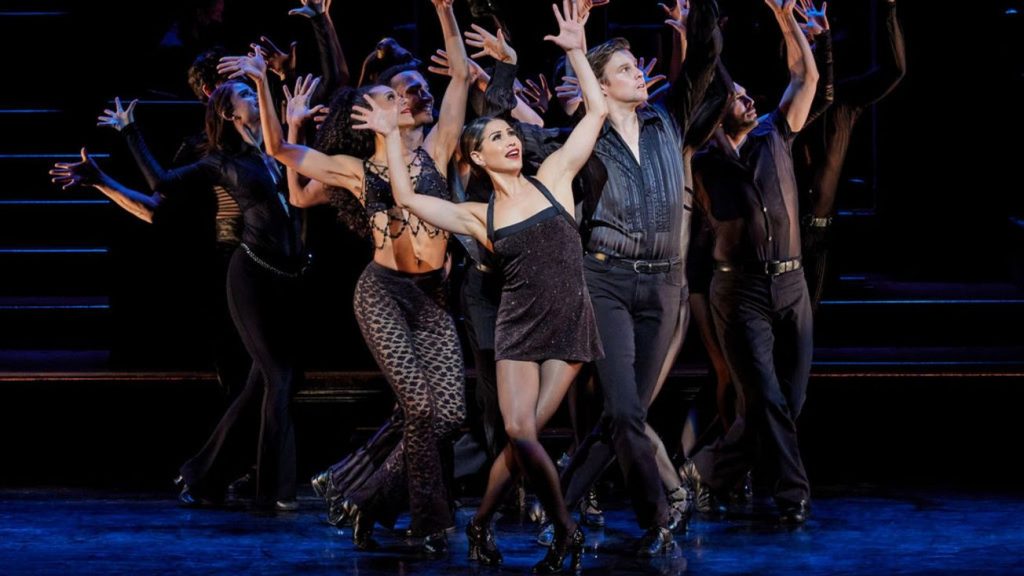
Chicago (1996 revival) by John Kander and Fred Ebb
Chicago’s original 1975 production ran for a respectable 936 performances. But it was its second coming, the 1996 revival, that made it a show everyone knows and loves.
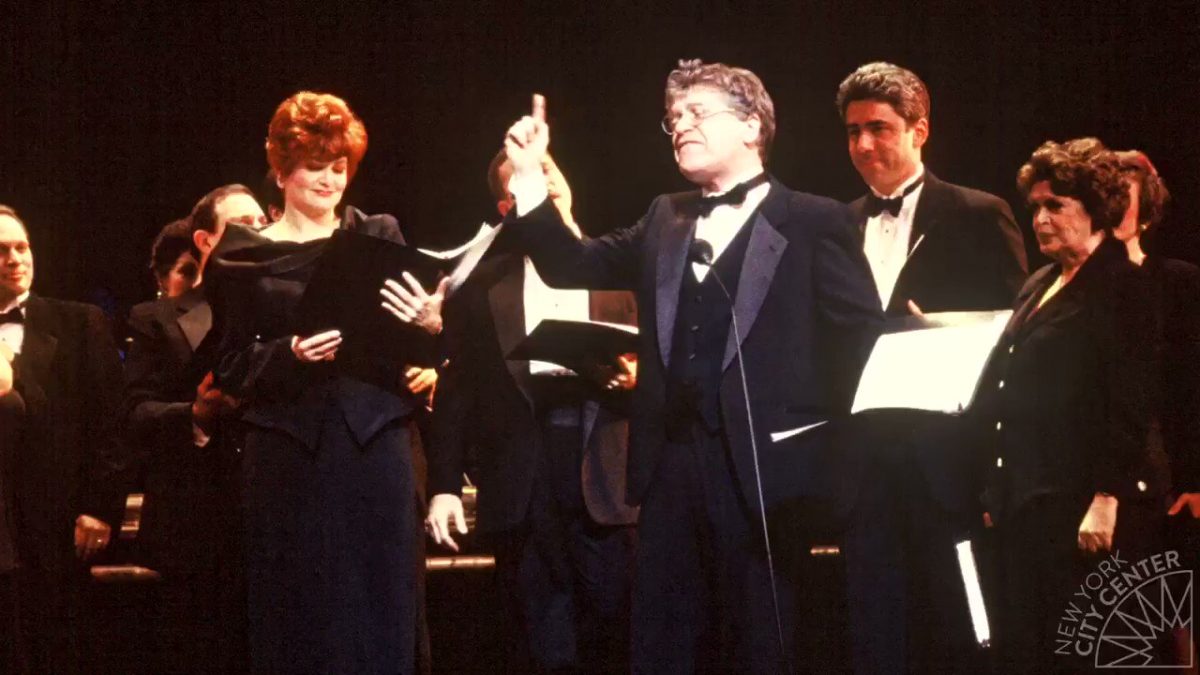
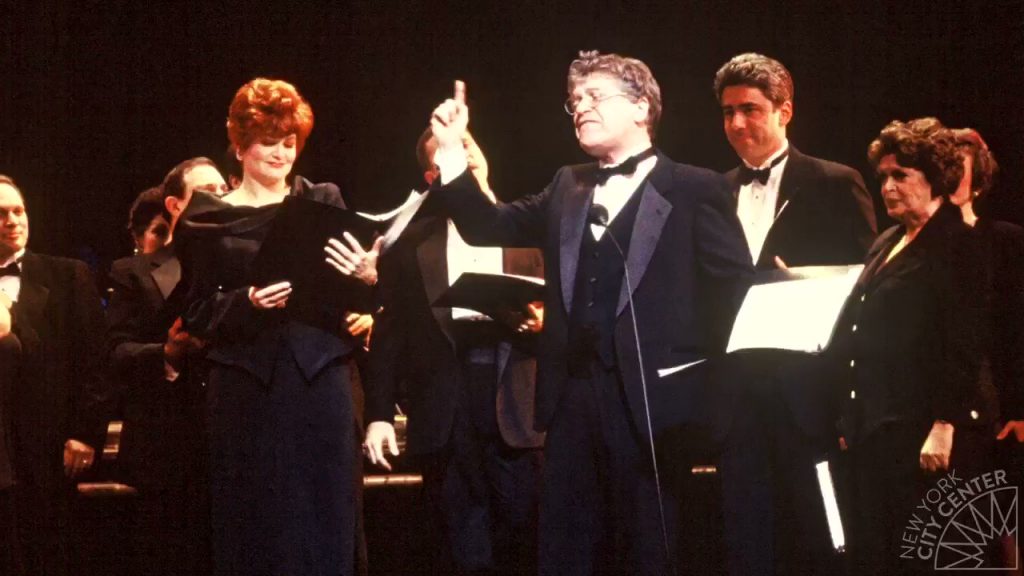
Following a showcase in the City Center Encores! series, Barry and Fran Weissler brought an expanded, revised, and jazzed-up production of the Encores! concert to the Richard Rodgers Theater (the same theater the original production was staged). After rave reviews and six Tony Awards, it was an undeniable hit and had to be moved to the larger Shubert Theater in 1997. It stayed there for seven years until it was moved for a second time to the Ambassadors Theater in 2014 where it still runs today.
So far, it’s had over 10,400 performances and is the longest-running revival in Broadway history.
Photo by Joan Marcus.
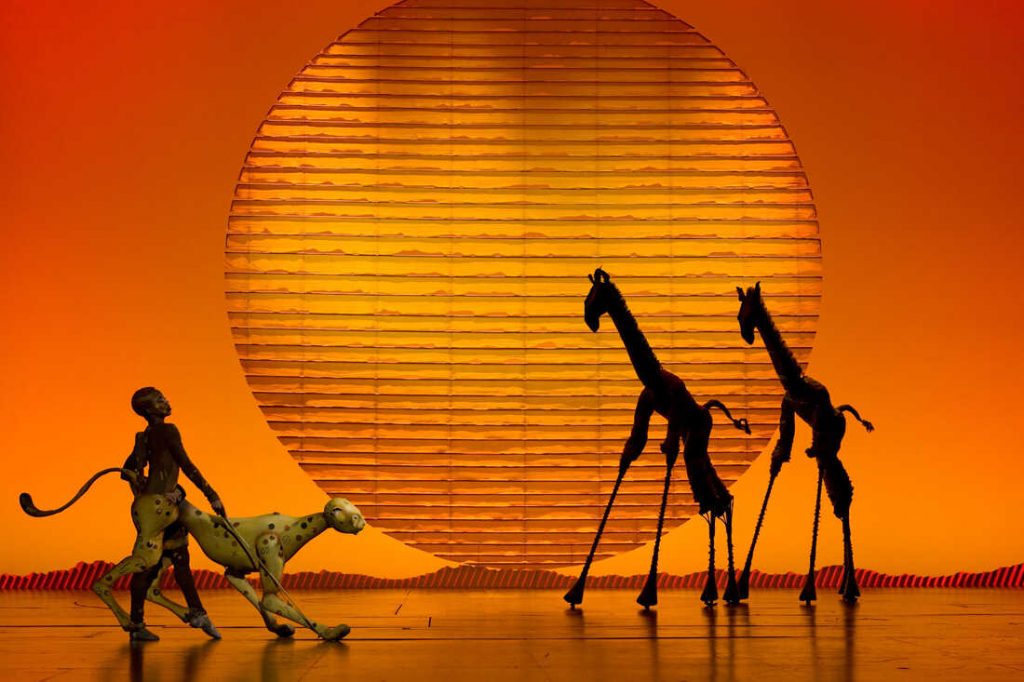
The Lion King by Elton John and Tim Rice
The groundbreaking stage adaptation of Disney’s animated film of the same name left both children and adults filled with wonder. Featuring giant puppets and unforgettable songs by Elton John and Tim Rice, The Lion King had audiences stampeding to the theater to watch the incredible show.
It originally opened at the New Amsterdam Theater in 1997 before moving to the Minskoff Theater in 2006. Its current performance count stands at over 10,000 which has resulted in over $1 billion in gross sales making it the highest-grossing Broadway production of all time.
Photo by Mark Senior.
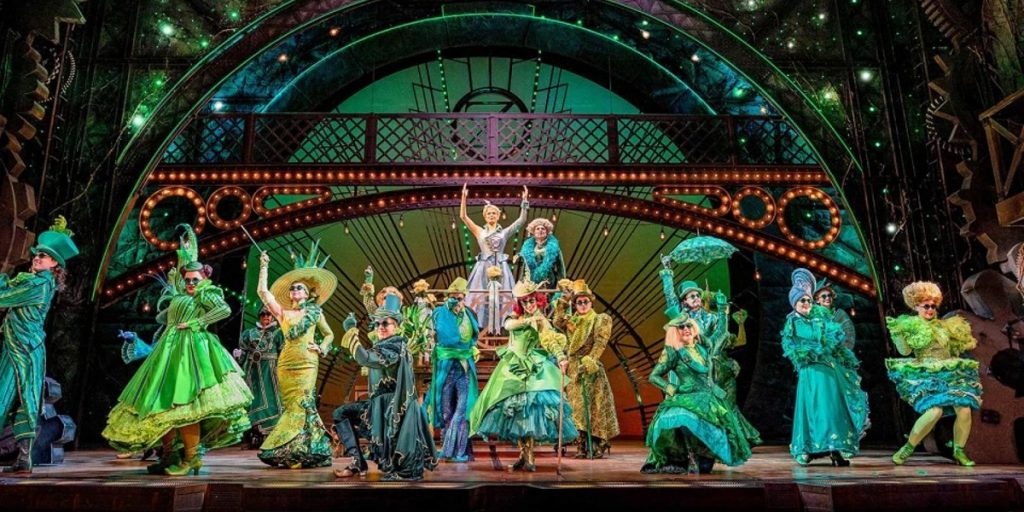
Wicked by Stephen Schwartz and Winnie Holzman
Leaving other shows green with envy is Wicked – the original musical based on Gregory Maguire’s 1995 novel of the same name. Focusing on the origin story of the Wicked Witch of the West from The Wizard of Oz, the colorful, whimsical, and crowd-pleasing show reframed our preconceptions of the previously hateful character and gave us another perspective.
The original production opened in 2003 at the Gershwin Theater and starred Kristin Chenoweth and Idina Menzel – making both household names. So far, it’s had over 7,500 performances and with a film adaptation starring Ariana Grande and Cynthia Erivo coming up, we don’t see it going anywhere for a long time.
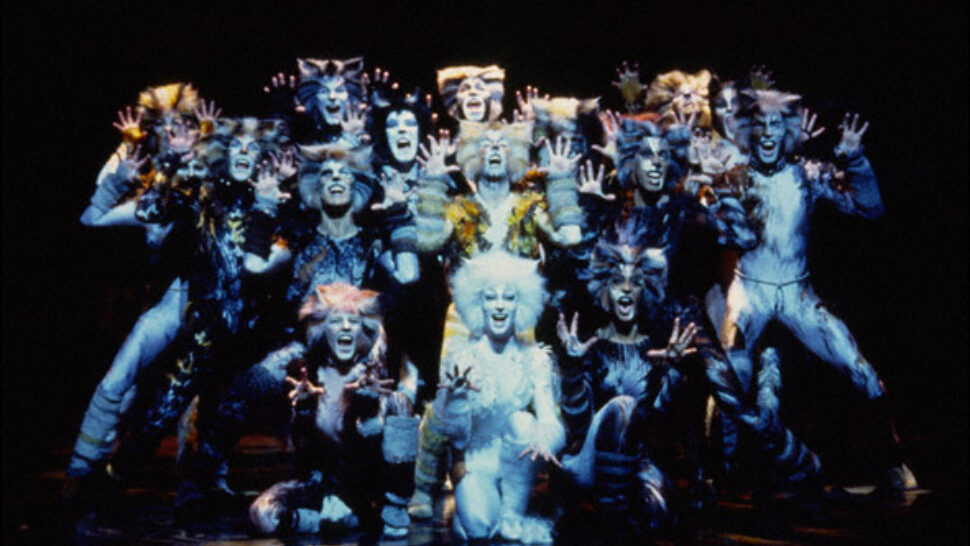
Cats by Andrew Lloyd Webber
Based on the 1939 poetry collection by T.S. Eliot, Cats is a sung-through musical about a tribe of cats who are trying to decide which among them will be ascended to the Heaviside Layer before coming back to a new life. The surreal show opened in 1982 and was unlike anything seen on Broadway before. It won seven Tony Awards and a Grammy making it a must-see show.
It opened at the Winter Garden Theater on October 7 1982 where it ran until its close on September 10 2000. It was the first Broadway show to reach over 7,000 performances reaching 7,485 performances when it closed.
It looks as though Cats will happily perch at number five on the list for a while as the next show on the list that’s currently open is The Book of Mormon which sits with 4,400 performances which, again, would take approximately eight years to overtake Cats.
With the 2023-2024 theatrical season underway, Broadway’s Best Shows is sharing some of the most exciting productions heading to the main stem in the coming months! With more shows still to be announced, this is just a first look at some of what Broadway and beyond has to offer theatergoers in the year ahead.
Most Anticipated Musical Revival: Cabaret
From across the pond, where this production of Cabaret has been playing in the West End since 2021, the Kander & Ebb classic will make its fifth Broadway appearance spring 2024. The Rebecca Frecknall-helmed revival will play the August Wilson Theatre with a cast yet to be announced (though some reporting suggests Oscar winner Eddie Redmayne will resume the Emcee role in which he opened the London production).
Most Anticipated Play Revival: Doubt: A Parable
Liev Schreiber and Tyne Daly are set to lead the first Broadway revival of the 2005 Tony-winning Best Play Doubt: A Parable. The John Patrick Shanley play, which was later adapted into a film starring Meryl Streep, Philip Seymour Hoffman, and Viola Davis, will run at Roundabout Theatre Company’s American Airlines Theatre in the new year. The theater is also set to be renamed after late Roundabout Artistic Director Todd Haimes, who passed away in May 2023.
Most Anticipated New Musical: Harmony & Water for Elephants (TIE)
After successful world premiere productions, two exciting new musicals are headed to Broadway this season, and we couldn’t pick our favorite!
With music by Barry Manilow and book and lyrics by Bruce Sussman, Harmony will play the Ethel Barrymore Theatre beginning October 18. The cast, under the direction and choreography of Warren Carlyle, is led by Chip Zien and Sierra Boggess reprising their roles from the Off-Broadway run at the National Yiddish Theatre Folksbiene, and Funny Girl standout standby Julie Benko will join the cast.
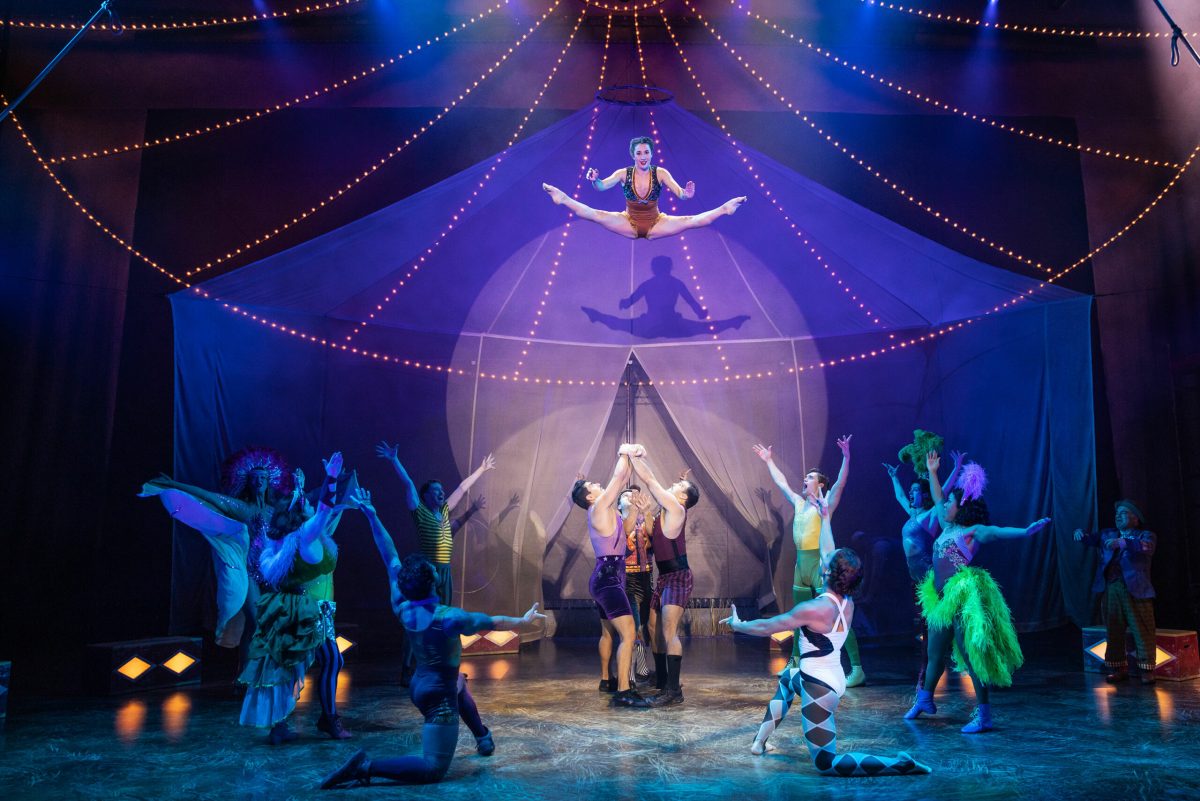
Though official word has not been given, we have reason to believe that Water For Elephants is destined for a Broadway bow after wowing audiences in its Atlanta premiere at the Alliance Theatre this summer. Directed by Kimberly Akimbo’s Jessica Stone, this musical adaptation of the novelbrings high-flying circus to the stage.
Most Anticipated New Play: Prayer For the French Republic
Manhattan Theatre Club is transferring its Off-Broadway hit from last season, Joshua Harmon’s three-act epic about Jewish identity and resilience during and after the Holocaust, to the Samuel J. Friedman Theatre in early 2024. Directed by David Cromer with a cast yet to be announced, Harmon’s second Broadway at-bat after 2017’s Significant Other may have some exciting surprises in store…
Most Anticipated Comedy: Purlie Victorious: A Non-Confederate Romp Through the Cotton Patch
Leslie Odom, Jr. and Kara Young will lead the first-ever Broadway revival of Ossie Davis’ landmark 1961 play Purlie Victorious: A Non-Confederate Romp Through the Cotton Patch. Kenny Leon directs the biting comedy, which will run at the Music Box Theatre beginning September 7, with an opening night set for September 27. The cast also features Billy Eugene Jones, Jay O. Sanders, and Heather Alicia Simms.
Most Anticipated Off-Broadway Production: Hell’s Kitchen at the Public Theater
Alicia Keys. Shoshana Bean. Michael Greif. Camille A. Brown. This musical and theatrical A-Team is coming together to bring the world premiere of Hell’s Kitchen to New York City this fall. A semi-autobiographical musical about a young “Ali” growing up in midtown Manhattan, it will feature both classics and new songs by pop icon Alicia Keys.
Most Anticipated Special Theatrical Event: Pal Joey at City Center Encores! Annual Gala
Ephraim Sykes, Aisha Jackson, and Elizabeth Stanley lead the cast of a reimagined take on Rodgers and Hart’s Pal Joey. Set to play for just one week in November as part of New York City Center’s annual gala, the production is co-directed by Tony Goldwyn and Savion Glover, with Glover also choreographing. Also set to appear in the production are Brooks Ashmanskas, Loretta Devine, and Jeb Brown.
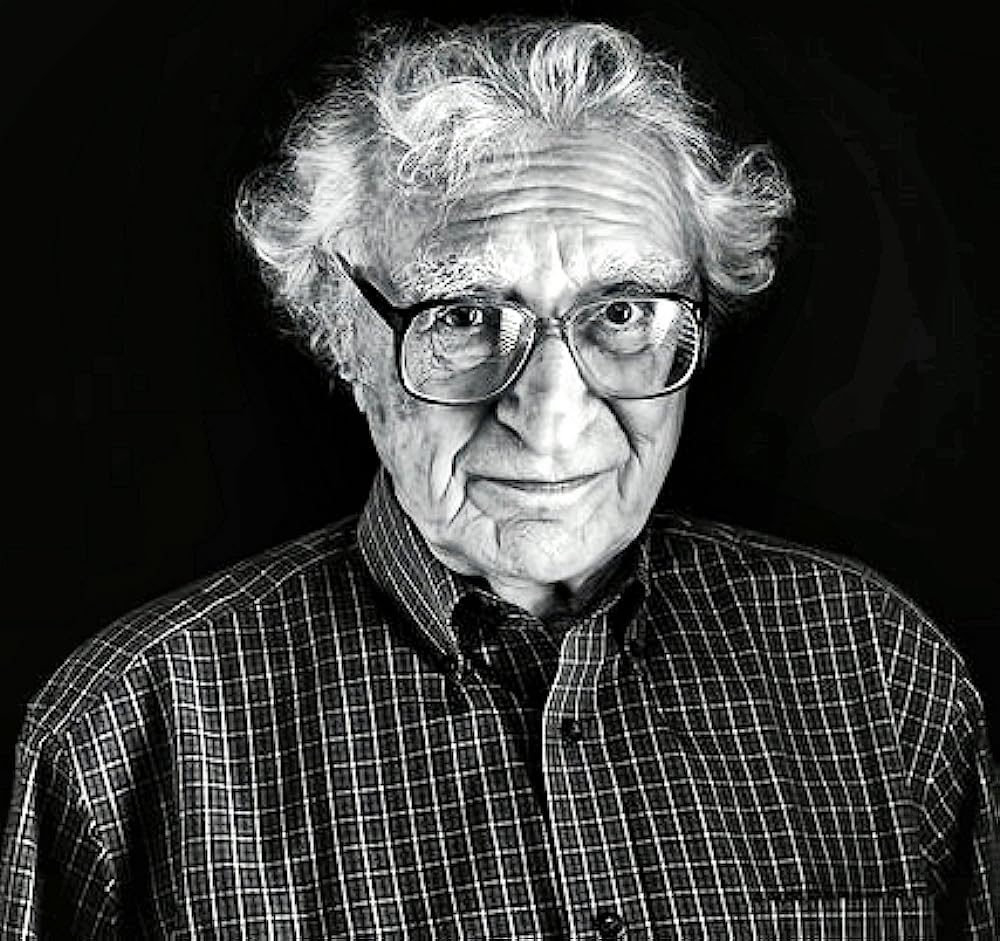
Sheldon Harnick, lyricist of such Broadway classics as Fiddler on the Roof, She Loves Me, Fiorello!, and more, passed away on June 23, 2023, at the age of 99. Broadway’s Best Shows asked some of the artists who have staged his iconic material on and off Broadway to reflect on his body of work and his artistry.
Sheldon Harnick
Danny Burstein
Danny Burstein as Tevye in the 2015 Broadway revival of Fiddler on the Roof.
The great lyricist, Sheldon Harnick has passed and the world is a sadder place for it. His genius and influence will most assuredly live on forever.
Sheldon wrote lyrics that were honest, intelligent, witty, profound, heartbreaking, ridiculously funny and always specific for characters. He and Jerry Bock wrote some of the world’s most glorious songs. Here is one of them:
“Will He Like Me” – From the musical, She Loves Me
Will he like me when we meet? Will the shy and quiet girl he’s going to see Be the girl that he’s imagined me to be? Will he like me?
Will he like the girl he sees? If he doesn’t, will he know enough to know That there’s more to me than I may always show? Will he like me?
Will he know that there’s a world of love Waiting to warm him? How I’m hoping that his eyes and ears Won’t misinform him.
Will he like me? Who can say? How I wish that we could meet another day. It’s absurd for me to carry on this way. I’ll try not to.
Will he like me? He’s just got to.
When I am in my room alone I write Thoughts come easily, words come fluently then. That’s how it is when I’m alone, but tonight There’s no hiding behind my paper and pen.
Will he know that there’s a world of love Waiting to warm him? How I’m hoping that his eyes and ears Won’t misinform him.
Will he like me? I don’t know. All I know is that I’m tempted not to go. It’s insanity for me to worry so. I’ll try not to.
Will he like me? He’s just got to. Will he like me? Will he like me?
When I think of this lyric, I weep. How perfectly it sits in the music. How perfectly it encapsulates the character’s feelings. How perfectly it tells the story. My heart breaks to think that both of the men who created this brilliant song are no longer with us.
Sheldon was a dear friend to both myself and my late wife Rebecca. Whether it was professionally or personally, we treasured his counsel and his company. Sheldon was a shining example of a life well-lived.
Julie Benko
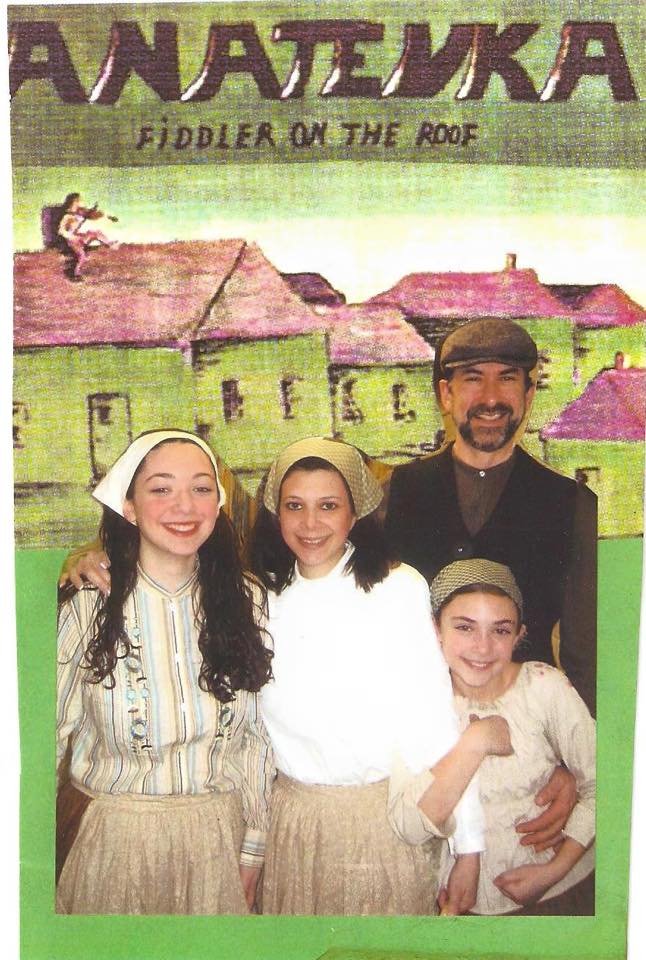
Julie Benko as Hodel in Fiddler on the Roof.
When I was 14 years old, I was cast as Hodel in the local JCC community theater production of Fiddler. The show was a family affair: my sister played Bielke, my dad was cast as Reb Mordcha, and my mom was a villager selling bagels. That production changed everything for me. I fell head over heels in love with the theater and began to pursue a life in show business. So, it was an enormous honor to get cast in the 2015 Broadway revival of “Fiddler,” where I understudied eight roles (one for each night of Chanukah!) and had the chance to meet Sheldon. I hope I was able to express to him just how much his words have shaped me. I have carried them with me through every major moment of my life and expect them to resonate through many more. “Sunrise, sunset,” indeed. Rest In Peace, Sheldon.
Jerry Zaks
Jerry Zaks plays the title role in the 1994 Encores production of Fiorello.
If ever anyone personified Emerson’s definition of success, it was Sheldon.
A true great: talented, kind, and funny.
What Is Success by Ralph Waldo Emerson
To laugh often and much; To win the respect of intelligent people and the affection of children; To earn the approbation of honest critics and endure the betrayal of false friends; To appreciate beauty; To find the best in others; To give of one’s self; To leave the world a bit better, whether by a healthy child, a garden patch, or a redeemed social condition; To have played and laughed with enthusiasm and sung with exultation; To know even one life has breathed easier because you have lived – This is to have succeeded.
Scott Ellis
Footage from the 1993 Broadway revival of She Loves Me, directed by Scott Ellis.
My first Broadway show I ever directed was She Loves Me… how lucky was I? It was a glorious experience, and Sheldon Harnick was one of the main reasons why. He approached that production as if it had never been done before. Sheldon was so encouraging, supportive, and beyond respectful to a very young director doing this for the first time. He was joyous, loving, and so, so incredibly smart. I could not have asked for a better teacher and collaborator. We remained friends in the years following, and eventually, I had the privilege of revisiting She Loves Me twenty years later. Nothing had changed; Sheldon still approached the process as if it was the first production and brought all of his love and support back into the room. I am so fortunate to be able to look back and see where my life and career shifted. She Loves Me was that moment, and Sheldon was the center of it all. How lucky for everyone that his legacy will live on with future generations through his beautiful work.
Broadway has long been a platform for diverse stories, and the LGBTQ+ community has found a powerful voice within its hallowed theaters. From groundbreaking dramas to electrifying musicals, the Broadway stage has showcased the struggles, triumphs, and vibrant lives of LGBTQ+ individuals. Let’s delve into the realm of LGBTQ+ plays and musicals, exploring iconic productions that have captivated audiences and left an indelible mark on both the stage and society.
Angels in America: Tony Kushner’s monumental masterpiece, “Angels in America,” shattered barriers and ignited conversations about sexuality, politics, and the AIDS crisis. Set against the backdrop of 1980s America, this two-part play explores the intersecting lives of a group of individuals affected by the epidemic. With its poetic language, powerful themes, and unforgettable characters, “Angels in America” remains an enduring symbol of LGBTQ+ resilience and the fight for equality.
Fun Home: Based on Alison Bechdel’s graphic memoir, “Fun Home” invites audiences on a deeply personal journey of self-discovery and acceptance. This groundbreaking musical delves into Bechdel’s experiences growing up in a funeral home, her relationship with her closeted gay father, and her own exploration of her sexuality. With its poignant storytelling and memorable songs, “Fun Home” shines a light on the complexities of family dynamics and the quest for authenticity.
A Strange Loop: Uplifting and introspective, “A Strange Loop” offers a fresh and unapologetic perspective on the challenges faced by a young, black, queer artist. Michael R. Jackson’s innovative musical takes audiences on a journey through the mind of Usher, a struggling writer grappling with self-doubt, body image, and societal expectations. With its blend of humor, soul-stirring songs, and raw honesty, “A Strange Loop” celebrates the power of self-love and artistic expression. A Strange Loop is coming to the West End.
The Normal Heart: Larry Kramer’s seminal play, “The Normal Heart,” serves as a powerful testament to the early years of the AIDS crisis and the tireless activism that emerged during that time. Through the character of Ned Weeks, loosely based on Kramer himself, the play confronts the government’s inaction, the stigma surrounding HIV/AIDS, and the urgent need for community support. “The Normal Heart” continues to be a rallying cry for LGBTQ+ rights and a reminder of the importance of solidarity in the face of adversity.
The Laramie Project: “The Laramie Project” is a poignant and heart-wrenching play that explores the aftermath of the brutal murder of Matthew Shepard, a gay college student in Laramie, Wyoming. Through a series of interviews conducted with the people of Laramie, the play reflects the town’s response to the hate crime and examines broader issues of prejudice and intolerance. By giving voice to various perspectives, “The Laramie Project” calls for empathy and understanding in a divided world.
The Boys in the Band: Mart Crowley’s groundbreaking play, “The Boys in the Band,” made its mark in 1968 as one of the first plays to unapologetically portray gay characters. Set during a birthday party, the play explores the complexities of friendship, love, and self-acceptance within a group of gay men. It remains a significant cultural touchstone, representing a time of evolving LGBTQ+ visibility and the challenges faced by the community.
The Nance: Set in the 1930s, “The Nance” provides a glimpse into the world of burlesque and the life of a “nance” — a stock character often portrayed as a campy, effeminate gay man. Douglas Carter Beane’s play sensitively explores the dichotomy faced by the protagonist, Chauncey Miles, as he navigates his personal life while performing on stage. “The Nance” serves as a powerful reminder of the struggles faced by LGBTQ+ individuals during an era of limited acceptance.
Torch Song Trilogy: Harvey Fierstein’s “Torch Song Trilogy” follows the journey of Arnold Beckoff, a drag queen and gay man, as he seeks love, family, and acceptance in 1970s and 1980s New York City. This landmark play explores themes of identity, relationships, and the longing for a sense of belonging. With its mix of heartache, humor, and resilience, “Torch Song Trilogy” became a touchstone for LGBTQ+ audiences and a symbol of hope.
Hedwig and the Angry Inch: A rock musical like no other, “Hedwig and the Angry Inch” tells the story of Hedwig, a transgender rock singer from East Germany. With a fusion of catchy songs and a compelling narrative, this musical explores themes of gender identity, love, and the quest for self-acceptance. “Hedwig and the Angry Inch” has captivated audiences with its fierce energy and unapologetic celebration of individuality.
Kinky Boots: Inspired by a true story, “Kinky Boots” follows the journey of Charlie Price as he takes over his family’s struggling shoe factory and forms an unlikely partnership with drag queen Lola. With a vibrant score by Cyndi Lauper, this feel-good musical celebrates acceptance, self-expression, and the power of embracing one’s true self. “Kinky Boots” offers a joyous celebration of diversity and the triumph of love over prejudice.
Priscilla Queen of the Desert: Based on the hit film, “Priscilla Queen of the Desert” takes audiences on a fabulous journey across the Australian Outback with a trio of drag queens. This exuberant musical combines dazzling costumes, disco hits, and a heartfelt story of friendship and self-discovery. Through its vibrant spectacle and themes of resilience and acceptance, “Priscilla Queen of the Desert” has become a beloved LGBTQ+ anthem.
Broadway has played a vital role in giving voice to LGBTQ+ narratives, allowing for greater understanding, acceptance, and celebration of the community’s experiences. As Broadway continues to evolve, it remains an essential platform for sharing the diverse stories of the LGBTQ+ community, fostering empathy, and inspiring change.
Tony & Grammy Award winner and Academy Award nominee Leslie Odom, Jr. will star alongside two-time Tony nominee Kara Young (Clyde’s, Cost of Living) in the first Broadway revival of Ossie Davis’ Purlie Victorious: A Non-Confederate Romp Through the Cotton Patch. Kenny Leon is set to direct the production, which will mark Odom, Jr.’s return to the Broadway stage after his Tony-winning turn in Hamilton.
Odom, Jr. announced live on MSNBC’s Morning Joe this morning that the comedy will run at the Music Box Theatre with performances beginning September 7. An opening night date will be announced at a later date.
The cast also includes Billy Eugene Jones, who is in the Broadway cast of Fat Ham, and Jay O. Sanders, who was last seen on Broadway in Girl From the North Country. Vanessa Bell Calloway, Noah Robbins, Heather Alicia Simms, Bill Timoney, and Noah Pyzik round out the company.
As previously announced, set design is by Tony Award winner Derek McLane, costume design is by Tony Award nominee Emilio Sosa, and lighting design is by Adam Honoré. Sound design will be by Peter Fitzgerald.
Davis’ play originally ran on Broadway in 1961 before being adapted into a film titled Gone Are The Days!, in which he and his wife and collaborator, Ruby Dee, reprised their stage roles. A classic piece of American theatre, the production will mark the play’s grand return to the Broadway stage.
The producing team is led by Jeffrey Richards, Hunter Arnold, Irene Gandy, Kayla Greenspan and Leslie Odom, Jr., making his Broadway producing debut.
Some Broadway shows can’t be contained in just a proscenium stage. The Main Stem has one permanent theater-in-the-round, the Circle in the Square, but there’s also a long history of visionary set designers and directors completely renovating one of the other 40 Broadway theaters to serve the needs of a show. The Broadway Theatre, on 53rd Street, has had its orchestra seats ripped out to make room for an immersive staging not once but thrice. A transformed theater, while costly, can fully immerse an audience into the world of the piece, creating unforgettable experiences. Below are some of the most fascinating immersive set designs in Broadway history.
Here Lies Love (2023)
The first theatrical transformation on our list is Broadway’s latest, with this season’s Here Lies Love, which begins performances June 17. It’s the first of the three shows on our list to call the Broadway Theatre home. Something about its massive scale and vaulted ceilings, originally designed in the 1920s for showing movies, makes it a prime choice for mega-musicals like Miss Saigon and experimental immersive productions alike.
Here Lies Loves is directed by Alex Timbers, and the set design by David Korins surrounds audiences in a 1980s American disco like the ones frequented by the show’s subject, former First Lady of the Philippines Imelda Marcos. Premiering at the Public Theater back in 2013, the idea of the show is to envelop viewers in a seductively cheerful world, to demonstrate how Marcos denied her and her husband’s regime’s cruelty, and how fascism packages itself to be attractive, as well as the lingering effects of American colonialism. The disco-electro-pop score by David Byrne and Fatboy Slim, originally written as a concept album, is so danceable that audiences can buy tickets for the standing section closest to the runway stage, where they will be part of the show and guided to join in choreographer Annie-B Parsons’ dance moves. (This is the first time in Broadway history that standing room tickets are the most expensive instead of the least!)
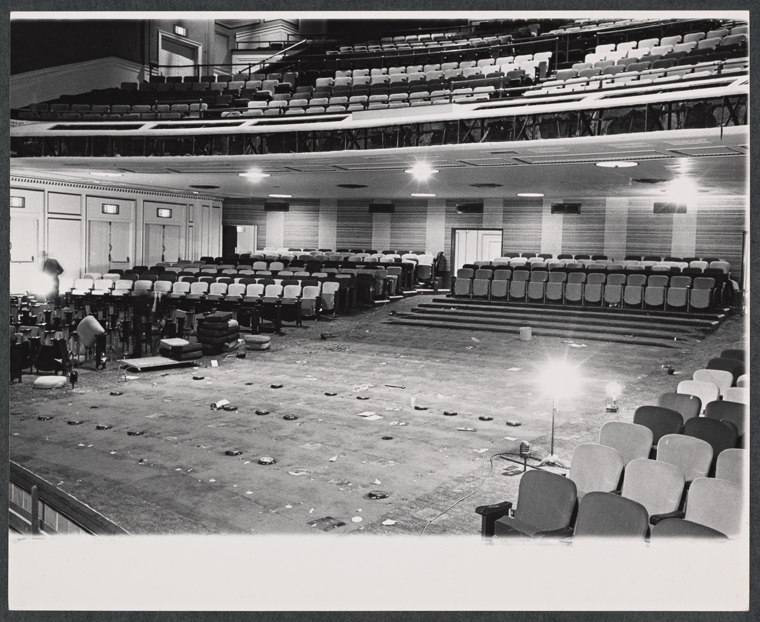
The gut renovation for Here Lies Love, taking all the orchestra seats out of the Broadway:
Dude (1972)
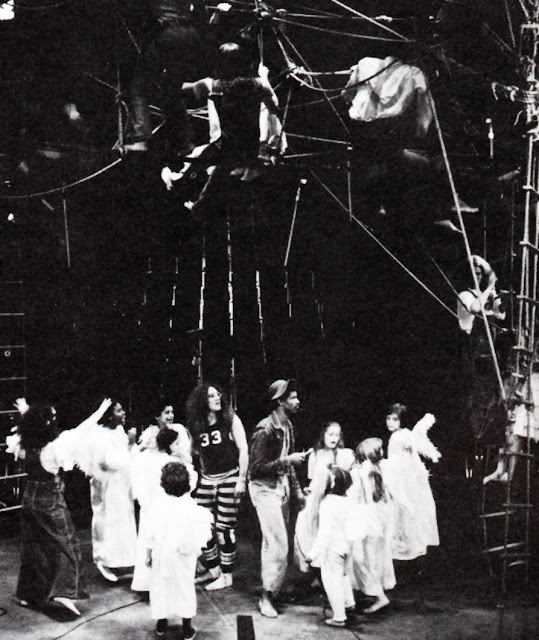
The ill-fated Dude: The Highway Life may have only played 16 performances on Broadway in 1972, but this counterculture ‘happening’ from Gerome Ragni and Galt McDermot of Hair fame upended the rules for how a Broadway theater could be used. Bringing downtown uptown, the Broadway Theatre was rearranged by designer Eugene Lee into a theater-in-the-round, with the actors where the orchestra section had been, and some audience members sitting on the stage.
It even featured trapezes and trap doors, with actors, in character as “Mother Earth,” “Suzy Moon,” or the titular “Dude,” frequently interacting with the audience. Its “morality play” plot baffled critics, and Dude closed at a loss of $1 million, very high for 1972.
Natasha, Pierre, and the Great Comet of 1812 (2017)
Photo by Thomas Loof
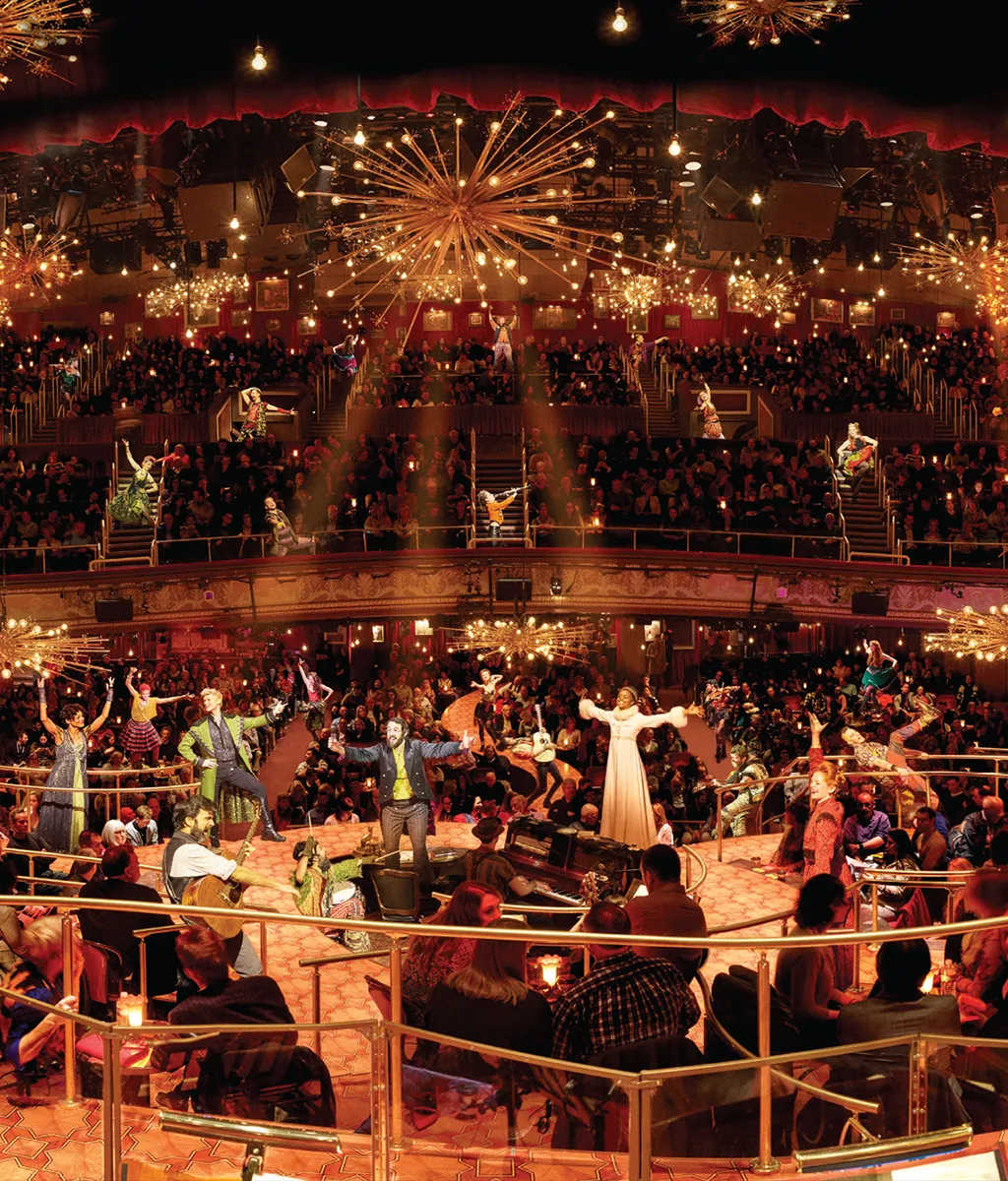
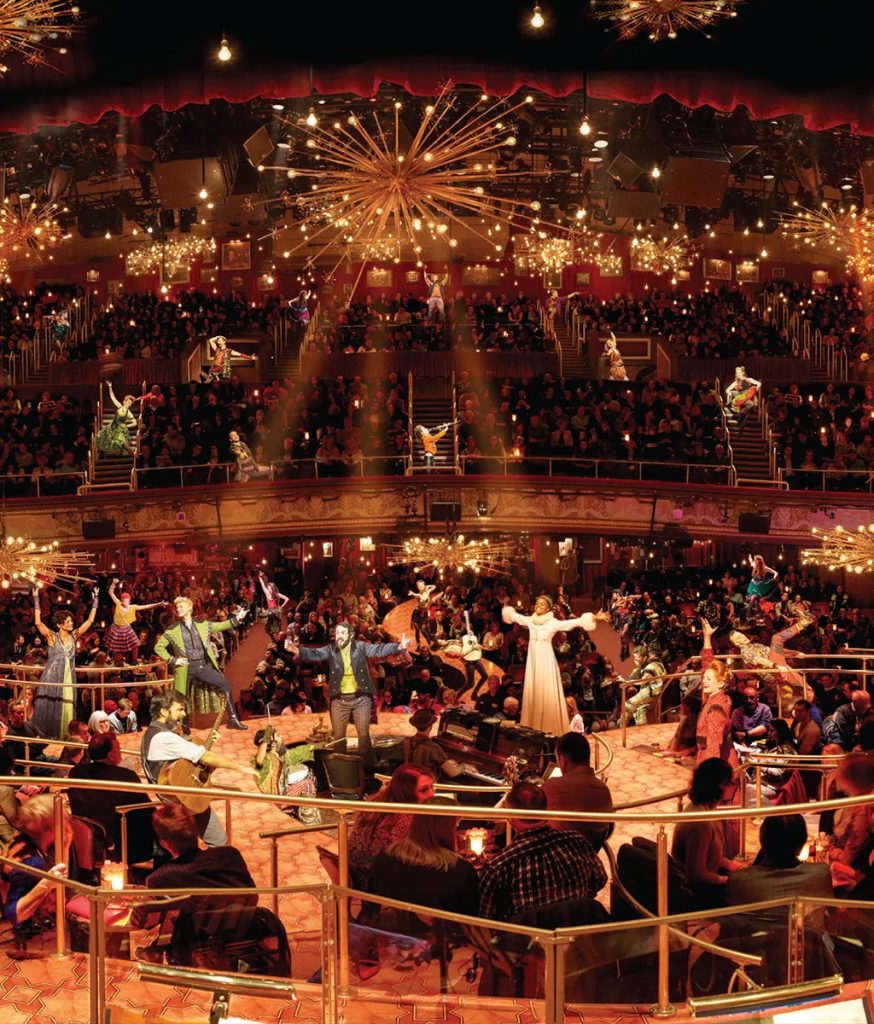
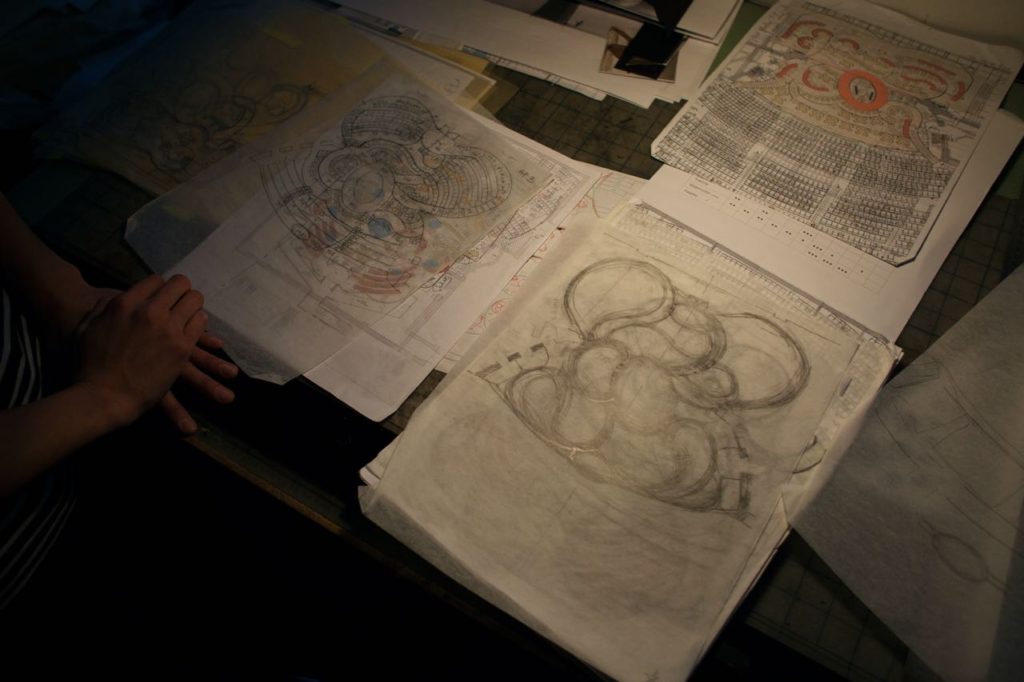
Great Comet, perhaps the most exhaustive and striking theater transformation on this list besides Here Lies Love, originated at Ars Nova, a flexible off-off-Broadway venue. As the show transferred to a tent in Hell’s Kitchen (dubbed “Kazino”), and then to the American Repertory Theater in Boston for its pre-Broadway tryout, director Rachel Chavkin and set designer Mimi Lien worked to retain the intimacy, playfulness, and Napoleonic and Russian flair of the show. Composer-lyricist Dave Malloy based the show on a sliver of War & Peace, and created a score pulling equally from klezmer, EDM, and Sondheim. The entire Imperial Theatre auditorium was wrapped in red velvet, and a series of cascading staircases connected the original stage, the orchestra, and even the balcony section into one cohesive playing space. The titular comet was represented by a gargantuan chandelier, inspired by the one at the Metropolitan Opera and made of thousands of Swarovski crystals. Lien and her team even redesigned the lobby, adding elements of a Cold War-era bunker. Comet was nominated for 12 Tonys, and won two, for Set and Lighting Design.
Mimi Lien’s initial sketches for Comet:
Cabaret (1998/2014 Revival)
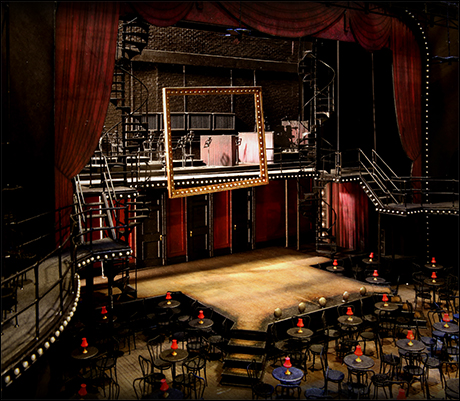
For director Sam Mendes’ vision of the Kander and Ebb classic Cabaret, a former Broadway theater that had since been used as an adult movie theater and disco was reshaped into a grungy and sensual Kit Kat Club. Designer Robert Brill transformed the space on 43rd St, then known as Henry Miller’s Theater, for the show’s opening night. (10 years after Cabaret, Henry Miller’s was rebuilt as the Stephen Sondheim theater.) When it became clear Cabaret was a runaway hit, Brill and the producers searched for a more permanent home for an extended run, and decided to overhaul another former Broadway playhouse-turned-disco, the legendary Studio 54 nightclub space, which was in desperate need of renovation after decades of Andy Warhol’s parties. In both spaces, the stage was tightened into a small thrust, like the setup at many nightclubs both in New York and Berlin, and the premium orchestra seats were replaced with small tables and chairs. Brill, the Cabaret team, and the Roundabout Theater Company led by the late Todd Haimes did so much work on Studio 54 that they had reverted it back to its original purpose as a state-of-the-art Broadway theater, and when Cabaret closed in 2004 after a six year run, Studio 54 became home to everything from Waiting for Godot starring Nathan Lane in 2009 to Lifespan of a Fact starring Daniel Radcliffe in 2018, and the return of the very same Sam Mendes production of Cabaret, in 2014.
Candide (1974)
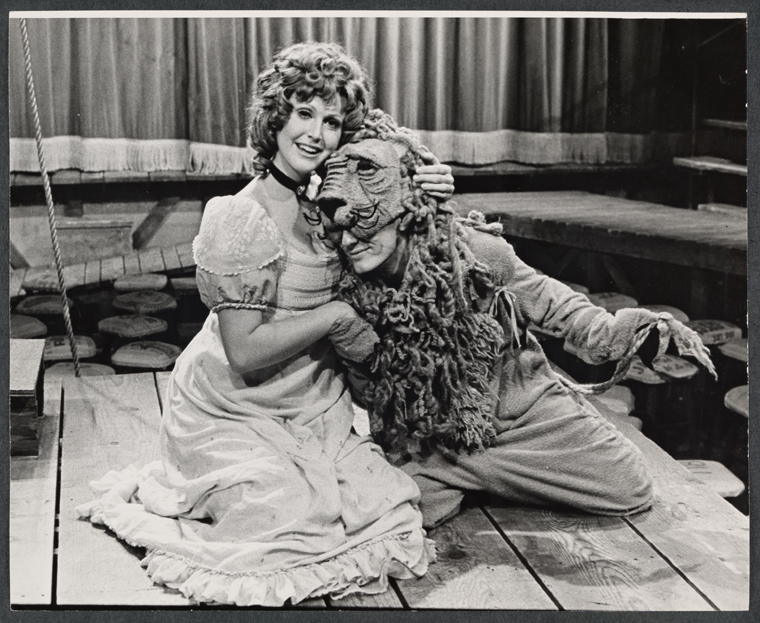
A production image from Candide; notice the barstools in the background, which were audience seating
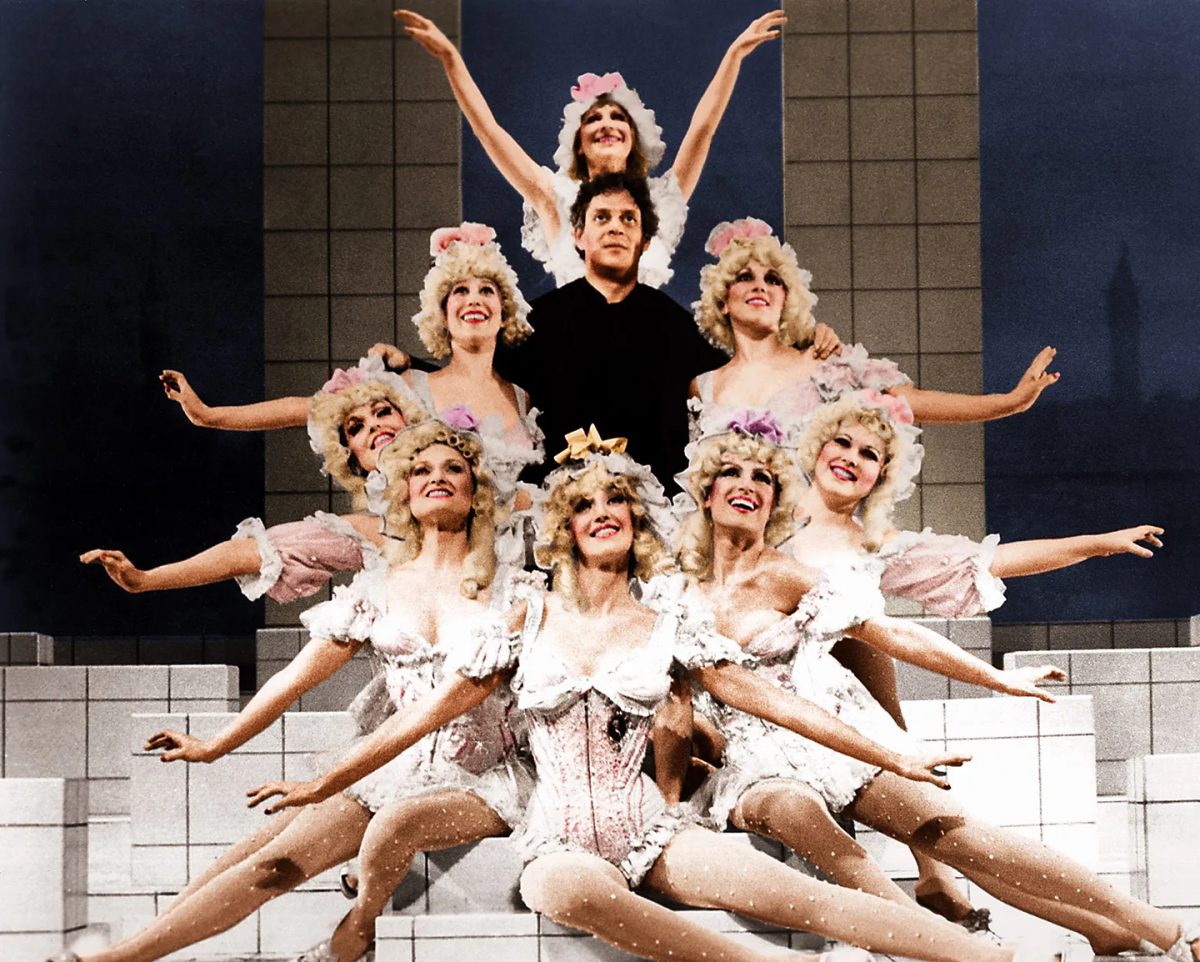
Harold Prince revived Candide, the 1950s Bernstein operetta based on the work of Voltaire, off-Broadway in 1973. It featured a revised and clarified book by Hugh Wheeler, and a stripped-down design ethos that emphasized Candide’s hapless, everyman journey. Audiences surrounded a series of platforms and gangways, with some audience members even inside the rectangle of playing space. Hal Prince, never a risk-averse producer and director, was willing to reduce the number of tickets available in order to fit this conceptual set into the space. To transfer the production from the Brooklyn Academy of Music, set designers Eugene and Franne Lee ripped out most of the Broadway Theatre’s orchestra seating, just as they had done for Dude.Candide fared far better than Dude, running for 740 performances and winning 5 Tonys, including for the Lees’ design, and for Hal Prince’s direction. Eugene Lee passed away earlier in 2023 after designing 27 Broadway shows, and his work can still be seen in Wicked.
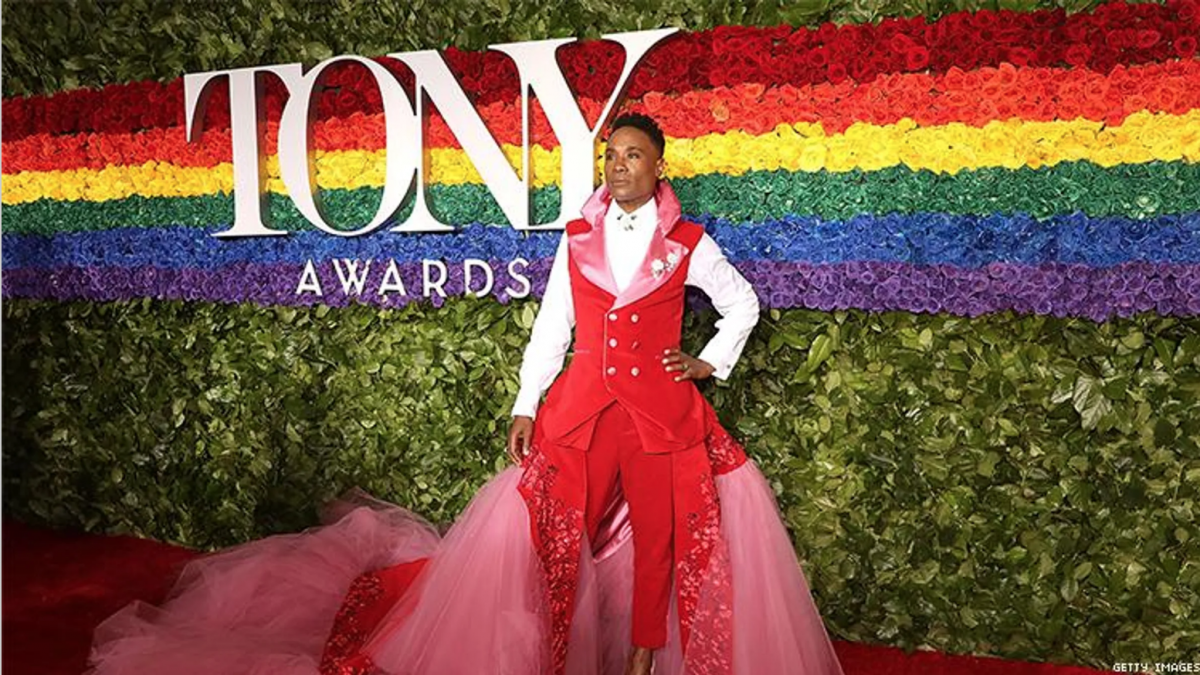
This year’s 76th Annual Tony Awards will be broadcast live from the United Palace in Washington Heights on Sunday, June 11th. As this year’s nominated shows head into the final stretch of their awards campaigns, Broadway’s Best Shows is here to remind you that no one is guaranteed a Tony, not even Aaron Tveit. Here is a list of our top 10 surprise upset wins, across 76 years of Tony history.
10. Christopher Ashley wins for directing Come From Away – 2017
Conventional wisdom had the category as a showdown between Michael Greif for Dear Evan Hansen and Rachel Chavkin for Natasha, Pierre, and the Great Comet of 1812, parallel to the competition happening over in the Best Musical category. Perhaps because Greif and Chavkin split the vote, Christopher Ashley was genuinely flabbergasted when he won his first Tony. Ashley was previously nominated in the same category for Memphis and The Rocky Horror Show.
The cast of Come From Away performs in the 2017 Tonys:
9. 1978 Best Play
The Pulitzer Prize-winning The Gin Game was the anticipated winner for best play – that, or Chapter Two, a comedy about grief from Broadway heavyweight Neil Simon. However, the Tony voters chose the lesser-known Irish playwright Hugh Leonard, for Da, a memory play about a man traveling back to the suburbs of Dublin to cope with the death of his adopted father.
Cicely Tyson and James Earl Jones in the 2015 revival of The Gin Game:
8. Follies and the 2012 Revivals category
For whatever reason, Follies has particularly bad Tonys luck, as we also discuss below. Its revival in 2011, starring Bernadette Peters, Jan Maxwell, and Elaine Paige, was not a major commercial success, but it was expected to win the Best Revival category against Evita, Jesus Christ Superstar, and Porgy & Bess. Instead, the Diane Paulus-directed Porgy won the statue.
Norm Lewis, Audra McDonald, and the company of Porgy & Bess perform at the 2012 Tonys:
The always delightful Danny Burstein performs a song from Follies at the 2012 Tonys broadcast:
7. Children of a Lesser God wins Best Play – 1980
Best known for its 1986 film adaptation starring Marlee Matlin, Children of a Lesser God was a watershed moment for portrayals of Deaf people in theater, exploring the complex issue of Deaf schools insisting students learn to speak, instead of using ASL. Its original star Phyllis Frelich was the first Deaf person ever to win a Tony Award. It beat out Talley’s Folly, a romance by Lanford Wilson that won the Pulitzer and was expected to win, and Bent, a gut wrenching drama about queer people in Nazi concentration camps by Martin Sherman.
Children of a Lesser God was also revived on Broadway in 2018, with direction by Kenny Leon:
6. Marissa Jaret Winokur wins Best Actress
While Hairspray was expected to win Best Musical in 2003, Bernadette Peters was the favorite to win the Tony Award for Best Actress in a Musical for her performance as Mama Rose in Gypsy. Peters had previously won for Song and Dance and Annie Get Your Gun. But it was Marissa Janet Winokur, in her Broadway principal debut as Tracy Turnblad in Hairspray, who ended up winning.
Marissa’s acceptance speech:
5. Kinky Boots wins Best Musical
Prevailing wisdom said that Matilda, like the many British mega-musicals before it, was going to sweep the 2013 Tony awards. In a battle between the lovably sassy British drag queens and the lovably sassy British schoolchildren (only in New York!), it was the American-produced Kinky Boots that won out. Why? Perhaps its surprise win at the Drama League Awards earlier that month moved the needle, or perhaps the almost entirely American Tony voter pool wanted to support one of its own. While both shows were uplifting, Kinky Boots’ pro-LGBTQ+ rights message may have resonated extra hard. (Matilda ended up just fine though – it ran for four years on Broadway, and is still open in the West End.)
4. 2007 Best Actor in a Musical
Theater fans are still arguing over whether Raúl Esparza should have won for Company over David Hyde Pierce for Curtains. Esparza gave a heart wrenching performance as Bobby in John Doyle’s stripped down reimagining of the Sondheim classic. While the rest of the cast played their own instruments throughout the show, Esparza-as-Bobby only sits down in front of a piano to accompany himself in the finale, “Being Alive.” Sondheim is notoriously tricky for pianists, and to also act and sing it at the same time is a rare feat:
But it was beloved Frasier star David Hyde Pierce who won out, for his portrayal of a sensitive and theater-obsessed police detective in Curtains. Pierce, who had put himself into musical theater bootcamp to prepare for his debut in Spamalot a few years prior, may have been helped by his reputation as the nicest person in showbusiness, and the goodwill he had amassed by choosing to come back to Broadway after winning four Emmys for Frasier. Below, DHP and the company of Curtains perform at the Tonys:
3. 1972 – Follies loses best musical
A piece of Tonys trivia that always surprises theater lovers: Stephen Sondheim’s masterpiece Follies did not win the 1972 Tony Award for Best Musical. That award went to Two Gentlemen of Verona, a groovy Shakspeare adaptation by Galt McDermot, the composer behind Hair, in collaboration with playwright John Guare. It also beat out heavyweights like Grease and Ain’t Supposed to Die A Natural Death, and Jesus Christ Superstar wasn’t even nominated in the category.There are a few theories for why this happened: first, 2 Gents is a much frothier, more optimistic show than Follies. It was a diverting entertainment that left audiences joyful, while Follies matched the dark reality of the national mood amidst the Vietnam war, Watergate, and Greatest Generation discontent. 2 Gents takes a firm antiwar stance, but it didn’t confront middle-aged Tony voters with their unhappy marriages they way Follies did. At the same time, voters may have picked 2 Gents to save face after Hair was a massive cultural moment back in 1968 but didn’t win any Tonys, making the awards seem out of touch.
2 Gents was revived off-Broadway in 2005 at the Delacorte with Norm Lewis, Oscar Isaac, Rosario Dawson, John Cariani, and Renee Elise Goldsberry. Here’s Goldsberry and Lewis performing “Night Letter” from that production:
2. Nine beats Dreamgirls
Dreamgirls was an instant, massive smash when it opened to rave reviews in December of 1981. Loosely based on the story of Diana Ross and The Supremes, and with an energetic Motown-inspired score, the production starred Jennifer Holliday and Sheryl Lee Ralph. Nine, a baroque exploration of an Italian film director’s psychosexual whirlwind based on Federico Fellini’s film 8½, had its first *workshop* performance in February of 1982, and opened on Broadway the day of the Tonys cutoff in May. Dreamgirls, directed by Michael Bennett of A Chorus Line fame,was at the Shubert-owned Imperial, and Nine played at the Nederlander-owned Rodgers right next door, and was directed by Tommy Tune. Even juicier, Bennett and Tune had once been dear friends, with Bennett having taken Tune under his wing (if you can take someone who’s 6’6” under your wing.) When Nine was quickly announced to open in the 1981-1982 season, on the final day of Tonys eligibility no less, Bennett called Tune and begged/threatened him to take the show out of town and bring it to New York next year instead. Tune refused. So the story goes, during the Tonys campaigning period in May 1982, the Dreamgirls team refused to step into restaurants the Nine people went to, and vice-versa. The American Theatre Wing, the producer of the Tony Awards, amped up the drama by seating the teams on opposite sides of the Imperial Theatre for the ceremony in June. The producers of Nine pushed their narrative as the scrappy show that could, and that Dreamgirls, backed by the mighty Shubert Organization, didn’t need – or deserve – a vote. Many in the industry were grateful for how fierce the competition got, since Broadway hadn’t had a huge hit since 1975’s A Chorus Line, and the brewing feud got lots of press. While Dreamgirls won many awards at the ceremony, including Best Actress for Jennifer Holliday, Nine shocked the world and won Best Musical. It ran for two years on Broadway, and was also revived in 2003 – when it won again, for Best Revival. Dreamgirls ran for four years, and was only briefly revived in 1987, although its historical impact as a Broadway show with three-dimensional roles for Black women and the way it tackles fatphobia, racism, and colorism in the music industry makes Nine’s womanizer-genius focus look a bit hollow in retrospect.
Jennifer Holliday brings down the house with “I Am Telling You I’m Not Going”:
The cast of Nine performs at the Tonys:
Avenue Q bests Wicked
Stephen Schwartz’s Wicked was the enormous smash of the 2003-2004 Broadway season, its creative team and producers all established industry veterans. Avenue Q, a weirder but better-reviewed show by then-unknowns Robert Lopez, Jeff Marx, and Jeff Whitty, wasn’t expected to do well at the Tonys, or last longer than a few months on Broadway. In spring 2004, the country was also gearing up for the 2004 presidential election, and the Avenue Q producers crafted a campaign that both parodied politics and spoke to voters directly: “Vote Your Heart,” pleaded the red, white, and blue posters and buttons, and the puppets even participated in a mock debate. The producers were using a strategy first used by Nine in 1982, the last time a Best Musical race was this excruciating (see below). They appealed to the Tony voters, all 700 or so of them, to support the underdog, the subtext being that Wicked would do well regardless of whether it won, while a Best Musical win could make or break Avenue Q’s future. The campaign worked, and the little puppet show written by newcomers won not just Best Musical, but Best Book and Score of a Musical as well. Avenue Q ran on Broadway for 6 years, and Off-Broadway for another 10. Wicked seems to be doing okay too.
Note the shock on the producer’s faces when they announce that Avenue Q won:
Whether you’re cramming in a few more shows before this year’s Tony Awards (reminder: June 11th!), entertaining friends from out-of-town, or just in need of a good meal in Midtown, here are five quality restaurants in the Theater District, hand-picked by the Broadway’s Best Shows editorial team. All five wait staffs will get you to your 7 or 8 o’clock curtain in time if you ask. We highly recommend reserving tables in advance.
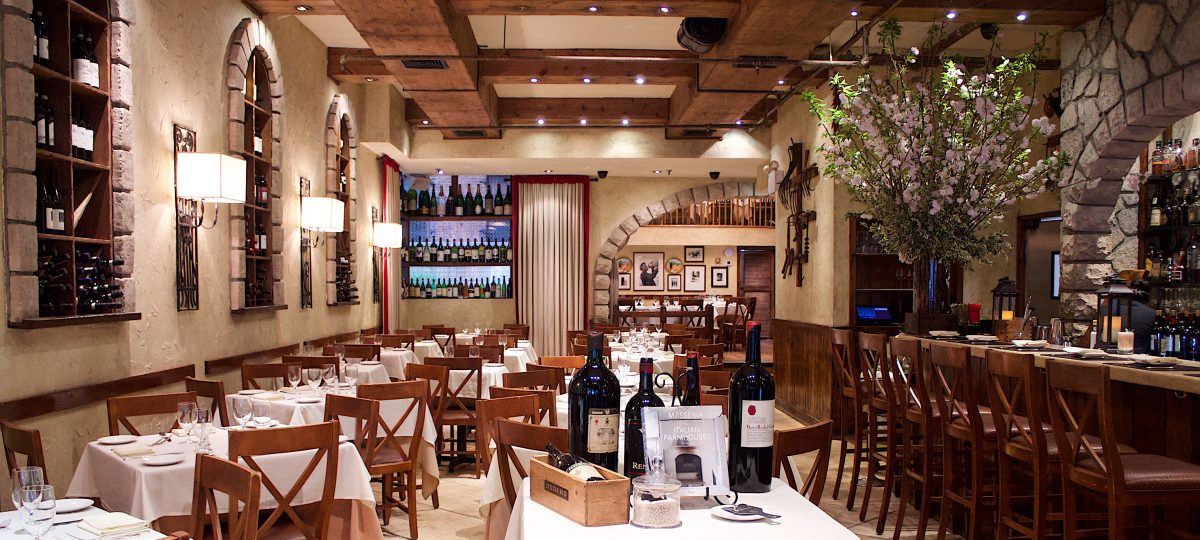
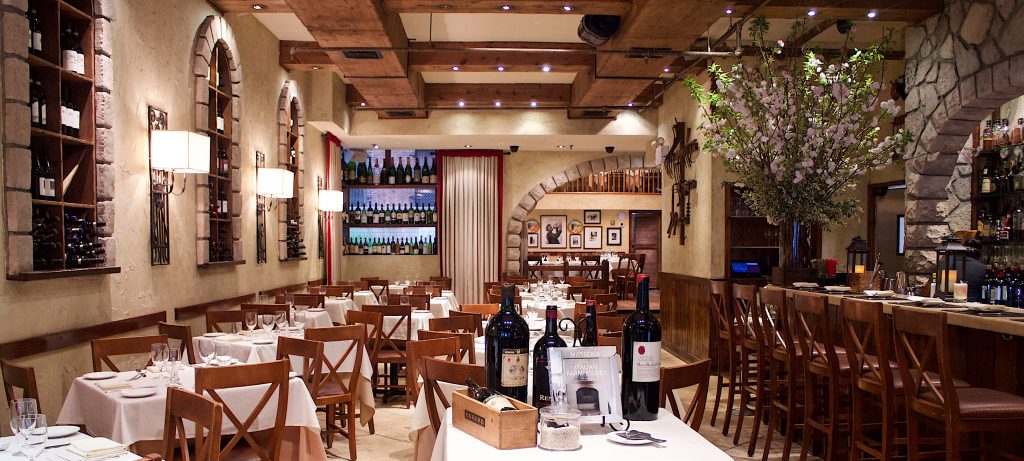
La Masseria
This Theater District mainstay opened in 2004, and is more elegant and a little less chaotic than other red sauce joints in the neighborhood, while still being great for families or groups. Try the Capri-style ravioli di angelina or the i cucuzielli fritti alla Chef Pino, a.k.a. the chef’s specialty fried zucchini.
235 W 48th St (between Broadway and 8th.) Reservations available by phone or email here.
The Lambs Club
The Lambs Club was formerly the home of a private club for actors and performers, and the decor might make you feel dropped into an episode of Mad Men. Chef Jack Logue offers a three-course pre theater menu for $75, or you might try the baroque-ish “Stanford White burger” with Gruyere and pickled onion.
132 W 44th st (between 6th and 7th.) Reservations on Resy.
Gallagher’s
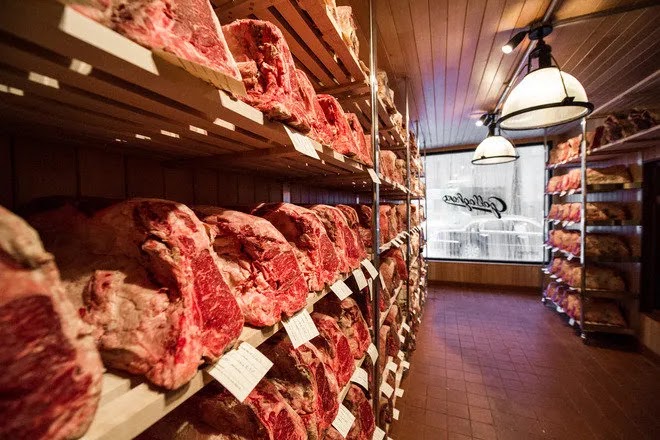
This nearly one hundred year old institution is so old school it even has a dress code (no tank tops, sports jerseys, or hats) but the menu isn’t tired at all. The name of the game here is the steaks, which you can see carefully aging through a storefront window on 52nd. Again, not a spot for a light meal! Try to save room for the pecan pie a la mode.
228 W 52nd (between Broadway and 8th.) Reservations on OpenTable.
Barbetta
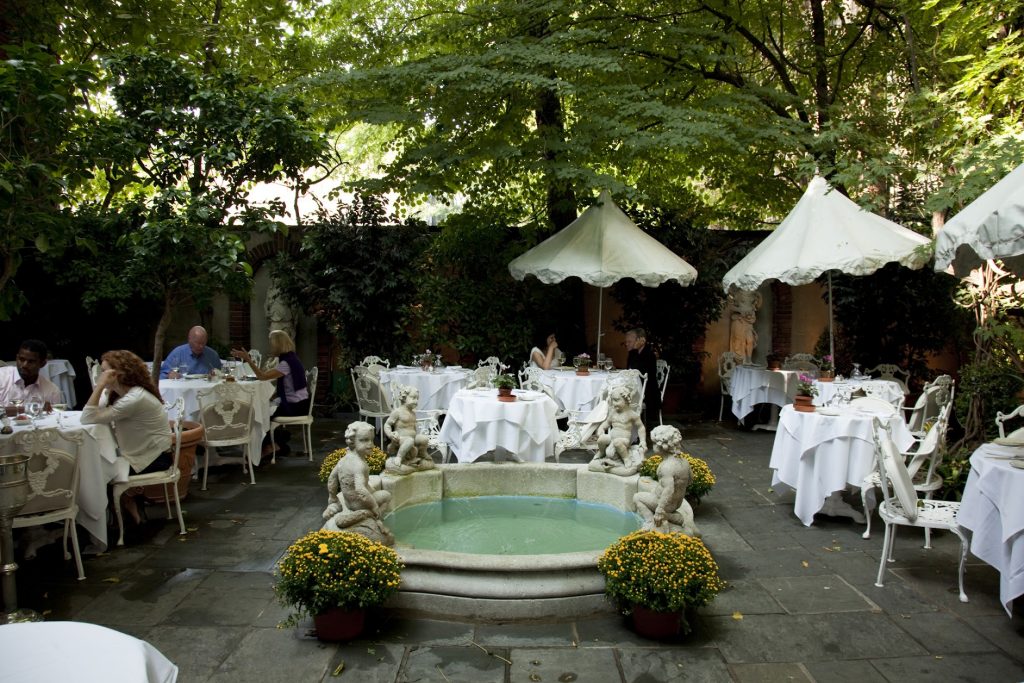
Situated in a former Astor mansion, the luxurious Barbetta is the oldest restaurant in New York to still be owned by the family that opened it, way back in 1906. The menu features delicacies from the Peimonte region of Northwest Italy. If you arrive for the pre-theatre pre fixe menu early enough, you might be able to score a table in the restaurant’s jaw dropping back patio – it’s first come, first serve. The menu notes the year each dish was added to the repertoire, like the minestrone soup, made using the same recipe they used on opening day in 1906.
321 W 46th (between 8th and 9th.) Reservations here.
The Mermaid Inn
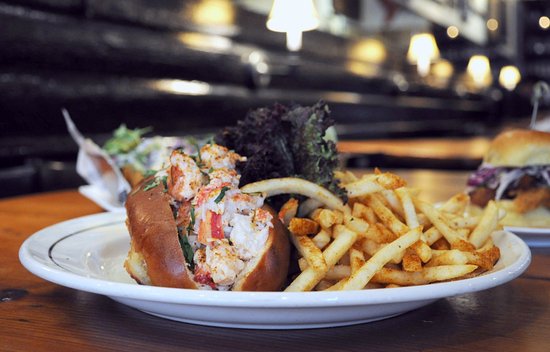
The Mermaid Inn might be best known as a stylish and unpretentious cocktails and oysters bar, and their raw selections and happy hour options are excellent. For those who prefer their crustaceans cooked, they offer Manhattan’s best lobster roll. Be sure to try their french fries seasoned with Old Bay spice mix. The Inn also has locations in Greenwich Village and Chelsea, and will soon reopen on the Upper West Side at Columbus and 76th.
127 W 43rd (between Broadway and 6th.) Reservations on OpenTable.
We would be remiss not to mention:
Sardi’s and Joe Allen
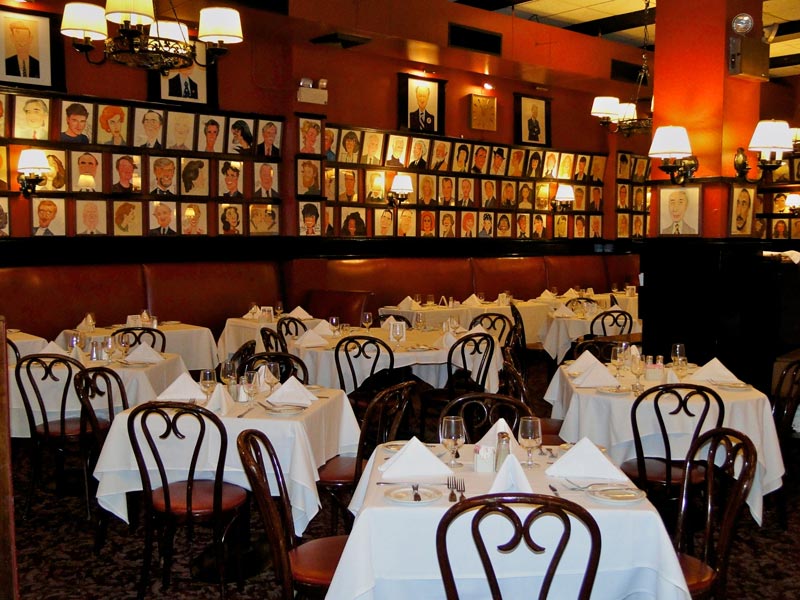
We’ll never reveal just how much of our “Broadway’s Best Kept Secrets” newsletter feature comes from overheard conversations at Sardi’s and Joe Allen. The caricatures lining the walls at Sardi’s have become so famous that sometimes we need a reminder that they also serve food there– particularly classic the spinach cannelloni. Joe Allen stays open late for an after-theater burger, and you can eye the posters of flop shows while you gossip and eat.
Sardi’s, 234 W 44th (between Broadway and 8th.) Reservations on OpenTable.
Joe Allen, 326 W 46th (between 8th and 9th, across the street from Barbetta.) Reservations on OpenTable.